 Wow! eBook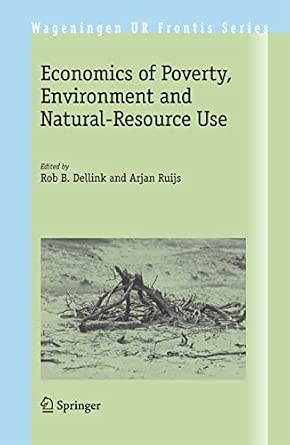
Economics of Poverty, Environment and Natural-Resource Use: 25 (Wageningen UR Frontis Series, 25) 2008th Edition
Author(s): Rob B. Dellink (Editor), Arjan Ruijs
- Publisher: Springer
- Publication Date: 8 April 2008
- Edition: 2008th
- Language: English
- Print length: 218 pages
- ISBN-10: 9781402083020
- ISBN-13: 1402083025
Book Description
Reduction of poverty is a tremendous and persistent challenge for the global community. Given that the livelihood of millions is at stake, there is an urgent need to reconsider the causes of and the remedies for poverty. Poverty and its reduction are closely linked to the natural-resources base. The quality and bounty of the local environment certainly affect living conditions of the poor and their poverty is often seen as a contributing factor to the degraded condition of the local environment. Teasing apart the direction of causality in this resource–poverty nexus is a serious empirical challenge.
This book contributes to an improved understanding of the economic dimensions of environmental and natural-resource management and poverty alleviation. The ten chapters of the book offer an overview of the current knowledge concerning the relation between poverty, environment and natural-resource use. Three sides of the debate receive particular attention. First, the relation between resource use and poverty is discussed from a theoretical point of view. Second, it is questioned whether payments for environmental services or considering values of resources can be an effective tool for stimulating both sustainable resource use and poverty alleviation. Third, alternative strategies to break the land degradation–poverty cycle are discussed.
Editorial Reviews
Review
“Readers will find in this book a good formal theoretical synthesis of the subtle and multidimensional inter-linkages between poverty, environment and natural-resource use supported with rich case-study analyses. This book is a significant addition to existing knowledge of the complex causal mechanisms involved and shows how context variations make it especially hard to design generalized policy solutions to achieve the dual objectives of poverty eradication and nature conservation. It is a must-read book for many people, especially those directly involved in the practice or the study of ways of managing the coupled social-ecological systems to improve the well being of the poor today and of all future generations.” Professor Rashid M. Hassan, CEEPA, University Pretoria, South Africa
From the reviews:
a oeReaders will find in this book a good formal theoretical synthesis of the subtle and multidimensional inter-linkages between poverty, environment and natural-resource use supported with rich case-study analyses. This book is a significant addition to existing knowledge of the complex causal mechanisms involved and shows how context variations make it especially hard to design generalized policy solutions to achieve the dual objectives of poverty eradication and nature conservation. It is a must-read book for many people, especially those directly involved in the practice or the study of ways of managing the coupled social-ecological systems to improve the well being of the poor today and of all future generations.a (Professor Rashid M. Hassan, CEEPA, University Pretoria, South Africa)
From the Back Cover
Reduction of poverty is a tremendous and persistent challenge for the global community. Given that the livelihood of millions is at stake, there is an urgent need to reconsider the causes of and the remedies for poverty. Poverty and its reduction are closely linked to the natural-resources base. The quality and bounty of the local environment certainly affect living conditions of the poor and their poverty is often seen as a contributing factor to the degraded condition of the local environment. Teasing apart the direction of causality in this resource–poverty nexus is a serious empirical challenge.
This book contributes to an improved understanding of the economic dimensions of environmental and natural-resource management and poverty alleviation. The ten chapters of the book offer an overview of the current knowledge concerning the relation between poverty, environment and natural-resource use. Three sides of the debate receive particular attention. First, the relation between resource use and poverty is discussed from a theoretical point of view. Second, it is questioned whether payments for environmental services or considering values of resources can be an effective tool for stimulating both sustainable resource use and poverty alleviation. Third, alternative strategies to break the land degradation–poverty cycle are discussed.


