Wow! eBook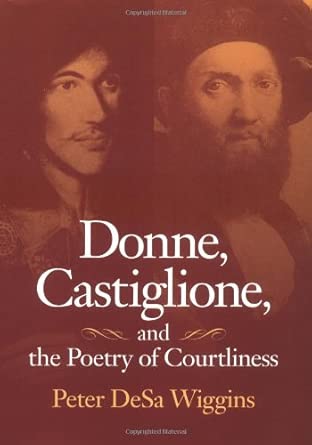
Donne, Castiglione and the Poetry of Courtliness
Author(s): Peter DeSa Wiggins (Author)
- Publisher: Indiana University Press
- Publication Date: 22 Jan. 2001
- Language: English
- Print length: 192 pages
- ISBN-10: 9780253338143
- ISBN-13: 025333814X
Book Description
John Donne remains something of an enigma. He was a poet, surely, and a celebrated cleric, but was he an alienated radical or an ambitious conformist? Is it fair to read his career and his poetry as reflections of a fawning social climber or a subversive (politically and morally) outsider? Does Donne accept the mantle of Church of England preacher, only because he has failed to win the ambassadorship to Venice? Peter DeSa Wiggins does not propose to resolve this conundrum, but he has discovered in Castiglione’s The Courtier a key toward understanding part of the puzzle. Though The Courtier has long been recognised as the approved repository of the rules for political advancement in Donne’s society, its influence on Donne’s work has been neglected, even by those who read Donne as the poet of ambition.The Courtier fired Donne’s imagination. It provided him with a structure within which he could retain his critical detachment and at the same time write poetry aimed at advancing his political interests. In his secular poetry, Donne applies, adapts, and unfolds to its fullest potential the persona of the courtier. Wiggins focuses on four important codes or ‘moves’ that emerge from Castiglione’s social discourse: tolerance of the dissonant in crucial areas of experience to the point where tolerance becomes the mark of a disabused mentality; the preference for provocative play over serious debate; concealment of the difficulty of one’s achievements and disparaging them; and, love of casuistry, or demonstrating that artifice as practised by a courtier is the exception to the rule that dissimulation is evil. These four moves or codes are capable, individually or collectively, of endless elaboration.They are the seeds of social and verbal performances of great complexity and, importantly for Donne, they promote poetic innovation and marshal it in the service of a conservative social impulse. By showing that all four codes are at work in combination in much of Donne’s secular poetry, Wiggins establishes a resemblance between Donne and Castiglione which is more than casual. He offers revelatory readings of some of Donne’s most important work. And he tells a story of a famous instance in Western history when a powerful aristocracy canonised a text for voicing a style of social intercourse it thought to be its own, and when a brilliant artist embraced this style, turned it to his advantage, built one political career out of it (which he lost), then built another, and in the process revolutionised his art form.
Editorial Reviews
Review
” … a new perspective and literary context for appreciation of [Donne’s] rhetorical abilities. Wiggins’s persuasive discussion of the part played by the secular poetry in the construction of a courtly persona complements existing studies on the social performance of Donne’s works … “–TLS, March 8, 2002
About the Author
Peter DeSa Wiggins is Professor of English at The College of William and Mary. (More to come.)