Wow! eBook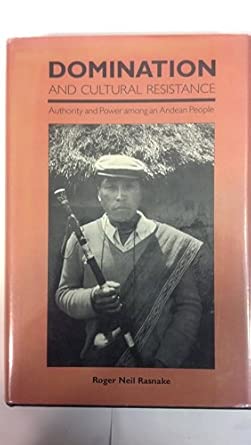
Domination and Cultural Resistance: Authority and Power Among an Andean People
Author(s): Roger Neil Rasnake (Author)
- Publisher: Duke University Press
- Publication Date: 22 Aug. 1988
- Edition: Illustrated
- Language: English
- Print length: 334 pages
- ISBN-10: 0822308096
- ISBN-13: 9780822308096
Book Description
Editorial Reviews
Excerpt. © Reprinted by permission. All rights reserved.
Domination and Cultural Resistance
Authority and Power among an Andean People
By Roger Neil Rasnake
Duke University Press
Copyright © 2015 Duke University Press
All rights reserved.
ISBN: 978-0-8223-0809-6
Contents
Illustrations,
Figures,
Tables,
Photographs,
Acknowledgments,
Introduction,
1 The Cultural Traditionalism Of The Andean World,
Part I The Yura Social Order And The Kuraqkuna,
2 Yura Environment and People,
3 Social Organization And The Ayllu,
4 The Kuraqkuna Of Yura Today,
Part 2 Indigenous Authorities Of The Past,
5 Invasion And Adaptation To The Colonial System,
6 Transformation Of The Kurakaship,
Part 3 The Kuraqkuna And The Construction Of The Yura Symbolic World,
7 Festivals Of The Kuraqkuna,
8 The Festival Of Reyes,
9 The Symbolic World Of The Kuraqkuna,
10 A Symbolic Dialogue,
11 Conclusion Symbolic Power and Cultural Resistance,
References,
CHAPTER 1
THE CULTURAL TRADITIONALISM OF THE ANDEAN WORLD
The Reality of Foreign Domination and “Cultural Resistance”
The people of the rural Andes present a seeming paradox. For over four hundred and fifty years they have been subjected to control by a succession of external rulers: European invaders, then European-oriented, colonial elite classes, and finally hispanicized national dominant classes. All of these have attempted to impose on the rural peoples of the Andes their own cultures and institutions, first those of Spain and then later those of the nascent republics of Ecuador, Peru, and Bolivia. Yet today, in spite of centuries of pressure from above, many Andean ethnic groups have maintained a way of life— or more specifically, symbolic configurations and complex modes of organization—which is derived from their Andean past and which distinguishes them from the hispanicized world of the “modern” classes inhabiting the towns and cities of the three countries. The continuities that characterize Andean rural life are not due simply to a lack of awareness of alternatives or to isolation from the national elites and the mechanisms of the state. Peasant populations of the Andes, unlike the neighboring lowland tribal peoples of the Amazonian rain forest, have long experience in dealing with larger and more encompassing political entities. As a case in point, the Yura, the peasant group of the southern Bolivian Andes who form the focus of this study, have confronted state impositions at least from the time of the Inka Empire. Historical evidence points to the prior creation of state-level institutions even before the Inkas appeared on the scene.
When the Spanish expeditionary force invaded the Andes after 1532, its military successes therefore did not lead to the creation of new, complex civilizational forms where none had previously existed. Rather, the Spanish conquest brought about the destruction and replacement of the overarching Inkan and regional state structures which the invaders found in place at their arrival. As sensitive as some of them were to the complexities of the Andean civilization they found, the new colonial regime was not in the business of upholding what many of the administrators and ecclesiastics saw as an alien and barbaric political structure.
Furthermore, their goal was to create a new colonial order to provide economic support for the motherland and permit those who came to make their fortune. Given the dense populations of the Andean highlands, that goal could best be accomplished by creating ways to control the labor of Andean agriculturalists and herders and to appropriate their wealth. The new Spanish rulers soon established the institutional means by which the defeated populations were forced to provide their resources and their work in fields and mines for the benefit of colonists and Crown. At the same time Spanish policy imposed a continually more severe and rigid proselytization in the Catholic faith, apparently based on the assumption that Andean peoples would, as they accepted Christianity, also come to know and accept, part and parcel, the hispanic worldview and its fundamental values.
The Spaniards and their successors were able to establish efficient means of economic extraction, even at the cost of drastic depopulation and the massive flight of groups to areas beyond colonial control. Although native Andean groups fought the worst abuses of the new exploitative institutions in the Crown’s courts and even, from time to time, on the battlefield and in millenarian movements, they generally acquiesced in paying the head tax and working in the mines; it was for them the simplest strategy in the struggle to maintain a bare existence for themselves and their families.
However, the Spaniards failed in the attempt to convince Andean groups to abandon their cultural heritage. The rural peoples did not easily give up their ethnic identities in those early decades. Indeed, even now many groups retain an ethnic identification which is distinctly Andean, not European. In terms of their social order such peoples organize themselves according to models foreign to hispanic patterns, in ways that historical investigation shows are contemporary versions of forms already in place from the earliest years of European rule. The same is true of other aspects of Andean life in the late twentieth century. For example, the agricultural and herding practices found in many areas today are clearly the result of adaptations over millennia to the special Andean environment. In the symbolic realm the ritual life of these groups creates a symbolic context which refers to their indigenous internal organization and to the physical world around them in an idiom alien to the European elites.
The paradox, then, lies in the fact that Andean peoples have accepted the burdens of the state, rarely directly challenging its legitimacy and impositions, yet, on the other hand, they have not accepted the “symbolic universe” (including both systems of values and common conceptions) that the urban, nationally oriented population would have them adopt. Nor do they accept the concomitant social identity that these latter find more amenable.
There is no simple explanation for such cultural continuities in the Andes. Rural people’s integration into the wider economy (Caballero 1983; Figueroa 1983), the historical patterns of social relations reproduced from colonial times (Service 1955; Kleymeyer 1982), and the way these are related to present-day structures of power and control (Bourricaud 1967) have all been advanced to account for the continuing retention and coherence of Andean cultural patterns. The research described in the following pages argues that many of these factors can be more adequately highlighted and integrated into a wider pattern of analysis by examining one central institution—the indigenous authorities found in local rural groups throughout the Andean republics. Indeed, the authorities provide real insight into the patterns of resistance, passive and active, that Andean peasants have shown for centuries to the impositions of the national society. Through the study of the indigenous authority and service roles that are still retained today, we can examine the complex and ambiguous links between Andean social groups and the states that now incorporate them. Furthermore, our understanding of the process by which ethnic groups are able to maintain their autonomy can be broadened by adopting a diachronic view of the authorities, by delving into their long history, since it is now quite clear that for centuries the indigenous leaders have served as the primary mediators between the “top” and the “bottom”—in the past between the component ethnic groups and the rulers of the various colonial regimes, and today between the peasants and the modernizing governments of the Andean nations.
The present state of our knowledge of historical processes and of varying patterns of symbolic resistance is not complete enough, unfortunately, to undertake a general study of indigenous authorities throughout the Andes. These pages are therefore devoted to the examination of a single case, the Yura of the department of Potosí in south-central Bolivia. The Yura have nurtured their authority roles with care up to the present; even today these posts are a major focus of activity in social and ritual life. For the Yura, the authorities—whom they call kuraqkuna, or “elders”—mediate structurally as a direct social link between the Bolivian state and the ethnic group members. For example, the kuraqkuna are responsible for collecting the land taxes that have for centuries been paid to the colonial and republican governments; and they continue to serve as constables for the state’s local magistrates.
As we shall see, they also act as symbolic mediators, and it is clear that this is the more important aspect of the roles today. In the context of ritual the kuraqkuna create models of Yura social organization which tie them to a sacred vision of the world. In rituals—and especially in festivals—the actions of the elders serve to construct a symbolic formulation of the Yura ethnic group’s internal organization which is then intertwined with a broader set of meanings referring to Yura relations with other social groupings within Bolivia as well as with the state. The elders’ ritual actions provide for themselves and their fellow Yura (who participate wholeheartedly with them in these symbolic performances) a coherent vision of their world and their place in it. Ritual thus reproduces the meanings and values that orient the Yura understanding of their placement within their own territory and in the larger social world. But, as we shall see, rituals can also serve as a basis for change, for reformulating those concepts and values.
Before we turn to the specific case of Yura, though, let us briefly review several ethnological studies that have looked at Andean local-level authorities.
The Warayuq: Studies of Andean Authorities
As early as 1919 Pastor Ordóñez stressed the ritual and traditional elements of the indigenous Andean authorities, what he termed the varayocc (or, to use a more modern spelling, the warayuq, or “staff bearers”). He viewed the peasant leaders around Cuzco as an institution that surely had its origins among the Inkas. The alcaldes, regidores, and campos he saw in native Andean villages were, for him, the modern descendants of the Inka tukuy rikuq (inspector) and llaqta kamayuq (town leader) described in the early Spanish sources. Basing his description of the contemporary offices largely on what he observed in the single Cuzco community of Acomayo, he urged the national government to reconsider its disdain and neglect of these roles. According to Ordóñez, the warayuq “would offer better and more efficient services if they were officially recognized as authorities which serve as a link that unites the misti [the mestizo, or hispanicized] classes with the indigenous groupings in the perfect, harmonic and progressive march of the nation” (1920:42).
More than twenty years later Bernard Mishkin described the set of Quechua authorities he had encountered in the late 1930s in a community near Urcos in southern Peru. In contrast to Ordóñez, he stressed the Spanish characteristics of the warayuq there, emphasizing the facts that, as in Acomayo, all the names of the posts were in Spanish and “the functions of the Quechua officers parallel those of the Spanish village officialdom in the 16th and 17th centuries” (1946:443). He recognized that the varas, the staffs that the authorities carry, “possess some religious significance, but precisely what is unclear” (1946:444). Mishkin also observed that there was considerable variation in the political organization of different villages. Although his own experience in Kauri led him to doubt the continued vitality of the warayuq system, he was nevertheless impressed by a description of the strength of similar authorities in Q’iru. It was his general conclusion, however, that the indigenous authorities, a syncretic phenomenon to begin with, were gradually breaking down in southern Peru except in extremely isolated areas.
An examination of the warayuq in the north of Peru was carried out by William Stein in Hualcan, not far from the hacienda of Vicos. A nominally free community when it was studied in 1952, Hualcan was the home of Andean peasants who maintained a set of authorities like those in Acomayo and Kauri. Here, too, the names are Spanish, and the chief official, called a comisario, is described as being nothing more than an errand boy for the mestizo authorities in nearby Carhuáz (Stein 1961:182–91). The warayuq, however, are said to have important roles in the festive life of the community, roles which structure ritual action (1961:262–63). Following the pattern of the day, Stein also describes the warayuq of Hualcan as if they formed an institution solely at the level of the community. Yet there are indications that this organization may be integrated into a much more encompassing system. For example, at one point he mentions an official at a higher level than the comisario of Hualcan, one who ruled over “a division of the District of Carhuáz, a leader of another varayuh organization which is separate from that of Hualcan” (1961:186). He then states that the two high-level officials of this larger warayuq system share their authority in the numerous communities of a large section of the Santa River valley—one official governed the villages on the east bank of the river, and the other those on the west. Indeed, the highest authority for the west bank is chosen in alternate years from Hualcan itself (1961:195). Unfortunately, the warayuq system is not a main focus of Stein’s study, so these loose ends are not tied. The psychologistic tone of the study (which Stein later regretted) took the author’s attention elsewhere, and the indigenous organization was not examined further.
One researcher who focused primarily on indigenous authorities was Gabriel Escobar. His study (1961) makes several advances over Stein’s, going above the community level to look at indigenous leaders in an entire zone. It struggles with the ambiguities of the relationship between indigenous and local-level mestizo state officials. It is more dynamic in examining the creation of state-mandated authorities and their links to the traditional warayuq. Yet Escobar encountered the same situation as Mishkin and Ordóñez: although village authorities are frequently strong in Peru, the higher levels of indigenous authority (those roles that Stein saw but did not pursue) are either greatly weakened or have apparently largely disappeared.
In the sixties and seventies the studies of Andean communities and groups multiplied, giving a wider base for comparison. Each community study—and most of them have been community studies —addresses the question of indigenous authorities more or less directly. On one hand, some confirm that in a few areas of Peru the indigenous political organization has been lost completely. Brush, for example, found no remnant of it in Spanish-speaking Uchucmarca in the northern part of the country (1977:51). In other areas, especially in the south, the community-level authorities have been beaten down and fragmented. Núñez del Prado writes that the indigenous leaders of Kuyo Chico and surrounding villages close to Pisac are “absolutely subordinate to the Mestizo authorities” (1973:16). Yet in still other areas of Peru the warayuq have retained a certain freedom of action and function in the community which suggests that they are more than mere puppets of the national society.
Perhaps most notable in this respect is Isbell’s description, from the department of Ayacucho, of the three systems of warayuq she found in Chuschi. One set of warayuq worked under national governmental authorities; another group supervised herding in the high pastures; while a third, which was organized according to the moieties of the town of Chuschi, oversaw affairs in the population center and in the surrounding cultivated fields. The latter authorities had a very important ritual role in the annual cleaning of the irrigation canals that bring water from highland lakes to the villagers’ fields (1978:83–93, 138–45). Mitchell (1972) has described a similar, if somewhat more reduced, warayuq system in the Ayacucho district of Quinua.
The list of Peruvian studies could be expanded with further examples of the local-level authorities. All could be placed on the same continuum, however, from the relative complexity and independence of the system in Chuschi to the subordination of Kuyo Chico and Kauri, and even to its loss, as in Uchucmarca. None of these shed much more light on the nature of the system or its history than we have already seen.
Moving south into Bolivia, we find a contrast between the former hacienda areas and those zones where Andean peoples historically retained control of their lands. In studies of ex-haciendas, such as Compi on the Altiplano and Charazani in the high steppes and mountain valleys north of Lake Titicaca, most peasant groups accepted a new sindicato (or labor union) structure after the agrarian reform promulgated in 1953 by the government of the Movimiento Nacionalista Revolucionario. The sindicatos of the ex-haciendas were to be ruled each by a committee of twelve secretaries led by a secretary general. In the case of Compi the sections of the community soon split apart and the secretary system withered (Buechler and Buechler 1971:53–54). In Charazani, where an ethnic identity and traditional social groupings unite settlements over a large area, the system of secretaries seems to have been molded by the people in a way that parallels the former indigenous authorities, where ritual responsibilities were as important as political ones (Bastien 1978:62).
(Continues…)Excerpted from Domination and Cultural Resistance by Roger Neil Rasnake. Copyright © 2015 Duke University Press. Excerpted by permission of Duke University Press.
All rights reserved. No part of this excerpt may be reproduced or reprinted without permission in writing from the publisher.
Excerpts are provided by Dial-A-Book Inc. solely for the personal use of visitors to this web site.