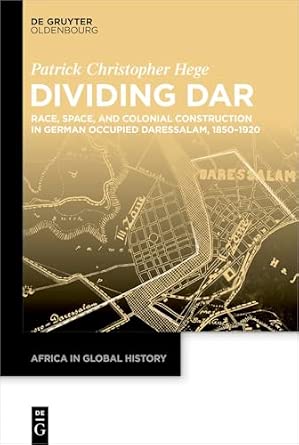
"This well-researched and well-written book adds to the expanding bookshelf on the history of Dar es Salaam, Tanzania in a number of important ways [...]
[T]he backbone of the book lie[s] in the rigorous methodology and the effectiveness of the literature review. The book engages with and draws upon the literature on East African history, geography, and anthropology, while also connecting with the historiography of African urban studies and colonial studies more broadly. [...]
The relatively short period of German colonial rule in Dar es Salaam is often overlooked or dismissed as fairly insignificant. This book accomplishes much more than simply forcing a reconsideration of that dismissal, placing the German period within a timeline of continuity from precolonial
years through the Omani-Zanzibari era and into the British colonial period that followed German occupation. Throughout the past-and, I would argue, continuing through to today in Dar es Salaam, at atime of billion-dollar World Bank investments in planning for sanitation, transportation, and climate change-the sentence with which Hege ends the book rings true to the narrative in this city, as in many others across the continent: 'urban identities [are]... made, and remade, by the residents of the city' (212)." - Garth Myers in The Journal of African History 66 (2025) 15: 1-3, https://doi.org/10.1017/S0021853725100595.
***
"[... ] [T]he book and this reflection emphasise shared responsibility, which is that citizens, institutions, planners, and leaders all shape how power is used. Dividing Dar invites Tanzanians to reflect; for policymakers, it encourages historically informed urban planning.
For security institutions, it offers a chance to reflect on trust and legitimacy. For journalists and scholars, it provides tools to ask deeper questions. For citizens, it reminds us that engagement is part of governance.
Understanding how colonial policing shaped African cities helps prevent the mistake of confusing inherited practices with modern necessity. And we can learn from history collectively, honestly, and calmly. And this is how societies move forward." - Mariam Gichan in The Chanzo Initiative, January 12, 2026, URL: https://thechanzo.com/2026/01/12/dividing-dar-unravels-how-power-was-wielded-on-the-streets-of-colonial-dar-es-salaam/
***
"Dividing Dar is a concise and well-written account of how colonial planners sought to make sense of existing urban structures, hoping to transform an organically developed African cityscape into one suited to colonial rule. Hege's analysis of internal colonial debates offers important new insights into the contradictions of colonial governance [...and] into the early colonial history of Dar es Salaam and urban planning in the German Empire." - Andreas Greiner (German Historical institute Washington) in The American Historical Review 131 (2026) 1, 338-339, DOI: https://doi.org/10.1093/ahr/rhaf625
"This well-researched and well-written book adds to the expanding bookshelf on the history of Dar es Salaam, Tanzania in a number of important ways […]
[T]he backbone of the book lie[s] in the rigorous methodology and the effectiveness of the literature review. The book engages with and draws upon the literature on East African history, geography, and anthropology, while also connecting with the historiography of African urban studies and colonial studies more broadly. […]
The relatively short period of German colonial rule in Dar es Salaam is often overlooked or dismissed as fairly insignificant. This book accomplishes much more than simply forcing a reconsideration of that dismissal, placing the German period within a timeline of continuity from precolonial
years through the Omani-Zanzibari era and into the British colonial period that followed German occupation. Throughout the past―and, I would argue, continuing through to today in Dar es Salaam, at atime of billion-dollar World Bank investments in planning for sanitation, transportation, and climate change―the sentence with which Hege ends the book rings true to the narrative in this city, as in many others across the continent: ‘urban identities [are]… made, and remade, by the residents of the city’ (212)." – Garth Myers in The Journal of African History 66 (2025) 15: 1–3, https://doi.org/10.1017/S0021853725100595.
***
"[… ] [T]he book and this reflection emphasise shared responsibility, which is that citizens, institutions, planners, and leaders all shape how power is used. Dividing Dar invites Tanzanians to reflect; for policymakers, it encourages historically informed urban planning.
For security institutions, it offers a chance to reflect on trust and legitimacy. For journalists and scholars, it provides tools to ask deeper questions. For citizens, it reminds us that engagement is part of governance.
Understanding how colonial policing shaped African cities helps prevent the mistake of confusing inherited practices with modern necessity. And we can learn from history collectively, honestly, and calmly. And this is how societies move forward." – Mariam Gichan in The Chanzo Initiative, January 12, 2026, URL: https://thechanzo.com/2026/01/12/dividing-dar-unravels-how-power-was-wielded-on-the-streets-of-colonial-dar-es-salaam/
***
"Dividing Dar is a concise and well-written account of how colonial planners sought to make sense of existing urban structures, hoping to transform an organically developed African cityscape into one suited to colonial rule. Hege’s analysis of internal colonial debates offers important new insights into the contradictions of colonial governance […and] into the early colonial history of Dar es Salaam and urban planning in the German Empire." – Andreas Greiner (German Historical institute Washington) in The American Historical Review 131 (2026) 1, 338–339, DOI: https://doi.org/10.1093/ahr/rhaf625
About the Author
Patrick C. Hege, Humboldt-Universität zu Berlin/Ethnologisches Museum, Deutschland.
Patrick C. Hege, Humboldt-Universität zu Berlin/Ethnological Museum Berlin, Germany.
 Wow! eBook