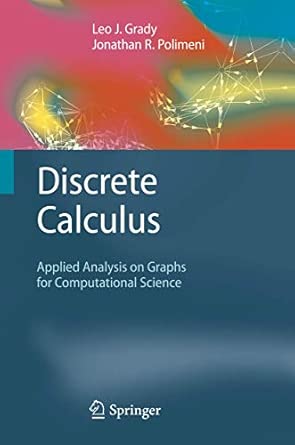
Discrete Calculus: Applied Analysis on Graphs for Computational Science 2010th Edition
Author(s): Leo J. Grady (Author), Jonathan R. Polimeni (Author)
Publisher: Springer
Publication Date: 2 Aug. 2010
Edition: 2010th
Language: English
Print length: 382 pages
ISBN-10: 1849962898
ISBN-13: 9781849962896
Book Description
The goal of this book is to present the topic of discrete calculus to scientists and - gineers and to show how the theory can be applied to solving a wide variety of re- world problems. We feel that discrete calculus allows us to unify many approaches to data analysis and content extraction while being accessible enough to be widely applied in many ?elds and disciplines. This project initially began as a tutorial on discrete calculus and its applications, and we hope that this work can provide an introduction to discrete calculus and demonstrate its effectiveness in many problem domains. This book bene?ted enormously from the friends and colleagues who provided software, data, and their time in reading the manuscript. In particular, for software we would like to thank Sebastien Bougleux for help with total variation code for an arbitrary graph and Camille Couprie for powerwatershed code. For use of their data, we wish to thank Jason Bohland, James Fowler, David Gleich, and Robert S- ner. For comments on the manuscript we would like to thank Christopher Alvino, Mukund Balasubramanian, Jason Bohland, Sebastien Bougleux, Gaelle Desbordes, Mathieu Desbrun, Noha El-Zehiry, Gareth Funka-Lea, David Gleich, Oliver Hinds, Anil Hirani, Hiroshi Ishikawa, Robert Kotiuga, Elliot Saltzman, Dheeraj Singaraju, Ganesh Sundaramoorthi and Enzo Tonti. We thank Eric Schwartz for all his help and support over the years. We would like to thank Wayne Wheeler, Simon Rees, and Catherine Brett at Springer for their enthusiasm and for initially proposing this project.
Editorial Reviews
Review
From the reviews:
“The book introduces some best practices and advanced techniques in the field of discrete calculus. The articles are written by a team of experts in the field and are aimed at scientists and engineers. The book shows how the theory can be applied to solving a wide variety of real-world problems. … All the examples are well described and illustrated with source code and screen shots. I recommend this book to anyone interested in discrete calculus and its application.” (Todor Jordanov Todorov, Mathematical Reviews, Issue 2012 d)
“This book illustrates the concepts of discrete calculus with examples in circuit theory, chosen because of its natural connection to algebraic topology and maturity. … this is a unique book that brings together research in complex networks and algorithm content extraction. I have no doubt that the book will be a valuable addition to the libraries of many researchers and graduate students working in the areas of complex networks, graphics, and algorithm design.” (Alexander Tzanov, ACM Computing Reviews, July, 2011)
From the Back Cover
The field of discrete calculus, also known as "discrete exterior calculus", focuses on finding a proper set of definitions and differential operators that make it possible to operate the machinery of multivariate calculus on a finite, discrete space. In contrast to traditional goals of finding an accurate discretization of conventional multivariate calculus, discrete calculus establishes a separate, equivalent calculus that operates purely in the discrete space without any reference to an underlying continuous process.
This unique text brings together into a single framework current research in the three areas of discrete calculus, complex networks, and algorithmic content extraction. Although there have been a few intersections in the literature between these disciplines, they have developed largely independently of one another, yet researchers working in any one of these three areas can strongly benefit from the tools and techniques being used in the others. Many example applications from several fields of computational science are provided to demonstrate the usefulness of this framework to a broad range of problems. Readers are assumed to be familiar with the basics of vector calculus, graph theory, and linear algebra.
Topics and features:
Presents a thorough review of discrete calculus, with a focus on key concepts required for successful application
Unifies many standard image processing algorithms into a common framework for viewing a wide variety of standard algorithms in filtering, clustering, and manifold learning that may be applied to processing data associated with a graph or network
Explains how discrete calculus provides a natural definition of "low-frequency" on a graph, which then yields filtering and denoising algorithms
Discusses how filtering algorithms can give rise to clustering algorithms, which can be used to develop manifold learning and data discovery methods
Examines ranking algorithms, as well as algorithms for analyzing the structure of a network
Graduate students and researchers interested in discrete calculus, complex networks, image processing and computer graphics will find this text/reference a clear introduction to the foundations of discrete calculus as well as a useful guide to have readily available for their work.
Dr. Leo J. Grady is a Senior Research Scientist with Siemens Corporate Research in Princeton, New Jersey, USA. Dr. Jonathan R. Polimeni is a Research Fellow at the Massachusetts General Hospital in Boston, Massachusetts, USA, and Instructor in Radiology at Harvard Medical School, Boston, Massachusetts, USA.
About the Author
Dr. Leo J. Grady is a Senior Research Scientist with Siemens Corporate Research in Princeton, New Jersey, USA. Dr. Jonathan R. Polimeni is a Research Fellow at the Massachusetts General Hospital in Boston, Massachusetts, USA, and Instructor in Radiology at Harvard Medical School, Boston, Massachusetts, USA.
 Wow! eBook