 Wow! eBook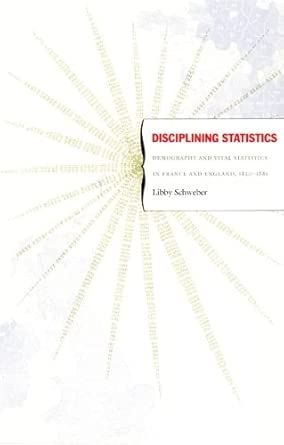
Disciplining Statistics: Demography and Vital Statistics in France and England, 1830–1885
Author(s): Libby Schweber (Author)
- Publisher: Duke University Press
- Publication Date: 28 Nov. 2006
- Language: English
- Print length: 288 pages
- ISBN-10: 0822338254
- ISBN-13: 9780822338253
Book Description
Tracing the introduction and promotion of vital statistics and demography, Schweber identifies the institutional conditions that account for the contrasting styles of reasoning. She shows that the different reactions to statistics stemmed from different criteria for what counted as scientific knowledge. The French wanted certain knowledge, a one-to-one correspondence between observations and numbers. The English adopted an instrumental approach, using the numbers to influence public opinion and evaluate and justify legislation.
Schweber recounts numerous attempts by vital statisticians and demographers to have their work recognized as legitimate scientific pursuits. While the British scientists had greater access to government policy makers, and were able to influence policy in a way that their French counterparts were not, ultimately neither the vital statisticians nor the demographers were able to institutionalize their endeavors. By 1885, both fields had been superseded by new forms of knowledge. Disciplining Statistics highlights how the development of “scientific” knowledge was shaped by interrelated epistemological, political, and institutional considerations.
Editorial Reviews
Review
"[Schweber's] work adds to a growing body of literature about the origins of the new social sciences in the nineteenth century, and their relationship to other sciences, the state, and public-policy formation. . . . The work is a closely argued, careful, and detailed reading of the organizational forms, intellectual debates, and scientific practices created by the men who defined, literally named, and built the new population sciences."--Margo J. Anderson "Journal of Interdisciplinary History"
"Schweber succeeds in terms of many of the goals she sets out at the beginning of her study. With the aid of an excellent opening historiographical survey in particular, we are reminded of the issues that divide scholars when it comes to discipline formation. Indeed, Schweber's own argument about how best to approach such subject matter offers many important insights for historians of science to consider."--Chris Renwick "British Journal for the History of Science"
"In this original and instructive book, Libby Schweber puts the history of statistics in a new light by providing an institutional and sociological account which connects the development of statistics to a broader history of state expertise."--Alain Desrosières, author of
The Politics of Large Numbers: A History of Statistical Reasoning"Libby Schweber addresses both the institutional conditions of scientific change and the actual forms of knowledge produced. And she convincingly rejects the usual teleology of disciplines as what scientific practitioners always want and advanced states always need. She shows how the assertion of a discipline can be a sign of weakness, of inability to shape policy, really a course of action when all else fails."--Theodore M. Porter, author of
Trust in Numbers: The Pursuit of Objectivity in Science and Public LifeFrom the Back Cover
About the Author
Libby Schweber is a Reader in the Department of Sociology at the University of Reading.
Excerpt. © Reprinted by permission. All rights reserved.
DISCIPLINING STATISTICS
DEMOGRAPHY AND VITAL STATISTICS IN FRANCE AND ENGLAND, 1830-1885By Libby Schweber
Duke University Press
Copyright © 2006 Duke University Press
All right reserved.
ISBN: 978-0-8223-3825-3
Contents
Acknowledgments.................................................................................................................................ixIntroduction....................................................................................................................................11 The "Invention" of Demography, 1853-1855......................................................................................................352 The Neglect of Demography, 1855-1867..........................................................................................................493 The Reinvention of Demography, 1867-1878......................................................................................................674 The Invention of Vital Statistics, 1830-1837..................................................................................................935 Vital Statistics as an Instrument of Social Reform............................................................................................1056 Discipline Formation at Last..................................................................................................................1357 Limits to Institutionalization................................................................................................................1578 The Challenge to Vital Statistics.............................................................................................................1799 Institutional Transformations and the Introduction of Disciplinary Specialization.............................................................191Conclusion......................................................................................................................................213Notes...........................................................................................................................................227Bibliography....................................................................................................................................253Index...........................................................................................................................................273
Chapter One
The "Invention" of Demography, 1853-1855
The question "Why establish a discipline in the nineteenth century?" serves to shift the researcher's attention from familiar features of contemporary disciplines, be they intellectual or institutional, to the act of discipline assertion itself. In the realm of demography the question leads to France, to the self-taught botanist and Republican political speaker Achille Guillard and his son-in-law Louis Adolphe Bertillon. The year is 1853, in the early years of the Second Empire, a period of political repression in which citizens, including scientists, need official permission to assemble in a group of more than three. Many outspoken Republicans have fled Paris for fear of imprisonment, leading academics have resigned their posts rather than swear allegiance to the new regime, and practicing social scientists are obliged to temper their words so as to avoid censorship. The occasion is the publication of a book entitled lements de la statistique humaine, ou dmographie compare, in which Guillard announced the birth of a new science, demography.
Very little has been written about Achille Guillard and his role in the founding of demography as a discipline. Those accounts which exist repeat the version presented by his grandchildren in a memorial volume for their father. According to their account, demography was conceived in prison in the early 1850s by Guillard and his future son-in-law. Incarcerated for their support of the Republican cause, the two men supposedly developed demography as a response to the failure of the Revolution of 1848. Curiously, none of the accounts that repeat this founding myth ask about the content of the original project. None attempt to explain what about this first version of demography rendered it a response to the collapse of the Second Republic, and all take for granted the association between intellectual project and disciplinary activity.
This first chapter uses Guillard's attempt to assert the existence of demography as a distinct science to explore three parallel sets of questions. First, what was demography in this initial version? Second, what do Guillard's eorts to establish demography as a discipline and their reception tell us about the institutional structures shaping social statistics at that moment? Third, what was the institutional significance, in this particular case, of explicit disciplinary activity? In other words, what was Guillard asking for when he linked his intellectual program to the recognition of a new discipline? What changes would discipline formation have introduced?
Guillard's Initial Project: Reforming Political Economy
The Intellectual Project
The content of Guillard's original project for statistics can be discerned in two short texts, which he submitted to the Journal des conomistes in 1853. The first was a letter to the editor, Joseph Garnier, entitled "On the need to record the age of death." In his letter, Guillard used the occasion of the creation of cantonal statistical offices to define what he referred to as la statistique humaine (soon to become demography). According to Guillard, statistics was the only science that established with certainty, thanks to its reliance on numbers, the "state of the nation." The aims of la statistique humaine were (1) to identify variations in the state of the population according to sex, age, location, and race; (2) to inquire into the causes of that condition; and (3) to make that information available to legislators and economists in their pursuit of progress.
In some respects, demography was yet another version of the Enlightenment project to use social science, and more specifically statistics, to hold legislators accountable to the "natural" laws governing society. Its audience was the liberal economists who dominated lite social science at the time. More specifically, demography challenged the use of Malthusian arguments to reject state support for the poor. Curiously, responses to Guillard's proposal focused not on the political stakes but on technical issues concerning data, statistical entities, and the limits to statistical manipulation.
Guillard's original project encompassed a campaign to improve official statistics so as to meet the needs of science, extensive discussions of how to use existing data by correcting for known omissions and verifying the data by comparing different sources, and discussions of the choice and use of different statistical measures. Beginning with the state of existing knowledge, Guillard decried the absence of precise knowledge about local population movements (births and deaths) and their cause. In particular, Guillard called attention to the failure of the decennial summaries of civil registries to specify ages of death. These data were essential for establishing the age structure of the population, which in turn influenced mortality rates. Far from being unusual, this focus on administrative practice was characteristic of French nineteenth-century statistics. Mathematicians measured their work by the logic and skill with which they manipulated numbers, but statisticians based their authority on the quality of the raw data and their administrative value. The novelty of Guillard's approach lay in his extension of population statistics from the art of data collection to the selection and manipulation of alternative statistical indices. As suggested below, this emphasis challenged existing boundaries between mathematics and statistics and between "scientific" and "administrative" forms of social statistics.
While statistics were an important component of Guillard's original intellectual project, they were not its raison d'tre. A second article, published in August 1853, outlined what for Guillard constituted the substantive contribution of demography to social knowledge. Like the first letter, the text was published in the Journal des conomistes. The occasion was a discussion at the Acadmie des Sciences Morales et Politiques on the subject of Joseph Garnier's article "Population," which had appeared in his Dictionnaire d'conomie politique in 1852. All three publications were associated with political economy, and Garnier was a leading spokesman for the discipline.
Guillard entitled his article "On Birth Statistics in Relation with the General Question of Population." His analysis consisted of a series of statistical demonstrations of what he claimed to be the true law of population and was presented as a refutation of Malthus's theory that population growth outruns subsistence. According to Guillard, the laws of nature are such that the population automatically proportions itself to the existing level of subsistence. As evidence, Guillard cited official statistics for France and Belgium. In each country an increase in economic prosperity had been accompanied by a decline in both mortality and natality and an increase in longevity. According to Guillard, nature automatically adjusts the number of births to the food supply, thus ensuring the maintenance of a natural equilibrium.
In developing this argument, Guillard directly challenged Garnier's position that overpopulation was the cause of poverty and that the only way to avoid suffering was for individuals to take responsibility for their situation by limiting their reproduction. While the message was clearly political, Guillard saved his passion for statistics. The thrust of his argument was that economists needed to turn to statistics to resolve their theoretical differences. Without such tools futile debates, such as that over population, would never be resolved and political economy would never become a real science.
The Initial Response
In 1853 neither of Guillard's two articles mentioned the term demography; in 1854 all of his articles did. The main event which would seem to have intervened between these two dates was the unequivocal rejection of Guillard's manuscript by the Acadmie des Sciences Morales et Politiques. Unfortunately, the archives of the academy contain no record of the reasons for this rejection. The only traces are the editorial comments that Joseph Garnier published in response to Guillard's two articles of 1853. Rather than discuss either Guillard's refutation of Malthus or his program for political economy, Garnier took on Guillard on his own ground, namely the use of statistics. Garnier opened by countering Guillard's call for improving administrative statistics, dismissing them as a scientific source. He criticized Guillard's statistical demonstration of Malthus's principle of population by questioning the ability of statistical observation to reveal laws.
According to Garnier, the successful limitation of population growth by a fall in the birth rate in France and Belgium did not of itself establish the universality of this mechanism. First, two cases were not enough to establish a law, and second, the use of national averages obscured the considerable variation or disequilibria displayed at the local level by both France and Belgium: "Now, if the result evoked by Mr. Guillard was not only a national average, but the expression of what really happened in the bosom of all the families (elements of this average in France, in Belgium and everywhere) ... if it (his measure) was the expression of facts which were constant and universal for the present and the past; if everywhere and always the fathers of families and their progenitor shared in the law of the equation of subsistence, oh! then we would believe that nature on its own takes responsibility to regulate births. Until now, and as we have seen in millions of special cases, it is death, proceeded by the suffering of misre, which has contained and contains populations within the limits of subsistence (emphasis and parenthesis added)."
The issue for Garnier was thus not a question of theory, but rather the relation of statistical averages to reality and the possibility of establishing a law based on statistical observations.
Criteria of Recognition: The Boundary between Theory and Observation
Political Economy under the Second Empire
Garnier's criticisms of Guillard's project for statistics can be interpreted in two ways. Either he used the statistical aspect of Guillard's work to raise political objections which in the climate of the authoritarian empire he preferred not to debate publicly, or he was genuinely troubled by Guillard's use of numbers. Nor are the two explanations mutually exclusive. Each is supported by the evidence. The epistemological argument highlights a basic feature of French liberal economic thought, while the political argument calls attention to the institutional strategy which economists adopted in the first decade of the Second Empire. A brief review of the history of French political economy serves to clarify Garnier's position.
In choosing the liberal economists as his main target, Guillard aimed at the lite social science of the time. Intellectually, the French political economists were first and foremost committed to the principles of the free market and individual liberty. The introduction of the social question during the 1840s divided them between ultraliberals, who insisted on individual responsibility and viewed the question of poverty in moral terms, and moderate liberals, who felt that the state should regulate certain excesses introduced by industrialization. In contrast to their English counterparts, French liberal economists were largely excluded from politics and policy making. It was only in the 1860s that their discourse gained political authority. The significance of this exclusion for the history of statistics is that while in England political economists' policies were tested by practical legislative experiments, in France the discourse developed as a largely intellectual construct.
With the establishment of the Second Empire, the possibility that liberals might obtain legislative backing for their policy of free trade became more realistic. In 1853 political economy was in a dominant, albeit precarious position. The collapse of the July Monarchy in 1848 had put an end to its period of institutional security. Under the provisional government, the chairs of political economy at the Collge de France and the cole des Ponts et Chausses were temporarily closed. With the creation of the Second Empire in 1851, the economists' position was marginally secured. According to Le Van Lemesle, the liberal economists retained their institutional position during the 1850s by adopting a defensive strategy in which scientific goals were suspended. In the first decade of the Empire, economists emphasized the vocational dimension of their knowledge and its contribution to maintaining public order and conciliation between classes. At the same time, they based their scientific credentials on the specifically deductive character of their knowledge. While both these factors are more than sufficient to explain why Guillard's project was rejected by the economists, they do not explain the substance of Garnier's criticisms.
Political Economy and Descriptive Statistics
As noted above, Garnier criticized Guillard's projects on two grounds: he rejected the adequacy of administrative statistics, and he challenged the ability of statistical observations to identify underlying laws. Both positions expressed a basic set of epistemological assumptions concerning the identification of natural laws and the relations between observation and theory. They were among the defining premises of political economy as a science. They were also an important axis of social differentiations, dividing between liberal political economy and other human sciences.
The founding father of French liberal political economy was Jean-Baptiste Say, and it was his writings on methodology and the relation between political economy and statistics that set the terms of the debate. Say's position can be described in terms of his distinction between two types of science (descriptive science and experimental science) and two types of statistics (descriptive statistics and political arithmetic). According to Say, experimental sciences were those sciences such as physics, chemistry, and political economy which aimed at identifying general laws and causal relations. Descriptive sciences such as botany, natural history, and statistics, by contrast, were classificatory endeavors. Whereas experimental sciences explained natural phenomena, descriptive sciences proceeded by naming and classifying observations. These differences corresponded to the types of knowledge that the two types of science produced. Political economy identified general, universal laws of nature that surpassed the particularities of time and place. By contrast, statistics, unable to take into account either history or general causes, produced a punctual, static image of society. In addition, the problems of data collection and multiple possibilities for error rendered most official data unusable for scientific purposes. Say's model for political economy thus provided for a clear division of labor or disciplinary map, whereby economists used deductive methods to identify natural laws which statisticians illustrated or validated. Although political economists under the July Monarchy consistently included statistical work in their journal, under the Second Empire they reverted to this strict hierarchy.
In 1853 Joseph Garnier was the permanent secretary of the Society of Political Economy, editor in chief of the Journal des conomistes, professor of political economy at the cole des Ponts et Chausses, and the author of one of the definitive treatises of political economy at the time. He had also recently coedited the widely read Dictionnaire d'conomie politique. Garnier used these forums to transmit what he himself described as "the most generally acknowledged doctrines" or "normal opinion" of the liberal school, rather than introduce any new ideas. Both institutionally and intellectually, Garnier's position was that of gatekeeper. His self-appointed role was to protect Say's intellectual legacy.
Among the liberal economists, Garnier was notable for his relative openness toward statistics and mathematics. For example, it was on his initiative that the mathematical works of Lon Walras were published in the Journal des conomistes. While Garnier gave voice to a wide range of intellectual positions in the Journal des conomistes, he did not present them as equally authoritative. Instead, he used his editorial powers to instruct readers on how they should evaluate the dierent articles that he published. As gatekeeper of the discipline, Garnier armed Say's position: descriptive statistics, yes; formalization of any kind, no; and a clear division of labor between theory and statistics. This position explains both Garnier's willingness to publish Guillard's letters and the content of his editorial comments. As self-appointed gatekeeper, Garnier may have welcomed the opportunity to expound on the limits of statistical analysis.
This reading suggests yet another reason for economists' initial reaction to demography. Not only did it challenge their reading of Malthus and upset their defensive institutional strategy, it also directly violated the epistemological boundary between observation and theory at the heart of the liberal economic project. In calling attention to these transgressions, Garnier effectively used the editorial column of the Journal des conomistes to re-enforce the disciplinary map that served to legitimate political economy. He also clearly indicated to Guillard that liberal economists were not interested in Guillard's attempt to improve their science.
(Continues...)
Excerpted from DISCIPLINING STATISTICSby Libby Schweber Copyright © 2006 by Duke University Press. Excerpted by permission.
All rights reserved. No part of this excerpt may be reproduced or reprinted without permission in writing from the publisher.
Excerpts are provided by Dial-A-Book Inc. solely for the personal use of visitors to this web site.


