Wow! eBook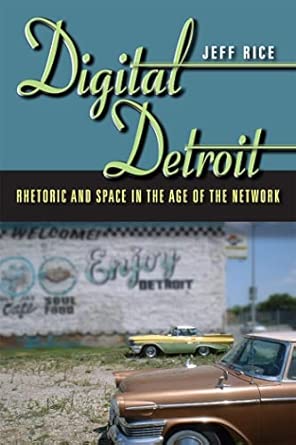
Digital Detroit: Rhetoric and Space in the Age of the Network
Author(s): Jeff Rice (Author)
- Publisher: Southern Illinois University Pr
- Publication Date: 15 Feb. 2012
- Edition: Illustrated
- Language: English
- Print length: 264 pages
- ISBN-10: 0809330873
- ISBN-13: 9780809330874
Book Description
Since the 1967 riots that ripped apart the city, Detroit has traditionally been viewed either as a place in ruins or a metropolis on the verge of rejuvenation. In Digital Detroit: Rhetoric and Space in the Age of the Network, author Jeff Rice goes beyond the notion of Detroit as simply a city of two ideas. Instead he explores the city as a web of multiple meanings which, in the digital age, come together in the city's spaces to form a network that shapes the writing, the activity, and the very thinking of those around it.
Rice focuses his study on four of Detroit's most iconic places--Woodward Avenue, the Maccabees Building, Michigan Central Station, and 8 Mile--covering each in a separate chapter. Each of these chapters explains one of the four features of network rhetoric: folksono(me), the affective interface, response, and decision making. As these rhetorical features connect, they form the overall network called Digital Detroit. Rice demonstrates how new media, such as podcasts, wikis, blogs, interactive maps, and the Internet in general, knit together Detroit into a digital network whose identity is fluid and ever-changing. In telling Detroit's spatial story, Rice deftly illustrates how this new media, as a rhetorical practice, ultimately shapes understandings of space in ways that computer applications and city planning often cannot. The result is a model for a new way of thinking and interacting with space and the imagination, and for a better understanding of the challenges network rhetorics pose for writing.
Editorial Reviews
Review
p.MsoNormal, li.MsoNormal, div.MsoNormal { margin: 0in 0in 0.0001pt; font-size: 12pt; font-family: "Times New Roman"; }p.Style1, li.Style1, div.Style1 { margin: 0in 0in 0.0001pt; font-size: 10pt; font-family: "Times New Roman"; }span.CharacterStyle2 { }div.Section1 { page: Section1; }
Digital Detroit: Rhetoric and Space in the Age of the Network explores the society-transforming effect of the network, and how electronic and physical culture affect one another. Although cities and the institutions within them are often thought of as fixed locations on a map, electronic networks add an interconnected dimension giving an extra layer of complexity. Chapters show how the horizons of a geographical entity are transformed, with Detroit as a prime example, in this scholarly, forward-looking rhetorical treatise. --James A. Cox
--James A. Cox "The Midwest Book Review" (4/1/2012 12:00:00 AM)
Rice, Jeff. Digital Detroit: Rhetoric and Space in the Age of the Network. Southern Illinois, 2012. 247p bibl index afp ISBN 9780809330874 pbk, $39.95; ISBN 9780809330881 e-book, $39.95
In this original approach to understanding place, Rice (writing, rhetoric, and digital media, Univ. of Kentucky) explores the fixed city of Detroit via the metaphor of digital space. This methodological choice allows him to search for rhetorical connections via a digital concept. In five chapters, he explores networked writing through what he calls an "undifferentiated" section of Detroit that, he writes, "moves out of its space and engages with other spaces." In other words, he explores Detroit the way a person would investigate a location online using Mapquest and Google--allowing one hit to lead to another click. The spaces Rice explores include Woodward Avenue, the Maccabees Building, Michigan Central Station, and 8 Mile. Rice's application is difficult, at times, to follow. But his method mimics the behavior of an electronic culture. Others have investigated the notion of digital "space"--for example, Edward Casey, in The Fate of Place: A Philosophical History (1997)--but none has applied this model in this age of the network. This book offers a fascinating look at a physical space through a digital lens. Summing Up: Highly recommended. All readers.--K. L. Majocha, University of Pittsburgh at Johnstown
--K. L. Majocha "CHOICE: Current Reviews for Academic Libraries" (8/1/2012 12:00:00 AM)
"In Digital Detroit, Jeff Rice demonstrates that the relatively static and measurable boundaries that give a city the status of a territory do not solely determine that city's identity, which is being rewritten at each moment according to the dynamic relations of its inhabitants. Captivating in its writing, compelling in its argument, and innovative in its method and performance, this book makes a major contribution to the rhetorics of space and place, specifically, and to rhetorical theory and digital rhetorics more generally."--Diane Davis, author of Breaking Up [at] Totality: A Rhetoric of Laughter and Inessential Solidarity
"Digital Detroit is the soundstage, and screenplay, for a lost episode of The Twilight Zone: a rhetorical study in demise and irony, ironworks and metal metonymy. Jeff Rice is a cross between Rod Serling and Bob Dylan, writing from the rubble of a re-'mixed up confusion' that is Detroit in the fifth dimension, tuning his keyboard somewhere on Wordward Ave. This is road trip reading at its best."--Cynthia Haynes, associate professor of English, Clemson University
"[Digital Detroit] is a promise for Detroit in the new rhetorical practice of the network in the digital age. The promise comes in a rhetoric of "allowing spatial meanings to avoid the total theory or grand narrative gesture (Detroit is in ruins/Detroit is about to be rejuvenated). . . . [The book] ends with a sense of closure that leaves us thinking that the Rice tour of Detroit for the digital tourist was a good one, and not just a good one, but a tour "good enough" for Detroit and more than good enough as a hueretic model for us residents of the digital rhetorical network."--Eric Hall, Clemson University
Digital Detroit: Rhetoric and Space in the Age of the Network explores the society-transforming effect of the network, and how electronic and physical culture affect one another. Although cities and the institutions within them are often thought of as fixed locations on a map, electronic networks add an interconnected dimension giving an extra layer ofcomplexity. Chapters show how the horizons of a geographical entity are transformed, with Detroit as a prime example, in this scholarly, forward-looking rhetorical treatise. --James A. Cox
--James A. Cox "The Midwest Book Review" (4/1/2012 12:00:00 AM)
120Normal0falsefalsefalseEN-USX-NONEX-NONE120Normal0falsefalsefalseEN-USX-NONEX-NONE
Rice, Jeff. Digital Detroit: Rhetoric and Space in the Age of the Network. Southern Illinois, 2012. 247p bibl index afp ISBN 9780809330874 pbk, $39.95; ISBN 9780809330881 e-book, $39.95
In this original approach to understanding place, Rice (writing, rhetoric, and digital media, Univ. of Kentucky) explores the fixed city of Detroit via the metaphor of digital space. This methodological choice allows him to search for rhetorical connections via a digital concept. In five chapters, he explores networked writing through what he calls an "undifferentiated" section of Detroit that, he writes, "moves out of its space and engages with other spaces." In other words, he explores Detroit the way a person would investigate a location online using Mapquest and Google--allowing one hit to lead to another click. The spaces Rice explores include Woodward Avenue, the Maccabees Building, Michigan Central Station, and 8 Mile. Rice's application is difficult, at times, to follow. But his method mimics the behavior of an electronic culture. Others have investigated the notion of digital "space"--for example, Edward Casey, in The Fate of Place: A Philosophical History (1997)--but none has applied this model in this age of the network. This book offers a fascinating look at a physical space through a digital lens. Summing Up: Highly recommended. All readers.--K. L. Majocha, University of Pittsburgh at Johnstown
--K. L. Majocha "CHOICE: Current Reviews for Academic Libraries" (8/1/2012 12:00:00 AM)