“In this thoughtful, well-organized, and readable textbook, [the author] illuminates this period of South American history by comparing three of the most flagrant cases of military rule: Brazil (1964-1988), Chile (1973-1990), and Argentina (1976-1983). …Dávila seeks to capture the urgency of this extraordinary period for contemporary readers and to help them to understand that if ‘the stakes were enormous, so were the costs.’
Since the book forms a part of Wiley-Blackwell’s Viewpoints/Puntos de Vista series, which seeks to introduce students to a significant theme or topic in Latin American history, the author has designed the narrative in ways to enlighten and engage an undergraduate audience.
An extremely helpful and thorough bibliography enhances the value of the text as a reference source not just for undergraduates but for scholars at all levels.
In short, at a time when many professors are abandoning textbooks to rely on scattered internet materials, those who deal with twentieth century Latin America will find that this one compact volume will bring to the fore enough challenging questions and useful information to engage their students throughout a semester.” – The Latin Americanist
“This concise history of Brazil, Argentina, and Chile from the mid-20th century until its end is excellent… Invaluable for undergraduate collections. Summing up: Essential. All levels/libraries.” (Choice, 1 October 2013)
“This ambitious book will change how we understand dictatorships and redemocratization. Dávila brings to light generally ignored aspects of life under military rule and argues forcefully that dictatorship is not a ‘natural’ aspect of Latin American society.” – Jeffrey Lesser, Emory University
“A thoughtful, deeply informed introduction to one of the darkest chapters of Latin American history. Highly recommended both for the breadth of its analysis and for its admirable concision.” – George Reid Andrews, University of Pittsburgh
“Dávila’s brisk and provocative survey of South American military dictatorships bristles with insights and strikes an elegant balance between synthetic analysis and attention to national specificity. Dávila’s engaging chapters, rich in illuminating detail, situate these dictatorships historically and reveal key continuities in each country.” – Thomas D. Rogers, Emory University
From the Inside Flap
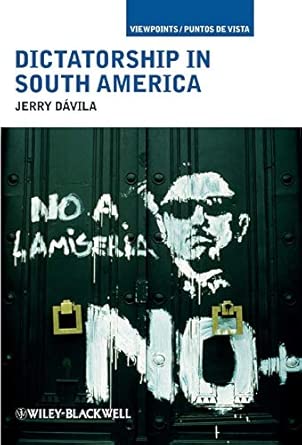
Assassination and political upheaval characterize the Cold War period in South America. Dictatorship in South America explores the Latin American experience of military dictatorship during this era, depicting citizens’ relationship with the brutal juntas that cycled in and out of power. Focusing on the experiences of Brazil, Chile, and Argentina, Dictatorship in South America delves into the wider political aftermath of the Cuban Revolution, an event that captured the minds of the public and pushed political regimes toward greater conservatism.
Dávila argues that the radical utopian dreams of students and workers in the aftermath of the Cuban Revolution, fuelled in later years by events in 60s America and Europe, were confronted by equally radical right-wing projects realized by the armed forces in Brazil, Chile and Argentina. Yet behind the appearance of order and progress promoted by the generals, whose unapologetic capitalism disguised unsustainable capital flight and exploitation, lay internal disorder, violence, and the systematic abuse of human rights: the ‘disappeared’ were a real social group, albeit defined by their absence and presumed deaths. This history of three countries’ experience with dictatorship, economic crisis and grassroots re-democratization brings a new perspective to the study of modern Latin American history.
From the Back Cover
Assassination and political upheaval characterize the Cold War period in South America. Dictatorship in South America explores the Latin American experience of military dictatorship during this era, depicting citizens’ relationship with the brutal juntas that cycled in and out of power. Focusing on the experiences of Brazil, Chile, and Argentina, Dictatorship in South America delves into the wider political aftermath of the Cuban Revolution, an event that captured the minds of the public and pushed political regimes toward greater conservatism.
Dávila argues that the radical utopian dreams of students and workers in the aftermath of the Cuban Revolution, fuelled in later years by events in 60s America and Europe, were confronted by equally radical right-wing projects realized by the armed forces in Brazil, Chile and Argentina. Yet behind the appearance of order and progress promoted by the generals, whose unapologetic capitalism disguised unsustainable capital flight and exploitation, lay internal disorder, violence, and the systematic abuse of human rights: the ‘disappeared’ were a real social group, albeit defined by their absence and presumed deaths. This history of three countries’ experience with dictatorship, economic crisis and grassroots re-democratization brings a new perspective to the study of modern Latin American history.
About the Author
Jerry Dávila is Jorge Paulo Lemann Professor of Brazilian History at the University of Illinois. He is the author of Diploma of Whiteness: Race and Social Policy in Brazil, 1917–1945 (2003) and Hotel Trópico: Brazil and the Challenge of African Decolonization, 1950 – 1980 (2010), both of which have been translated into Portuguese and published in Brazil. Dávila has taught in both the United States and Latin America, where he held the Fulbright Distinguished Chair in American Studies at the Pontifícia Universidade Católica in Rio de Janeiro and was a Fulbright Scholar at the University of São Paulo.
 Wow! eBook