Development of Antibody-Based Therapeutics: Translational Considerations 2012th Edition

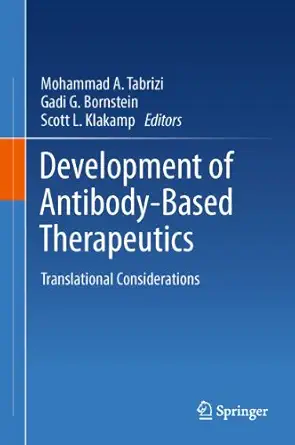
Development of Antibody-Based Therapeutics: Translational Considerations 2012th Edition book cover

Development of Antibody-Based Therapeutics: Translational Considerations 2012th Edition

Author(s): Mohammad A. Tabrizi (Editor), Gadi G. Bornstein (Editor), Scott L. Klakamp (Editor)

  • Publisher: Springer
  • Publication Date: April 24, 2012
  • Edition: 2012th
  • Language: English
  • Print length: 426 pages
  • ISBN-10: 144195953X
  • ISBN-13: 9781441959539

Book Description

Translational strategies for development of antibody-based therapeutics should allow understanding of the relationship between the ‘unit dose’ and ‘unit effect’ with respect to both beneficial and deleterious effects from early stages of development. The flow of information from later to earlier stages of development should provide opportunities to facilitate selection of more effective novel and next-generation drug candidates. Selection and evaluation of relevant biomarkers in early preclinical development in “relevant” animal models should allow for identifying potential risks to humans and establishing safe First-In-Human (FIH) dosing strategies. Hence, integration of knowledge with respect to target antigen properties such as antigen distribution, expression profile, kinetic properties, target pharmacology, antigen isoforms and pharmacological redundancy in health and disease, as well as antibody design criteria, such as antibody isotype, affinity, PK/PD and safety is a critical necessity for the design of effective translational strategies. Additionally, these factors will further offer critical differentiating characteristics for next-generation antibodies, and novel technologies prove instrumental in generation of biosuperior antibody candidates for market entry. This book will examine many important considerations necessary for the design of effective translational strategies during the development of antibody-based therapeutics.

Editorial Reviews

From the Back Cover

Development of Antibody-Based Therapeutics: Translational Considerations 2012th Edition examines important considerations necessary for the design of effective translational strategies during the development of antibody-based therapeutics. Translational strategies for development of antibody-based therapeutics require an understanding of the relationship between the ‘unit dose’ and ‘unit effect’ with respect to both beneficial and deleterious biological effects from early stages of development. The flow of information across various stages of development should provide opportunities to facilitate selection of more effective novel and next-generation drug candidates. Successful strategies for the development of monoclonal antibodies require integration of knowledge with regards to target antigen properties in health and disease, as well as antibody design criteria including affinity, isotype selection, pharmacokinetics/pharmacodynamics (PK/PD) properties, antibody cross-reactivity across species, and safety. Selection and evaluation of appropriate biomarkers in early preclinical development in “relevant” animal models should allow identification of potential risks and liabilities of an antibody drug candidate to humans and establishment of safe First-In-Human (FIH) dosing strategies. This volume provides a comprehensive review of the topics critical for establishing successful translational strategies for the development of antibody-based therapeutics.

About the Author

Mohammad Tabrizi, Ph.D., Vice President, Preclinical Development, AnaptysBio Inc. Mohammad Tabrizi is a leader in translational sciences as related to development of antibody-based therapeutics. His product development experience spans many therapeutic areas including oncology and inflammatory disease, and his technical expertise includes preclinical pharmacology and safety, preclinical and clinical pharmacokinetics, pharmacodynamics, GLP-compliant bioanalytics, and clinical pharmacology of therapeutic monoclonal antibodies. He is currently the Vice President of Preclinical Development at AnaptysBio, Inc., a privately held biotechnology company in San Diego CA, USA, the leader in Somatic HyperMutation (SHM) for development of therapeutic antibodies where he advances the preclinical development efforts.

Gadi Gazit Bornstein, Ph.D., Principal Scientist, AstraZeneca R&D Boston Dr. Bornstein has experience in research and development with an emphasis in development of therapeutic monoclonal antibodies in oncology. Dr. Bornstein is a Principal Scientist at AstraZeneca, where he currently leads several antibody programs within the Preclinical oncology portfolio. He received his B.S. in biochemistry at the University of California, Davis and his doctoral degree in biochemistry at the Keck School of Medicine of the University of Southern California. Dr. Bornstein completed his postdoctoral training at Stanford University School of Medicine in the Division of Immunology and Rheumatology. Following his postdoctoral training, Dr. Bornstein joined Amgen Fremont, Inc. (formerly Abgenix, Inc.) as a Staff Scientist in the Preclinical Oncology Department. During his tenure at Abgenix, he was a project team leader and lead biologist for multiple antibody programs.

Scott L. Klakamp, Ph.D., Research Fellow, Biophysical Chemistry and Research Informatics, Takeda San Francisco Scott Klakamp is one of the leading scientists in utilizing Biacore®, KinExA®, and FACS techniques to measure the binding kinetics and equilibrium constants of human monoclonal antibody/antigen complexes. He has extensive experience in research and development involving the biophysical and analytical characterization of biologics and monoclonal antibodies (mAb). He has also contributed significantly to the clinical immunology field by applying highly rigorous analytical detection concepts, previously unknown to the discipline, to immunogenicity studies of therapeutic mAbs. Currently, he is a Research Fellow at Takeda San Francisco, the therapeutic monoclonal antibody discovery engine for Takeda Pharmaceutical Company, and leads the Biophysical Chemistry and Research Informatics Groups.

View on Amazon

电子书代发PDF格式价格30我要求助
未经允许不得转载:Wow! eBook » Development of Antibody-Based Therapeutics: Translational Considerations 2012th Edition