“The book provides a good survey on destruction methods suitable for small and medium sized laboratories. The well-structured writing style provides an interesting textbook, helpful for every laboratory technician, and a reference book for supervisors responsible for the laboratory work.” (Materials and Corrosion, 1 August 2012)
“The writing is clear and precise, molecular structures and diagrams are clearly labelled, and procedures appear to be up-to-date, efficient, and adaptable . . . Summing Up: Essential. Graduate students through professionals/practitioners in academic, commercial, or industrial chemical laboratories.” (Choice, 1 November 2012)
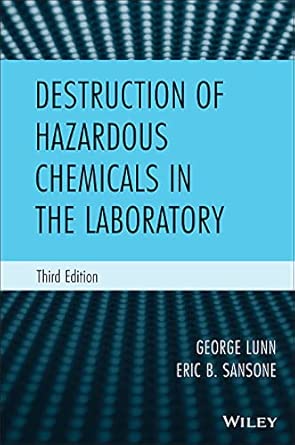
The fully updated reference on degrading and disposing of hazardous chemicals in the laboratory
When it’s time for laboratory technicians to get rid of hazardous materials, they can’t simply dump them in the trash. Detailed procedures need to be followed to safely degrade and dispose of hazardous chemicalsfrom bulk quantities of material to accidental spills.
This new edition of Destruction of Hazardous Chemicals in the Laboratory includes validated methods for safely degrading specific compounds, such as nitrosamines and aflatoxins, as well as general strategies that are applicable to all organic compounds. In addition, promising emerging technologies, such as advanced oxidation procedures, that are applicable to the destruction of hazardous compounds in the laboratory are discussed. Practical details are provided so these procedures can be readily implemented in the laboratory, often by technicians, without the use of exotic reagents or special equipment. Methods for the destruction of pharmaceuticals have been placed in a new and greatly expanded section, and many new monographs, including some on dealing with toxins derived from biological agents, are included.
Destruction of Hazardous Chemicals in the Laboratory, Third Edition integrates all the available validated procedures for the safe destruction of hazardous chemicals in the laboratory into one complete volume. No comparable text in this field provides such a wealth of in-depth coverage on such an important topic. Together with books on the hazardous properties of chemicals and general precautionary procedures, this practical guide should form the nucleus of any library concerned with chemical safety.
From the Back Cover
THE FULLY UPDATED REFERENCE ON DEGRADING AND DISPOSING OF HAZARDOUS CHEMICALS IN THE LABORATORY
When it’s time for laboratory technicians to get rid of hazardous materials, they can’t simply dump them in the trash. Detailed procedures need to be followed to safely degrade and dispose of hazardous chemicals?from bulk quantities of material to accidental spills.
This new edition of Destruction of Hazardous Chemicals in the Laboratory 3rd Edition includes validated methods for safely degrading specific compounds, such as nitrosamines and aflatoxins, as well as general strategies that are applicable to all organic compounds. In addition, promising emerging technologies, such as advanced oxidation procedures, that are applicable to the destruction of hazardous compounds in the laboratory are discussed. Practical details are provided so these procedures can be readily implemented in the laboratory, often by technicians, without the use of exotic reagents or special equipment. Methods for the destruction of pharmaceuticals have been placed in a new and greatly expanded section, and many new monographs, including some on dealing with toxins derived from biological agents, are included.
Destruction of Hazardous Chemicals in the Laboratory, Third Edition integrates all the available validated procedures for the safe destruction of hazardous chemicals in the laboratory into one complete volume. No comparable text in this field provides such a wealth of in-depth coverage on such an important topic. Together with books on the hazardous properties of chemicals and general precautionary procedures, this practical guide should form the nucleus of any library concerned with chemical safety.
About the Author
George Lunn, PhD, has been working as a review chemist for the FDA’s Office of New Drug Quality Assessment since 1996. Previously, he was a senior research scientist in the Environmental Control and Research Program at the NCI-Frederick Cancer Research and Development Center. He has written nine books and over sixty papers and review articles.
Eric B. Sansone, PhD, was the director of the Environmental Control and Research Program at the NCI-Frederick Cancer Research and Development Center until his retirement. He has also worked as a consultant in industrial hygiene and air pollution control for a widely diversified group of industries, law firms, universities, and governmental agencies. He has published many articles on the assessment of risk in cancer research.
 Wow! eBook