Wow! eBook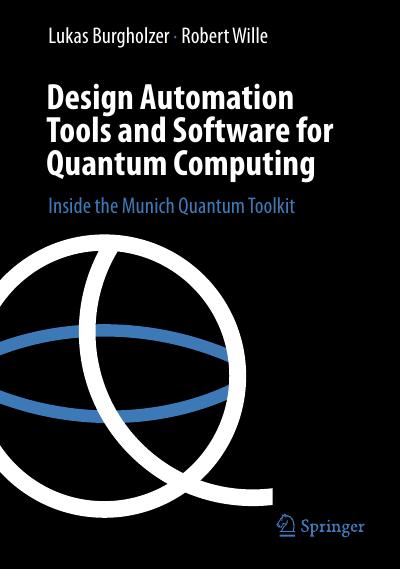
Design Automation Tools and Software for Quantum Computing: Inside the Munich Quantum Toolkit (Synthesis Lectures on Engineering, Science, and Technology)
Author(s): Lukas Burgholzer (Author), Robert Wille (Author)
- Publisher: Springer
- Publication Date: May 12, 2026
- Language: English
- Print length: 217 pages
- ISBN-10: 3032067693
- ISBN-13: 9783032067692
Book Description
This book provides an easy-to-read introduction to quantum computing and introduces readers to a set of software design tools that leverage the power of design automation for optimizing quantum circuits and applications. The authors describe methods and software for quantum computing that utilize explicitly core data structures (such as decision diagrams) or methods (such as dedicated reasoning engines), while focusing on three major design tasks in quantum software development, namely classical simulation of quantum circuits, compilation of quantum circuits, and verification of quantum circuits. All tools and software solutions discussed in this book are made available as open-source packages and constitute the backbone of the Munich Quantum Toolkit.
Editorial Reviews
Editorial Reviews
From the Back Cover
This book provides an easy-to-read introduction to quantum computing and introduces readers to a set of software design tools that leverage the power of design automation for optimizing quantum circuits and applications. The authors describe methods and software for quantum computing that utilize explicitly core data structures (such as decision diagrams) or methods (such as dedicated reasoning engines), while focusing on three major design tasks in quantum software development, namely classical simulation of quantum circuits, compilation of quantum circuits, and verification of quantum circuits. All tools and software solutions discussed in this book are made available as open-source packages and constitute the backbone of the Munich Quantum Toolkit.
About the Author
Lukas Burgholzer works as a research scientist at the Technical University of Munich in the Chair for Design Automation of Robert Wille and as CTO of the Munich Quantum Software Company (MQSC). He received his PhD from JKU Linz, Austria, in 2023 working as part of the Institute for Integrated Circuits as well as the LIT Secure and Correct Systems Lab. His research focuses on design automation tools and software for quantum computing. In these areas, he has published more than 60 papers in international conferences and journals. He is the chief developer of the Munich Quantum Toolkit (MQT) as well as one of the technical leads of the Munich Quantum Software Stack (MQSS) project, which is developed as part of the Munich Quantum Valley (MQV) initiative. For his research, he was awarded the EDAA Outstanding Dissertation Award, the Heinz Zemanek Prize, and more.
Robert Wille is a Full and Distinguished Professor at the Technical University of Munich, CEO of the Munich Quantum Software Company (MQSC), and Scientific Director at the Software Competence Center Hagenberg. He received his Diploma and Dr.-Ing. degrees in Computer Science from the University of Bremen, Germany, in 2006 and 2009, respectively. His academic journey has included positions at the University of Bremen, the German Research Center for Artificial Intelligence (DFKI), the University of Applied Sciences Bremen, the University of Potsdam, and the Technical University Dresden. From 2015 to 2022, he worked as a Full Professor at the Johannes Kepler University Linz before moving to Munich.
His research focuses on the design of circuits and systems for both conventional and emerging technologies. For over 15 years, he has been actively advancing the field of quantum computing—establishing foundational software and design automation concepts. His contributions have earned numerous accolades, including Best Paper Awards, the DAC Under-40 Innovator Award, a Google Research Award, an ERC Consolidator Grant, and more. He collaborates with leading academic and industrial partners and plays a key role in initiatives such as the Munich Quantum Valley. He has published over 400 papers and serves on editorial boards and numerous boards of major journals and conferences. Through his roles in companies, he is also deeply engaged in technology transfer from research to practice.