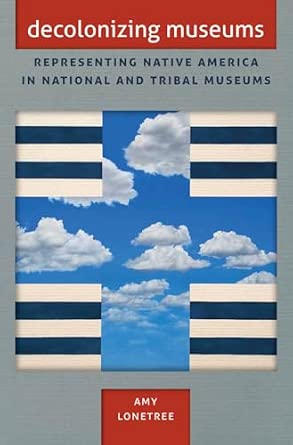
Decolonizing Museums: Representing Native America in National and Tribal Museums (First Peoples: New Directions in Indigenous Studies) (First Peoples: ... of North Carolina Press Paperback))

Decolonizing Museums: Representing Native America in National and Tribal Museums (First Peoples: New Directions in Indigenous Studies) (First Peoples: ... of North Carolina Press Paperback)) book cover

Decolonizing Museums: Representing Native America in National and Tribal Museums (First Peoples: New Directions in Indigenous Studies) (First Peoples: … of North Carolina Press Paperback))

Author(s): Amy Lonetree (Author)

  • Publisher: University North Carolina Pr
  • Publication Date: 15 Nov. 2012
  • Edition: New
  • Language: English
  • Print length: 248 pages
  • ISBN-10: 0807837156

Book Description

Museum exhibitions focusing on Native American history have long been curator controlled. However, a shift is occurring, giving Indigenous people a larger role in determining exhibition content. In Decolonizing Museums, Amy Lonetree examines the complexities of these new relationships with an eye toward exploring how museums can grapple with centuries of unresolved trauma as they tell the stories of Native peoples. She investigates how museums can honor an Indigenous worldview and way of knowing, challenge stereotypical representations, and speak the hard truths of colonization within exhibition spaces to address the persistent legacies of historical unresolved grief in Native communities.
Lonetree focuses on the representation of Native Americans in exhibitions at the Smithsonian’s National Museum of the American Indian, the Mille Lacs Indian Museum in Minnesota, and the Ziibiwing Center of Anishinabe Culture and Lifeways in Michigan. Drawing on her experiences as an Indigenous scholar and museum professional, Lonetree analyzes exhibition texts and images, records of exhibition development, and interviews with staff members. She addresses historical and contemporary museum practices and charts possible paths for the future curation and presentation of Native lifeways.

Editorial Reviews

Review

“[An] interesting and important new book.”–Anthropology Review Database

“A challenging and, at times, heartbreaking text. . . . Should be mandatory reading, for graduate level anthropology, museum studies, arts administration, and history classes dealing with Native American cultures and representation. Working museum professionals will gain much from this book, as well.”—Journal of Folklore Research

“An important new volume for understanding museum representation in different contexts.”–Ethnohistory

“Lonetree analyzes the complexities of developing exhibitions through collaborations between museum curators and Native communities, with the goal of telling stories that honor the Native worldview and way of knowing, challenge stereotypes, and speak the hard truths of colonization.”–Minnesota Historical Society Press

“Lonetree does an admirable job of incorporating Native American storytelling preferences into a kind of scholarly discourse that is insightful, critically astute, and a pleasure to read.”–Journal of American Ethnic History

“Lonetree generates compelling ideas for discussion and debate in the museum field, and these ideas call for practical application in museums and sites of cultural representation.”–Collaborative Anthropologies

“Lonetree offers a powerful and meditative study. . . . [It] is an uncompromising yet candid statement that no matter how far Western museums have come in their representations of Native Americans, there is still much work to be done.”–Indigenous Peoples’ Issues and Resources

“Provides the reader with an easy-to-follow breakdown of the concept of decolonization within the context of museums. . . [and] is well written and carefully structured.”–History News

“This book is written in a clear and accessible fashion, suitable for scholars and professionals as well as undergraduate students. . . . I highly recommend this book to museum professionals, museum studies scholars, anthropologists, historians, and students of museum theory and practice.”–Collaborative Anthropologies

“Thoughtful and compelling. . . . Recommended. All levels/libraries.”–CHOICE

From the Back Cover

Museum exhibitions focusing on Native American history have long been curator controlled. However, a shift is occurring, giving Indigenous people a larger role in determining exhibition content. In Decolonizing Museums, Amy Lonetree examines the complexities of these new relationships with an eye toward exploring how museums can grapple with centuries of unresolved trauma as they tell the stories of Native peoples. She investigates how museums can honor an Indigenous worldview and way of knowing, challenge stereotypical representations, and speak the hard truths of colonization within exhibition spaces to address the persistent legacies of historical unresolved grief in Native communities.

About the Author

Amy Lonetree (Ho-Chunk) is associate professor of American studies at the University of California, Santa Cruz, and co-editor, with Amanda J. Cobb, of The National Museum of the American Indian: Critical Conversations. She is co-author of People of the Big Voice: Photographs of Ho-Chunk Families, 1879-1942.

View on Amazon

电子书代发PDF格式价格30我要求助
未经允许不得转载:Wow! eBook » Decolonizing Museums: Representing Native America in National and Tribal Museums (First Peoples: New Directions in Indigenous Studies) (First Peoples: ... of North Carolina Press Paperback))