Wow! eBook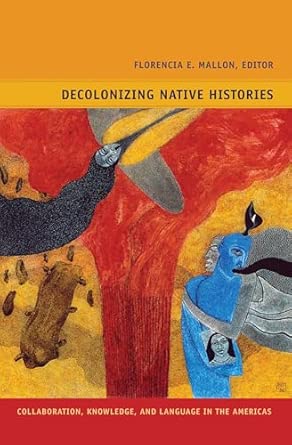
Decolonizing Native Histories: Collaboration, Knowledge, and Language in the Americas
Author(s): Florencia E. Mallon (Author), Gladys McCormick (Translator)
- Publisher: Duke University Press
- Publication Date: 30 Dec. 2011
- Language: English
- Print length: 272 pages
- ISBN-10: 9780822351375
- ISBN-13: 0822351374
Book Description
These wide-ranging case studies consider how language, the law, and the archive have historically served as instruments of colonialism and how they can be creatively transformed in constructing autonomy. The collection highlights points of commonality and solidarity across geographical, cultural, and linguistic boundaries and also reflects deep distinctions between North and South. Decolonizing Native Histories looks at Native histories and narratives in an internationally comparative context, with the hope that international collaboration and understanding of local histories will foster new possibilities for indigenous mobilization and an increasingly decolonized future.
Editorial Reviews
Review
“[S]cholars and students will benefit immensely from these explorations of the ways Indigenous people have transformed their relationship to the past, the state, and their interlocutors.”–David Carey Jr. “Canadian Journal of Native Studies”
“Overall, this ambitiously edited volume is able to deliver thoughtful essays, crossing geographic and political boundaries, which encourage the reader to examine Indigenous histories and narratives through the multi-faceted lens of decolonization in an international forum.” –Heather Y. Shpuniarsky “AlterNative”
“This fine volume highlights ways of writing indigenous history beyond the usual frameworks supplied by academia….This volume urges us out of our safe spaces to push the boundaries of what indigenous history can mean.”–Laura E. Matthew “Hispanic American Historical Review”
“This is a high-quality contribution for understanding the impacts of colonial empires on the native peoples of the Americas and related island areas in the Pacific….The book is recommended for academic courses and professionals with common research interests.”–Richard W. Stoffle “Bulletin of Latin American Research”
“
Decolonizing Native Histories is a stunning collection of essays from places and authors not often seen in each others’ company: they range from Bolivia to Rapa Nui, from Louisiana to Hawai’i. To read of the predicaments and possibilities of a Quechua-language newspaper, racism in a Native American community, and indigenous political resurgence in Rapa Nui in the same volume presents a rare opportunity to compare strategies and gain inspiration, and to transcend seemingly impassable geographic and linguistic differences, to achieve commonality in treasuring our indigenous languages, cultures, and lands. Invaluable for anyone interested in global indigenous histories and politics.”–Noenoe K. Silva, author of Aloha Betrayed: Native Hawaiian Resistance to American ColonialismAbout the Author
Florencia E. Mallon is the Julieta Kirkwood Professor of History and Latin American Studies and Chair of the History Department at the University of Wisconsin. She is the author of numerous books, including Courage Tastes of Blood: The Mapuche Indigenous Community of NicolÁs AilÍo and the Chilean State, 1906–2000 and the editor and translator of Rosa Isolde Reuque Paillalef’s When a Flower is Reborn: The Life and Times of a Mapuche Feminist, both published by Duke University Press.
Excerpt. © Reprinted by permission. All rights reserved.
DECOLONIZING NATIVE HISTORIES
Collaboration, Knowledge, and Language in the Americas
DUKE UNIVERSITY PRESS
Copyright © 2012 Duke University Press
All right reserved.
ISBN: 978-0-8223-5137-5
Contents
About the Series………………………………………………………………………………………………………………………….viiFLORENCIA E. MALLON Introduction. Decolonizing Knowledge, Language, and Narrative……………………………………………………………….1PART ONE Land, Sovereignty, and Self- Determination…………………………………………………………………………………………..21J. KEHAULANI KAUANUI Hawaiian Nationhood, Self-Determination, and International Law……………………………………………………………..27RIET DELSING Issues of Land and Sovereignty: The Uneasy Relationship between Chile and Rapa Nui…………………………………………………..54PART TWO Indigenous Writing and Experiences with Collaboration…………………………………………………………………………………79FERNANDO GARCÉS V. Quechua Knowledge, Orality, and Writings: The Newspaper Conosur Ñawpagman…………………………………………….85JOANNE RAPPAPORT AND ABELARDO RAMOS PACHO Collaboration and Historical Writing: Challenges for the Indigenous–Academic Dialogue…………………122JAN RUS AND DIANE L. RUS The Taller Tzotzil of Chiapas, Mexico: A Native Language Publishing Project, 1985–200………………………………..2144PART THREE Generations of Indigenous Activism and Internal Debates……………………………………………………………………………..175BRIAN KLOPOTEK Dangerous Decolonizing: Indians and Blacks and the Legacy of Jim Crow…………………………………………………………….179EDGAR ESQUIT Nationalist Contradictions: Pan-Mayanism, Representations of the Past, and the Reproduction of Inequalities in Guatemala…………………196Conclusion……………………………………………………………………………………………………………………………….219References……………………………………………………………………………………………………………………………….221Contributors……………………………………………………………………………………………………………………………..243Index……………………………………………………………………………………………………………………………………247
Chapter One
Land, Sovereignty, and Self- Determination
SINCE THE 1970S the internationalization of indigenous mobilization and the formation of globalized coalitions of Native peoples have changed the face of indigenous cultural politics and of indigenous claims to autonomy. One of the venues through which Native activism has been most dramatically felt has been the United Nations, where indigenous peoples have successfully pressured for the passage of broad- ranging resolutions supporting Native rights to self-determination, autonomy, and territorial and cultural integrity. Both the International Labor Organization’s (ILO) Convention 169, adopted in June 1989 and put in force in September 1991, and the United Nations Declaration on the Rights of Indigenous Peoples, ratified in September 2007, have broken new ground in the area of international recognition of indigenous rights.
During the 1990s, as Native peoples pressured existing nation- states to ratify and observe the principles of ILO Convention 169 in their dealings with indigenous peoples within their borders, it became clear that un resolutions can serve as powerful weapons for mobilization. Additionally, the intensification and deepening of international debate on indigenous issues, buttressed by back-to-back Decades of Indigenous Peoples declared by the United Nations (1990–2000, 2000–2010), have increased consciousness on the question of Native peoples and their rights, not only among political elites but also in intellectual and academic communities worldwide. And this new awareness has doubled back into Native societies, encouraging new forms of activism.
The two essays in part 1 situate the struggles of two indigenous peoples, the Kanaka Maoli of Hawai’i and the Rapanui of Rapa Nui, or so-called Easter Island, squarely within this evolving story of international indigenous mobilization. Informed by literatures in international politics, international human rights, and debates over indigenous self-determination, these essays take a broad view of the interactions between indigenous peoples and the states that colonized them. The focus is not on local forms of cultural practice or historical memory, but on the historically changing alternatives available to indigenous peoples as a whole in their struggle to retain land, culture, and resources and to achieve sovereignty and self-determination.
Kehaulani Kauanui places the historical struggle of Kanaka Maoli both in the context of U.S. federal government debates and within discussions in international law. As she makes clear, the case of Hawai’i is in some ways unique because, during the nineteenth century, the Kingdom of Hawai’i received international treaty recognition as a sovereign state. Subsequently, however, the U.S.-backed overthrow of the kingdom in 1893, the illegal annexation of Hawai’i as a U.S. territory in 1898, and the irregular vote that led to statehood in 1959 have all added layers of complexity and colonialism, making questions of national sovereignty, deoccupation, and indigenous rights deeply conflictual among the islands’ inhabitants. Indeed, as Kauanui explores in her essay, none of the alternatives existing today—whether indigenous self-determination under U.S. federal law or under international law, decolonization under international law, or deoccupation based on the kingdom’s previous existence as an independent state—attend simultaneously and effectively to the needs of all those involved.
Consciously developing a different kind of anthropological perspective, Riet Delsing traces the revitalization and recovery of identity and memory in Rapa Nui both as a story embedded in the narrative of the Chilean nation-state and as an international practice framed by the last generation of globalized indigenous mobilization. Delsing shows how the history of Chilean expropriation and colonization of the Rapanui is both embedded in the evolution of the Chilean nation-state and is a chapter in the broader story of Chilean Pacific imperialism and territorial expansion. At the same time, she traces the links between the evolution of a new Rapanui consciousness and the development of a Pacific-based indigenous consciousness. In the end, she suggests that the recent turn to militancy by a sector of Rapanui activists is articulated to the expansion of international indigenous activism and to the Rapanui’s recognition of themselves as a Polynesian, rather than an American, people.
Taken together, the two essays assume three important tasks of the collection as a whole. First, they show how, in two specific historical cases, the international indigenous movement and un debates on indigenous rights have changed the struggles for autonomy and self-determination over the last two generations. The richness of historical context provided is extremely important, because some analysts have tended to assume that, rather than coming to fruition in the context of the un debates, indigenous struggles actually originated in them. These essays demonstrate, to the contrary, that the changing international context has afforded new venues and languages within which to place already existing and ongoing struggles over cultural recognition, resources, and self-determination.
The second task the essays take on is to decenter the focus of the volume from the Americas. By concentrating on the Pacific region, and specifically on two Polynesian peoples, the authors remind us to look outside our national, or even continental, boundaries in considering the relationship between indigenous peoples and colonialism. Despite the dramatic differences in the history of Hawai’i and Rapa Nui, certain similarities in historical periodization and even in linguistic terminology (for example, the use of the word canaca in Rapa Nui and kanaka in Hawai’i to denote indigenous people) stand out. This process of decentering can perhaps be best appreciated visually by looking at the accompanying map. As the reader will see, in order to show Hawai’i it was necessary to cut off a portion of eastern South America, giving the image a certain counterintuitive feel.
The third task these essays perform is to raise the question of methodology in the writing of indigenous history and Native narrative. We tend to assume that Native history, because it is about indigenous communities, is best written from an ethnographic perspective that seeks to get inside the cultures about which we write. Certainly a close understanding of cultural categories and practices, of people’s narratives and memories, must stand at the center of how Native history is rendered. Yet at the same time, as we reflect in this book on notions of decolonization, we must also take to heart the fact that broad national and international narratives and analysis are equally important as Native peoples continue to engage nation-states, intellectuals, political organizations, and academic practitioners. Perhaps, in this sense, decolonization can also begin at home, as we think through the multiple ways and registers in which to render indigenous narratives, history, and experience in the ever more globalized world.
J. KEHAULANI KAUANUI
Hawaiian Nationhood, Self-Determination, and International Law
This measure does not preclude Native Hawaiians from seeking alternatives in the international arena. This measure focuses solely on self-determination within the framework of federal law and seeks to establish equality in the federal policies extended towards American Indians, Alaska Natives and Native Hawaiians. —U.S. Senator Daniel Kahikina Akaka (2001a)
Let me be clear—It is not my intention, nor the intention of the delegation, to preclude efforts of Native Hawaiians at the international level. The scope of this bill is limited to federal law. —U.S. Senator Daniel Kahikina Akaka (2001b)
U.S. Senator Daniel Kahikina Akaka’s assurances, made in 2001, were in regard to a legislative initiative to recognize a Native Hawaiian nation within the confines of U.S. federal policy on Tribal Nations that still remains before the U.S. Congress. Beginning in the 106th U.S. Congress in 2000 and continuing at least through the 111th Congress in 2011, Akaka, a Native Hawaiian Democrat from the State of Hawai’i, introduced this federal legislation in order to secure the recognition of Native Hawaiians as an indigenous people who have a “special relationship” with the United States and thus a right to internal self-determination. Passage of the bill would lay the foundation for a nation-within-a-nation model of self-governance defined by U.S. federal law as “domestic dependent nations” to exercise the right to self-government. The U.S. government has included Kanaka Maoli (indigenous Hawaiians) in over 160 legislative acts relating to Native Americans. However, it has not included Kanaka Maoli in its policy on Native self-determination. Akaka’s assertions that passage of the bill would not preclude Kanaka Maoli from seeking “alternatives in the international arena” have been his standard response to challenges posed to him by individuals and organizations opposed to the legislation because they favor Hawaiian independence from the United States—that is, the restoration of a Hawaiian state under international law. These groups include Hui Pu as well as those who are part of the Hawaiian Independence Action Alliance: the Pro-Kanaka Maoli Independence Working Group, Ka Pakaukau, Komike Tribunal, HONI (Hui o Na Ike), Ka Lei Maile Ali’i Hawaiian Civic Club, Koani Foundation, ‘Ohana Koa, NFIP—Hawai’i, Spiritual Nation of Ku—Hui Ea Council of Sovereigns, Living Nation, Settlers for Hawaiian Independence, MANA (Movement for Aloha No Ka ‘Aina), as well as the Hawai’i Institute for Human Rights.
Akaka’s response, however, echoed repeatedly by Hawai’i’s state and federal officials over the past decade, speaks only to the rights of indigenous peoples under international law (Namuo 2004). But because his mention of “alternatives in the international arena” here and elsewhere is ill-defined, he has led many to infer that Kanaka Maoli could pursue full independence in a postfederal recognition political scenario, if they so desire. What proponents of the Akaka bill refuse to acknowledge is that this strategy differs from the prevalent Hawaiian independence position from the outset. While many proponents of U.S. federal recognition presume that activists in the Kanaka Maoli independence movement merely want continued access to the United Nations as indigenous peoples, the vast majority of proindependence Kanaka Maoli support two entirely different legal strategies under international law, decolonization and deoccupation, neither of which is based on indigeneity. Decolonization is specific to colonized peoples in non-self-governing territories, while deoccupation pertains to occupied states.
The history of the Kingdom of Hawai’i, which was recognized as a state by all major global powers throughout the nineteenth century, provides Kanaka Maoli and others with a rare legal claim that shows the current state-driven push for federal recognition to be problematic for outstanding sovereignty claims. This essay critically analyzes the limits of both Akaka’s federal proposal for internal self-determination and the rights of indigenous peoples under international law to argue that passage of the Native Hawaiian Government Reorganization Act would indeed threaten the independence claims of the Hawaiian nation, which are not necessarily protected by the Declaration on the Rights of Indigenous Peoples. In other words, I show how the independence claim for the sovereignty of the Hawaiian kingdom exceeds the current rights accorded to indigenous peoples at the United Nations because the monarchy was recognized as a state prior to the U.S.-backed overthrow in 1893.
The case of Hawai’i illuminates the limitations of international law as a remedy for the politically fraught history of the kingdom and of Kanaka Maoli as an indigenous people. First, I offer some historical background in order to delineate the diplomatic relations of the Hawaiian kingdom and the United States, the U.S.-backed overthrow of the kingdom, and unilaterally imposed U.S. annexation and contested statehood for Hawai’i as the fiftieth state of the American Union. Next, I critically examine the prospect for internal self-determination under U.S. domestic policy as proposed in the Native Hawaiian Government Reorganization Act of 2009, also known as the Akaka bill, in order to assess the limits of that model of governance as it is detailed in the legislation. I also explore the ways in which the bill, if passed, could work to preempt and preclude the Hawaiian sovereignty claim under international law.
The next section delineates the terrain of indigenous peoples’ rights under international law as distinct from the rights of states. I suggest that although indigenous peoples’ rights are expanding, they still pose limits for the Hawaiian sovereignty claim—given the legal genealogy of the Hawaiian kingdom, an independent state—as it currently exists because of the way that international law continues to privilege the rights of states over the rights of peoples. Independence proponents who advocate restoration of the kingdom reject both indigenous self-determination under U.S. policy as well as indigenous self-determination under international law as legal strategies for recuperating Hawaiian sovereignty. Most also reject decolonization under the United Nations Charter, for reasons discussed below, and instead advocate for deoccupation. However, that legal strategy also has shortcomings vis-à-vis the plight of Kanaka Maoli, which I address.
The history of occupation and colonialism has generated a variety of options, but none of them seem sufficient in their current scope since each has serious limitations and demands an alternative approach to begin to address this complicated historical legacy in a way that promotes restorative justice.
From Kingdom to U.S.-Occupied Colony
Official diplomatic relations between the Kingdom of Hawai’i and the United States transpired over five decades. The treaties negotiated between the two were made after the U.S. government and other nations had already recognized the kingdom as an independent state. In 1842 King Kamehameha III dispatched a delegation to the United States and later to Europe that was endowed with the power to secure the recognition of Hawaiian independence by the major world powers of the time. On 19 December 1842 the delegation secured the assurance of President John Tyler of the United States of American recognition of the independence of the Kingdom of Hawai’i, and subsequently it secured formal recognition by Great Britain and France.
The treaties between the Kingdom of Hawai’i and the United States were not concerned with land or governance; they specified only relations of peace and friendship, commerce, and navigation. The first, signed at Washington on 20 December 1849, delineated protocols for perpetual peace and amity between the countries. It provided for reciprocal commerce and navigation, including the regulation of duties and imports at favored foreign nation rates and permission for U.S. whaling ships to dock at selected Hawaiian ports. The second treaty was negotiated in 1870 and concerned an arrangement between the postal services of the kingdom and the United States. The third treaty, known as the Reciprocity Treaty, was signed in 1875. This agreement for commercial reciprocity meant no export duty was imposed on Hawai’i or the United States and allowed for tax- free goods exchanged between the two nations to enter and leave Hawaiian and U.S. ports. In 1884 the two nations negotiated a convention to renew and supplement the treaty of 1875. This allowed the United States privileged access, over other nations, to use Pearl Harbor. The convention specified that the U.S. government had exclusive right to enter the harbor and to establish and maintain there a coaling and repair station for the use of U.S. vessels. Contrary to popular opinion, this supplement to the treaty ceded nothing to the United States in the way of territory. Last, in 1882 the two nations negotiated a convention between the Post Office Department of the United States and the Post Office Department of the Kingdom of Hawai’i concerning the exchange of money orders.
(Continues…)
Excerpted from DECOLONIZING NATIVE HISTORIES Copyright © 2012 by Duke University Press. Excerpted by permission of DUKE UNIVERSITY PRESS. All rights reserved. No part of this excerpt may be reproduced or reprinted without permission in writing from the publisher.
Excerpts are provided by Dial-A-Book Inc. solely for the personal use of visitors to this web site.