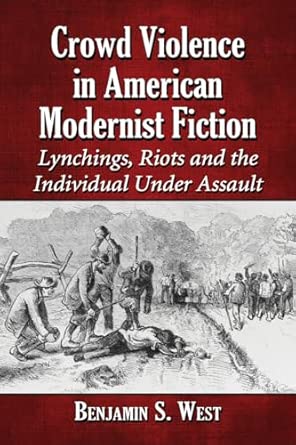
Crowd Violence in American Modernist Fiction: Lynchings, Riots and the Individual Under Assault

Crowd Violence in American Modernist Fiction: Lynchings, Riots and the Individual Under Assault book cover

Crowd Violence in American Modernist Fiction: Lynchings, Riots and the Individual Under Assault

Author(s): Benjamin S. West (Author)

  • Publisher: McFarland & Co
  • Publication Date: 15 April 2013
  • Language: English
  • Print length: 200 pages
  • ISBN-10: 0786471085
  • ISBN-13: 9780786471089

Book Description

This study explores numerous depictions of crowd violence, literal and figurative, found in American Modernist fiction, and shows the ways crowd violence is used as a literary trope to examine issues of racial, gender, national, and class identity during this period. Modernist writers consistently employ scenes and images of crowd violence to show the ways such violence is used to define and enforce individual identity in American culture. James Weldon Johnson, William Faulkner, Richard Wright, Ernest Hemingway, F. Scott Fitzgerald, and John Steinbeck, for example, depict numerous individuals as victims of crowd violence and other crowd pressures, typically because they have transgressed against normative social standards. Especially important is the way that racially motivated lynching, and the representation of such lynchings in African American literature and culture, becomes a noteworthy focus of canonical Modernist fiction composed by white authors.

Editorial Reviews

From the Back Cover

This study explores numerous depictions of crowd violence, literal and figurative, found in American Modernist fiction, and shows the ways crowd violence is used as a literary trope to examine issues of racial, gender, national, and class identity during this period. Modernist writers consistently employ scenes and images of crowd violence to show the ways such violence is used to define and enforce individual identity in American culture. James Weldon Johnson, William Faulkner, Richard Wright, Ernest Hemingway, F. Scott Fitzgerald, and John Steinbeck, for example, depict numerous individuals as victims of crowd violence and other crowd pressures, typically because they have transgressed against normative social standards. Especially important is the way that racially motivated lynching, and the representation of such lynchings in African American literature and culture, becomes a noteworthy focus of canonical Modernist fiction composed by white authors.
About the Author

Benjamin S. West is an assistant professor of English at the State University of New York at Delhi. He lives in Franklin, New York.

View on Amazon

电子书代发PDF格式价格30我要求助
未经允许不得转载:Wow! eBook » Crowd Violence in American Modernist Fiction: Lynchings, Riots and the Individual Under Assault