Wow! eBook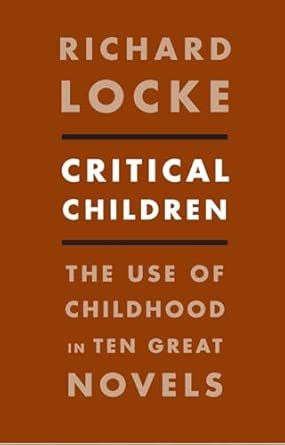
Critical Children: The Use of Childhood in Ten Great Novels First Edition
Author(s): Richard Locke (Author)
- Publisher: Columbia University Press
- Publication Date: 1 Aug. 2011
- Edition: First Edition
- Language: English
- Print length: 224 pages
- ISBN-10: 0231157827
- ISBN-13: 9780231157827
Book Description
Editorial Reviews
Review
Brilliant… Everyone… will be affected by Locke’s love for the works he discusses. His commentary sends you rushing back to the original novels, eager to reread them and do your own interpreting.–Irish Times
Highly recommended.–Choice
Richard Locke succeeds in giving a fresh mythic quality to the prismlike insights of Dickens, Twain, James, Barrie, Salinger, Nabokov, and Roth (with a nod to the other Roth, Henry)…. His chapters on Dickens and Barrie are outstanding; and Locke may be the first to detect the effect of seventeenth-century scholar Sir Thomas Browne on Holden Caulfield.–Publishers Weekly (starred review)
Critical Children is a fine example of literary criticism at its most sensitive and probing and hearteningly reminds us that the criticism of fiction is still possible and worth doing.–William H. Pritchard, author of Frost: A Literary Life Reconsideredincisive and entertaining….–Frank Cottrell Boyce “Wall Street Journal “
Deep, acute, skillful, responsive, and determined to get into these ten famous novels whose exteriors are so glistening, Richard Locke’s
Critical Children is a major instance of active literary criticism in our moment.–Richard Howard, author of Without SayingRichard Locke has done a remarkable job. His criticism operates at a very high level of engagement with the text, pulling into play a wide range of associations and intellectual focus that is rare and exhilarating.–Jay Parini, author of
Promised Land: Thirteen Books That Changed AmericaUsing the portrayal of childhood as his eye-opening theme and total immersion as his critical method, Richard Locke brilliantly reexamines classic novels we complacently thought we understood. He enlarges and freshens our insight into modern works by Salinger, Nabokov, and Philip Roth by placing them in a line that reaches back to masterpieces by Dickens and Twain. This is an intense, subtle, elegantly written, and exceptionally illuminating work.–Morris Dickstein, author of
Dancing in the Dark: A Cultural History of the Great DepressionWhile remaining sensitive to the historical and cultural specificity of texts, Locke celebrates these novels; he subjects character to the closest of close readings; he immerses himself and revels in the words on the page.–Amber K. Regis “Times Literary Supplement “