Critical Analysis of Science Textbooks: Evaluating instructional effectiveness 2013th Edition

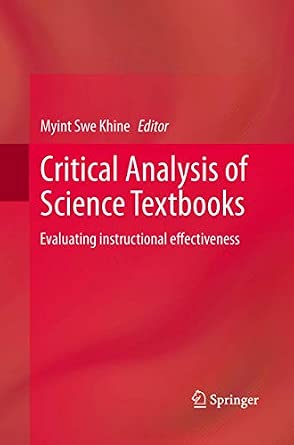
Critical Analysis of Science Textbooks: Evaluating instructional effectiveness 2013th Edition book cover

Critical Analysis of Science Textbooks: Evaluating instructional effectiveness 2013th Edition

Author(s): Myint Swe Khine

  • Publisher: Springer
  • Publication Date: 14 July 2015
  • Edition: 2013th
  • Language: English
  • Print length: 319 pages
  • ISBN-10: 9400794215
  • ISBN-13: 9789400794214

Book Description

The critical analysis of science textbooks is vital in improving teaching and learning at all levels in the subject, and this volume sets out a range of academic perspectives on how that analysis should be done. Each chapter focuses on an aspect of science textbook appraisal, with coverage of everything from theoretical and philosophical underpinnings, methodological issues, and conceptual frameworks for critical analysis, to practical techniques for evaluation.

Contributions from many of the most distinguished scholars in the field give this collection its sure-footed contemporary relevance, reflecting the international standards of UNESCO as well as leading research organizations such as the American Association for the Advancement of Science (whose Project 2061 is an influential waypoint in developing protocols for textbook analysis). Thus the book shows how to gauge aspects of textbooks such as their treatment of controversial issues, graphical depictions, scientific historiography, vocabulary usage, accuracy, and readability. The content also covers broader social themes such as the portrayal of women and minorities.

“Despite newer, more active pedagogies, textbooks continue to have a strong presence in classrooms and to embody students’ socio-historical inheritance in science. Despite their ubiquitous presence, they have received relatively little on-going empirical study. It is imperative that we understand how textbooks influence science learning. This book presents a welcome and much needed analysis.”

Tina A. Grotzer
Harvard University, Cambridge, Massachusetts, USA

The present book provides a much needed survey of the current state of research into science textbooks, and offers a widerange of perspectives to inform the ‘science’ of writing better science textbooks.

Keith S Taber
University of Cambridge, Cambridge, United Kingdom

Editorial Reviews

Review

From the book reviews:

“This edited book brings together a diverse collection of chapters, each concerned in some sense with analyzing science textbooks. … For authors, publishers and adopters of science textbooks this could be an important collection of papers. The contributions here offer many useful insights for those selecting a textbook for student use, and should be required reading for all science textbook authors.” (Keith S. Taber, Teacher Development, December, 2014)

“Critical analysis of science textbooks enlightens readers about how textbook analysis is a very rich domain to investigate and how textbooks influence science teaching and learning processes. … Although this book is aimed at researchers who study textbook analysis, I found it useful for science teachers and textbook authors as well.” (Canan Nakiboğlu, Education in Chemistry, March, 2014)

From the Back Cover

The critical analysis of science textbooks is vital in improving teaching and learning at all levels in the subject, and this volume sets out a range of academic perspectives on how that analysis should be done. Each chapter focuses on an aspect of science textbook appraisal, with coverage of everything from theoretical and philosophical underpinnings, methodological issues, and conceptual frameworks for critical analysis, to practical techniques for evaluation.

Contributions from many of the most distinguished scholars in the field give this collection its sure-footed contemporary relevance, reflecting the international standards of UNESCO as well as leading research organizations such as the American Association for the Advancement of Science (whose Project 2061 is an influential waypoint in developing protocols for textbook analysis). Thus the book shows how to gauge aspects of textbooks such as their treatment of controversial issues, graphical depictions, scientific historiography, vocabulary usage, accuracy, and readability. The content also covers broader social themes such as the portrayal of women and minorities.

“Despite newer, more active pedagogies, textbooks continue to have a strong presence in classrooms and to embody students’ socio-historical inheritance in science. Despite their ubiquitous presence, they have received relatively little on-going empirical study. It is imperative that we understand how textbooks influence science learning. This book presents a welcome and much needed analysis.”

Tina A. Grotzer

Harvard University, Cambridge, Massachusetts, USA

“The present book provides a much needed survey of the current state of research into science textbooks, and offers a wide range of perspectives to inform the ‘science’ of writing better science textbooks.”

Keith S Taber
University of Cambridge, Cambridge, United Kingdom

View on Amazon

电子书代发PDF格式价格30我要求助
未经允许不得转载:Wow! eBook » Critical Analysis of Science Textbooks: Evaluating instructional effectiveness 2013th Edition