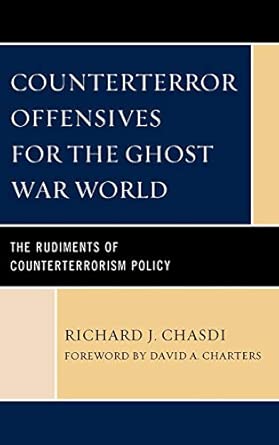
Counterterror Offensives for the Ghost War World: The Rudiments of Counterterrorism Policy
Author(s): Richard J. Chasdi (Author)
Publisher: Lexington Books (UK)
Publication Date: 16 Sept. 2010
Language: English
Print length: 908 pages
ISBN-10: 0739107941
ISBN-13: 9780739107942
Book Description
In Counterterror Offensives for the Ghost War World: The Rudiments of Counterterrorism Policy, Richard J. Chasdi has written a groundbreaking quantitative analysis that provides new insight into which types of counterterror practices work best and which types perform poorly in particular operational environments and circumstances. For Chasdi, effectiveness is defined as the capacity of counterterror practices to work with stealth-namely, without eliciting high amounts of related follow-up terrorist assaults. He moves beyond individual country analyses to tackle an analysis of counterterror practice effectiveness based on the type of political system of the country carrying out counterterror offensives and the power level of that country within the international political system. Chasdi furthermore provides essential qualitative descriptions of national security institutions, stakeholders, and processes to frame his quantitative results in ways that tie those findings to historical and contemporary political developments.
Editorial Reviews
Review
Dr. Richard J. Chasdi’s most recent book, Counterterror Offensives for the Ghost World War, provides a historical and analytical look at patterns, relationships, and effectiveness in counterterror practice. Chasdi’s well-researched, 877-page effort provides several significant theoretical and analytical contributions. Bottom line: the text is both a good read and reference. … Counterterror provides an excellent basis for analysis and is in itself a sufficient reason to read this text. … Counterterror provides a deluge of descriptive and inferential statistics in the form of frequency tables, bar graphs, contingency table analysis, and negative binomial regression models. The vast majority of the book is dedicated to the presentation and discussion of these results, making it mostly a quantitative contribution. … In balance, Dr. Chasdi provides three major contributions in Counterterror. He provides a conceptual framework that makes sense. He provides detailed statistical analysis that is useful to both modeling and understanding counterterror considerations. And he provides reasonable analysis of interactions and relationships among factors. In balance, the text is a worthwhile read and reference.
Richard J. Chasdi’s Counterterror Offensives for the Ghost War World is an intense read….It should serve to generate further research in striving to produce a metrics that benefits U.S. foreign policy and counterterrorism strategies in future environments by having studied a range of past efforts. To this end, Chasdi must be commended.
Chasdi”s work deserves praise and it is up to others to offer similarly detailed data-based accounts of post-9/11 counterterrorism practices. It is indeed striking that one decade since 9/11, this is still one of the first genuine empirical attempts to figure what ”works” in the fight against terrorism.
Rigorous measurement of the effectiveness of counter-terrorist measures has so far been elusive. No longer―thanks to Professor Chasdi”s innovative empirical study, we now know what works and what doesn”t. A remarkable breakthrough with profound policy implications. — Alex P. Schmid, Terrorism Research Initiative, Vienna
Chasdi”s book identifies critical issues for consideration and provides previously unavailable empirical support for integrated counterterrorist policy initiatives. It is full of unexpected insights regarding the success of less aggressive counterterrorist actions, the importance of context-specific explanatory factors in different operational environments, and the broader link between political reform and collaborative counterterror policy efforts. Policy makers should heed his advice on the importance of tailoring counterterrorist policies to the specific geographical locations at issue. — Richard Weitz, Center for Political-Military Analysis, Hudson Institute
About the Author
Richard J. Chasdi is associate professor in the Department of Management at Walsh College.
 Wow! eBook