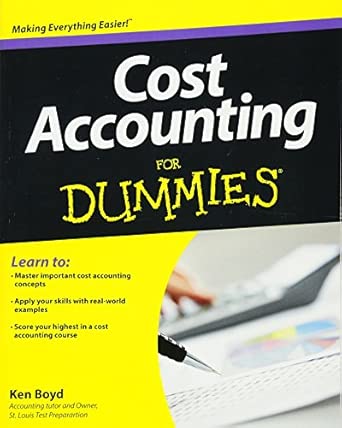
Critical in supporting strategic business decisions and improving profitability, cost accounting is arguably one of the most important functions in the accounting field. For business students, cost accounting is a required course for those seeking an accounting degree and is a popular elective among other business majors.
Cost Accounting For Dummies tracks to a typical cost accounting course and provides in-depth explanations and reviews of the essential concepts you’ll encounter in your studies: how to define costs as direct materials, direct labor, fixed overhead, variable overhead, or period costs; how to use allocation methodology to assign costs to products and services; how to evaluate the need for capital expenditures; how to design a budget model that forecast changes in costs based on expected activity levels; and much more.
Tracks to a typical cost accounting course
Includes practical, real-world examples
Walks you though homework problems with detailed, easy-to-understand answers
If you’re currently enrolled in a cost accounting course, this hands-on, friendly guide gives you everything you need to master this critical aspect of accounting.
Editorial Reviews
From the Inside Flap
Learn to:
Master important cost accounting concepts
Apply your skills with real-world examples
Score your highest in a cost accounting course
Get a grip on cost accounting? Easy.
Cost Accounting For Dummies tracks to a typical cost accounting course and provides in-depth explanations and reviews of the essential concepts you’ll encounter in your studies: how to define costs as direct materials, direct labor, fixed overhead, variable overhead, or period costs; how to use allocation methodology to assign costs to products and services; how to evaluate the need for capital expenditures; how to design a budget model that forecasts changes in costs based on expected activity levels; and more.
Cost Accounting 101 find out how cost accounting relates to other areas of accounting, which types of costs are most important, and step-by-step explanations on cost-volume-profit and activity-based costing
Plan for it take a stroll through the budgeting process, analyze the differences between your budget and actual results using variances, and get the lowdown on overhead costs
Make good decisions get the scoop on cost drivers and how they determine product price to make good decisions in running a business
Take action discover how to allocate costs, analyze business profitability, use shared resources, and more
Open the book and find:
Cost accounting terms and their purposes
How to use cost-volume-profit analysis
The hows and whats of activity-based costing
Why budgeting is important
The concept of relevance in cost accounting
Considerations for process costing
How to search for measures of quality
From the Back Cover
Learn to:
Master important cost accounting concepts
Apply your skills with real-world examples
Score your highest in a cost accounting course
Get a grip on cost accounting? Easy.
Cost Accounting For Dummies tracks to a typical cost accounting course and provides in-depth explanations and reviews of the essential concepts you’ll encounter in your studies: how to define costs as direct materials, direct labor, fixed overhead, variable overhead, or period costs; how to use allocation methodology to assign costs to products and services; how to evaluate the need for capital expenditures; how to design a budget model that forecasts changes in costs based on expected activity levels; and more.
Cost Accounting 101 find out how cost accounting relates to other areas of accounting, which types of costs are most important, and step-by-step explanations on cost-volume-profit and activity-based costing
Plan for it take a stroll through the budgeting process, analyze the differences between your budget and actual results using variances, and get the lowdown on overhead costs
Make good decisions get the scoop on cost drivers and how they determine product price to make good decisions in running a business
Take action discover how to allocate costs, analyze business profitability, use shared resources, and more
Open the book and find:
Cost accounting terms and their purposes
How to use cost-volume-profit analysis
The hows and whats of activity-based costing
Why budgeting is important
The concept of relevance in cost accounting
Considerations for process costing
How to search for measures of quality
About the Author
Ken Boyd is a former CPA with over 27 years of experience in accounting, education, and financial services. Ken is the owner of St. Louis Test Preparation (www.stltest.net). He provides online tutoring in accounting and finance to both undergraduate and graduate students.
 Wow! eBook