MacLean and Ahmed are to be commended for bringing together such a wide range of scholarship under the same theoretical umbrella. — Ian Campbell, Georgia State University ― Middle East Media and Book Reviews
Cosmopolitanisms in Muslim Contexts exceeds all previous efforts to address the intersection of Islam and cosmopolitan norms, values and options. Against the backdrop of Islamicate civilization and contemporary global challenges, its contributors accent cosmopolitanism as both a political ideal and a social practice in several contexts. At last one can, and does, grasp the critical cosmopolitan element of the Muslim world throughout the Afro-Eurasian ecumene. — Professor Bruce B. Lawrence, Author of The Qur’an – A Biography
Cosmopolitanisms in Muslim Contexts exceeds all previous efforts to address the intersection of Islam and cosmopolitan norms, values and options. Against the backdrop of Islamicate civilization and contemporary global challenges, its contributors accent cosmopolitanism as both a political ideal and a social practice in several contexts. At last one can, and does, grasp the critical cosmopolitan element of the Muslim world throughout the Afro-Eurasian ecumene. — Professor Bruce B. Lawrence, Author of The Qur’an- A Biography
From the Back Cover
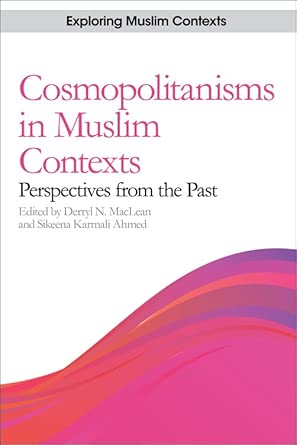
AUTHOR APPROVEDEstablished in London in 2002, the Aga Khan University, Institute for the Study of Muslim Civilisations aims to strengthen research and teaching about the heritages of Muslim societies as they have evolved over time, and to examine the challenges these societies face in today’s globalised world. It also seeks to create opportunities for interaction among academics, traditionally trained scholars, innovative thinkers and leaders, in an effort to promote dialogue and build bridges.Exploring Muslim ContextsSeries Editor: Abdou Filali-AnsaryThis series seeks to address salient and urgent issues faced by Muslim societies as they evolve in a rapidly globalising world. It brings together the scholarship of leading specialists from various academic fields, representing a wide range of theoretical and practical perspectives.Cosmpolitanisms in Muslim ContextsPerspectives from the PastEdited by Derryl N. MacLean and Sikeena Karmali Ahmed’/Cosmopolitanisms in Muslim Contexts/ exceeds all previous efforts to address the intersection of Islam and cosmopolitan norms, values and options. Against the backdrop of Islamicate civilization and contemporary global challenges, its contributors accent cosmopolitanism as both a political ideal and a social practice in several contexts. At last one can, and does, grasp the critical cosmopolitan element of the Muslim world throughout the Afro-Eurasian ecumene.’Bruce B. Lawrence, Marcus Family Professor of Humanities and Professor of Islamic Studies Emeritus, Duke UniversityCosmopolitanism has become a key concept in social and political thought, standing in opposition to ideologies such as nationalism, parochialism, and fundamentalism. Much recent discussion of this concept has been situated within contemporary Western self-perceptions, with little inclusion of information from historical Muslim contexts. This volume redresses the balance by focusing attention on instances in modern world history where cosmopolitan ideas and practices pervaded specific Muslim societies and cultures.Derryl N. MacLean is Director of the Centre for the Comparative Study of Muslim Societies and Cultures and Associate Professor in the Department of History at Simon Fraser University, Canada.Sikeena Karmali Ahmed is Manager of Publications at the Aga Khan University, Institute for the Study of Muslim Civilisations.
About the Author
Derryl N. MacLean is Director of the Centre for the Comparative Study of Muslim Societies and Cultures, and Associate Professor in the Department of History at Simon Fraser University, Canada. Sikeena Karmali Ahmed is Manager of Publications at Aga Khan University Institute for the Study of Muslim Civilisations.
 Wow! eBook