 Wow! eBook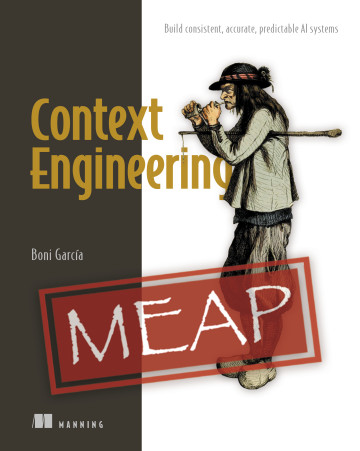
Context Engineering: Build consistent, accurate, predictable AI systems
Author(s): Boni García (Author)
- Publisher: Manning
- Publication Date: MEAP began June 2026 Last updated August 2026 Publication in Fall 2026 (estimated)
- Language: English
- Print length: 169 pages
- ISBN-13: 9781633434257
Book Description
The responses from large language models (LLMs) are more accurate, consistent, and explainable when you provide specific relevant information, or context, to support your prompts. Context engineering is the discipline of selecting, organizing, updating, compressing, and prioritizing the precise context a model needs to generate accurate responses. This book shows you how to combine well-designed prompts with smart search, content filtering, and advanced RAG techniques incorporating many types of stored data to create reliable responses in your AI applications.
Because context engineering is typically implemented programmatically, automation is essential as applications evolve from simple prompts to workflows, agents, and agentic systems. Context engineering is particularly critical with the rise of autonomous agents and context windows that can take in a million or more tokens. Irrelevant or poorly selected context raises the chance of hallucinations, brittle agents, and unpredictable outputs. In Context Engineering, author Boni García helps you design an AI’s information environment with the same rigor as your codebase. It unifies every part of the context stack—including RAG, memory, and harness engineering—into one coherent discipline.
The book takes you hands on with the entire context engineering stack. You’ll learn how to use tools such as DSPy, LangChain, CrewAI, and LlamaIndex to build context-aware AI applications with frontier models from OpenAI, Anthropic, and Google. Because each chapter builds intuition first and ends with a practical hands-on section grounded in real tools, you’ll come away thinking like a system designer who knows exactly what enters the context window, what stays out, what gets retrieved just in time, and what becomes persistent memory or state.
brief contents
1 Introduction to context engineering
2 Instructions in AI agents
3 External knowledge and retrieval
4 Tools in AI agents
5 Memory and state in agentic systems
6 User prompts for LLMs
7 Context management and orchestration
8 Evaluation and observability
9 Governance and operations
10 AI frameworks for context engineering
11 Context engineering for software development
12 State of the art on context engineering
Appendix A. The AI Ecosystem
Appendix B. References and further reading


