Wow! eBook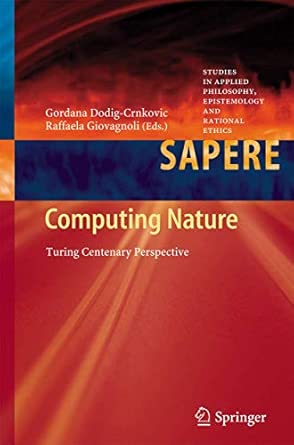
Computing Nature: Turing Centenary Perspective: 7 2013th Edition
Author(s): Gordana Dodig-Crnkovic (Editor), Raffaela Giovagnoli
- Publisher: Springer
- Publication Date: 6 April 2013
- Edition: 2013th
- Language: English
- Print length: 275 pages
- ISBN-10: 9783642372247
- ISBN-13: 3642372244
Book Description
This book is about nature considered as the totality of physical existence, the universe, and our present day attempts to understand it. If we see the universe as a network of networks of computational processes at many different levels of organization, what can we learn about physics, biology, cognition, social systems, and ecology expressed through interacting networks of elementary particles, atoms, molecules, cells, (and especially neurons when it comes to understanding of cognition and intelligence), organs, organisms and their ecologies?
Regarding our computational models of natural phenomena Feynman famously wondered: “Why should it take an infinite amount of logic to figure out what one tiny piece of space/time is going to do?” Phenomena themselves occur so quickly and automatically in nature. Can we learn how to harness nature’s computational power as we harness its energy and materials?
This volume includes a selection of contributions from the Symposium on Natural Computing/Unconventional Computing and Its Philosophical Significance, organized during the AISB/IACAP World Congress 2012, held in Birmingham, UK, on July 2-6, on the occasion of the centenary of Alan Turing’s birth. In this book, leading researchers investigated questions of computing nature by exploring various facets of computation as we find it in nature: relationships between different levels of computation, cognition with learning and intelligence, mathematical background, relationships to classical Turing computation and Turing’s ideas about computing nature – unorganized machines and morphogenesis. It addresses questions of information, representation and computation, interaction as communication, concurrency and agent models; in short this book presents natural computing and unconventional computing as extension of the idea of computation as symbolmanipulation.
Editorial Reviews
From the Back Cover
This book is about nature considered as the totality of physical existence, the universe, and our present day attempts to understand it. If we see the universe as a network of networks of computational processes at many different levels of organization, what can we learn about physics, biology, cognition, social systems, and ecology expressed through interacting networks of elementary particles, atoms, molecules, cells, (and especially neurons when it comes to understanding of cognition and intelligence), organs, organisms and their ecologies?
Regarding our computational models of natural phenomena Feynman famously wondered: “Why should it take an infinite amount of logic to figure out what one tiny piece of space/time is going to do?” Phenomena themselves occur so quickly and automatically in nature. Can we learn how to harness nature’s computational power as we harness its energy and materials?
This volume includes a selection of contributions from the Symposium on Natural Computing/Unconventional Computing and Its Philosophical Significance, organized during the AISB/IACAP World Congress 2012, held in Birmingham, UK, on July 2-6, on the occasion of the centenary of Alan Turing’s birth. In this book, leading researchers investigated questions of computing nature by exploring various facets of computation as we find it in nature: relationships between different levels of computation, cognition with learning and intelligence, mathematical background, relationships to classical Turing computation and Turing’s ideas about computing nature – unorganized machines and morphogenesis. It addresses questions of information, representation and computation, interaction as communication, concurrency and agent models; in short this book presents natural computing and unconventional computing as extension of the idea of computation as symbolmanipulation.