 Wow! eBook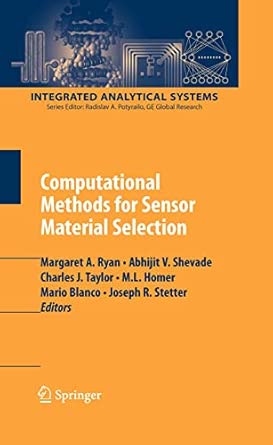
Computational Methods for Sensor Material Selection 2010th Edition
Author(s): Margaret A. Ryan (Editor), Abhijit V. Shevade (Editor), Charles J. Taylor (Editor), M. L. Homer (Editor), Mario Blanco (Editor), Joseph R. Stetter (Editor)
- Publisher: Springer
- Publication Date: 16 Oct. 2009
- Edition: 2010th
- Language: English
- Print length: 334 pages
- ISBN-10: 9780387737140
- ISBN-13: 9780387737140
Book Description
Chemical vapor sensing arrays have grown in popularity over the past two decades, finding applications for tasks such as process control, environmental monitoring, and medical diagnosis. This is the first in-depth analysis of the process of choosing materials and components for these “electronic noses”, with special emphasis on computational methods. For a view of component selection with an experimental perspective, readers may refer to the complementary volume of Integrated Microanalytical Systems entitled “Combinatorial Methodologies for Sensor Materials.”
Editorial Reviews
Review
From the reviews:
“The book is written in a comprehensible manner. Each chapter contains descriptive examples. After a short introduction, the book gives very detailed information about scientific issues in each topic. Besides quantum mechanical principles, statistical approaches are covered as well. Therefore, all important topics for selecting sensing materials for chemical vapor sensing are covered. Owing to this excellent collection, the book is recommended for all scientists working on chemical vapor sensing.” (Felix Kolarov, Analytical and Bioanalytical Chemistry, Vol. 397, May, 2010)
From the Back Cover
In Computational Methods for Sensor Material Selection 2010th Edition, experts discuss the design and selection of active sensing surfaces for chemical sensors, particularly sensors used in vapor sensing arrays or electronic noses.
Part I covers first principles.
Part II focuses on identifying and evaluating candidate sensing materials and covers such topics as calculations of sensor-analyte interactions, statistical and semi-empirical methods based on characteristics of sensing material and analyte, and new experimental methods.
Part III advises on selecting materials for inclusion in arrays by use of statistical methods and algorithm-based methods for evaluating the array response to target analytes.
This book will appeal to researchers in academia and industry involved in chemical vapor sensing and monitoring. Also, it will be of special interest to those who are developing devices based on chemical sensing arrays.


