Wow! eBook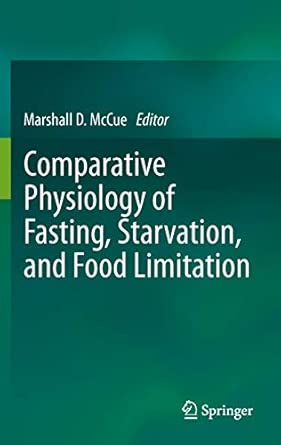
Comparative Physiology of Fasting, Starvation, and Food Limitation 2012th Edition
Author(s): Marshall D. McCue
- Publisher: Springer
- Publication Date: 18 May 2012
- Edition: 2012th
- Language: English
- Print length: 444 pages
- ISBN-10: 3642290558
- ISBN-13: 9783642290558
Book Description
Editorial Reviews
From the Back Cover
All animals face the possibility of food limitation and ultimately starvation-induced mortality. This book summarizes state of the art of starvation biology from the ecological causes of food limitation to the physiological and evolutionary consequences of prolonged fasting. It is written for an audience with an understanding of general principles in animal physiology, yet offers a level of analysis and interpretation that will engage seasoned scientists. Each chapter is written by active researchers in the field of comparative physiology and draws on the primary literature of starvation both in nature and the laboratory. The chapters are organized among broad taxonomic categories, such as protists, arthropods, fishes, reptiles, birds, and flying, aquatic, and terrestrial mammals including humans; particularly well-studied animal models, e.g. endotherms are further organized by experimental approaches, such as analyses of blood metabolites, stable isotopes, thermobiology, and modeling of body composition.
About the Author
All animals face the possibility of food limitation and ultimately starvation-induced mortality. This book summarizes state of the art of starvation biology from the ecological causes of food limitation to the physiological and evolutionary consequences of prolonged fasting. It is written for an audience with an understanding of general principles in animal physiology, yet offers a level of analysis and interpretation that will engage seasoned scientists. Each chapter is written by active researchers in the field of comparative physiology and draws on the primary literature of starvation both in nature and the laboratory. The chapters are organized among broad taxonomic categories, such as protists, arthropods, fishes, reptiles, birds, and flying, aquatic, and terrestrial mammals including humans; particularly well-studied animal models, e.g. endotherms are further organized by experimental approaches, such as analyses of blood metabolites, stable isotopes, thermobiology, and modeling of body composition.