 Wow! eBook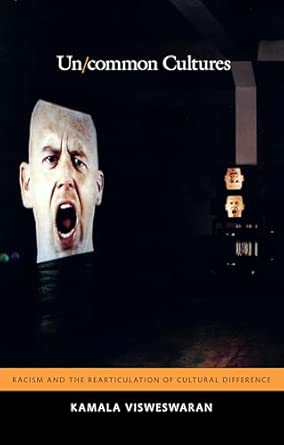
Un/common Cultures: Racism and the Rearticulation of Cultural Difference
Author(s): Kamala Visweswaran (Author)
- Publisher: Duke University Press
- Publication Date: 19 July 2010
- Language: English
- Print length: 360 pages
- ISBN-10: 0822346214
- ISBN-13: 9780822346210
Book Description
Editorial Reviews
Review
“Visweswaran’s project is challenging and important in confronting the ways in which cultural difference has been, and is, used as a substitute for broader issues of inequality, exclusion, and racial discrimination. . . .
Un/Common Cultures provides a crucial and welcome challenge to the discipline’s airbrushed colonial heritages and selective amnesia, and a broader provocation to rethink the consequences of culture-thought and culture-talk in the contemporary world.”–Claire Alexander “Ethnic and Racial Studies”“
Un/common Cultures is a profound and important book, a major intervention in cultural studies, anthropology, and feminist and South Asian studies. It has all the hallmarks of Kamala Visweswaran’s work–impeccable scholarship and a keen sense of purpose that is both activist and intellectual.”–R. Radhakrishnan, author of History, the Human, and the World Between“In
Un/common Cultures Kamala Visweswaran provides an acute, historically informed diagnosis of the relative weakness of the culture concept so central to American anthropology, and a provocative and fascinating explanation of why, during the past two decades, other fields and interdisciplinary arenas have developed more cogent critiques of culture. This first-rate book will be read widely and generate much discussion.”–George E. Marcus, co-author of Designs for an Anthropology of the ContemporaryFrom the Back Cover
About the Author
Kamala Visweswaran is Associate Professor of Anthropology and Asian Studies at the University of Texas, Austin. She is the author of Fictions of Feminist Ethnography.
Excerpt. © Reprinted by permission. All rights reserved.
Un/common Cultures
RACISM AND THE REARTICULATION OF CULTURAL DIFFERENCEBy KAMALA VISWESWARAN
Duke University Press
Copyright © 2010 Duke University Press
All right reserved.
ISBN: 978-0-8223-4621-0
Contents
ACKNOWLEDGMENTS………………………………………………………………………………………………………ixINTRODUCTION Un/common Cultures: Racism and the Rearticulation of Cultural Difference………………………………………..11. Wild West Anthropology and the Disciplining of Gender………………………………………………………………….182. Race and the Culture of Anthropology…………………………………………………………………………………523. The Interventions of Culture: Claude Lvi-Strauss and the Internationalization of the Modern Concept of Race…………………744. Is There A Structural Analysis of Racism? Louis Dumont and the Caste School of Race Relations………………………………1035. India in South Africa: Counter-genealogies for a Subaltern Sociology…………………………………………………….1316. Legacies of Culture, Languages of the State…………………………………………………………………………..1647. Gendered States: Rethinking Culture as a Site of South Asian Human-Rights Work……………………………………………189EPILOGUE The Traffic in Social Movements: Narmada, Bhopal, Texas…………………………………………………………..213NOTES……………………………………………………………………………………………………………….227BIBLIOGRAPHY…………………………………………………………………………………………………………283INDEX……………………………………………………………………………………………………………….319
Chapter One
“Wild West” Anthropology and the Disciplining of Gender
While we were in Boston in 1879, a lady told me that after studying ethnology for years in books and museums she now wished to visit Indian tribes in their own lodges, living as they lived and observing their daily customs herself-especially the women’s and children’s ways. “Did you ever camp out?” I asked. “No, never.” I found it hard to take her plan seriously. She, a thorough product of city life, was evidently nearing her forties. I could not imagine her leaving all her home comforts to go out to the far frontier and live among the Indians in an Indian lodge. Still, she was so earnest that I reluctantly agreed to take her someday with our group for the trip she wished. But I gave her fair warning: “You can’t stand such a trip. You’ll have to sleep on the cold ground. The food will be strange to you. You’ll meet storms on the open prairies and be wet to the skin. Burning sun and wind will blister your face and hands. Long days of travelling will exhaust you. You’ll have no privacy night or day. I’m sure you can never endure it.” “Yes I can!” she insisted.
The image of tender womanhood scourged by the wilderness of the western frontier was perhaps one of the most potent underlying the ideological structure of “manifest destiny.” Stereotypes of the courageous frontier woman notwithstanding, the idea that the West was “no place for a woman” defined the skepticism “pioneer” anthropologists like Alice Fletcher faced from more experienced field companions like Henry Tibbles, as illustrated in his account above.
Yet the first generation of women anthropologists contributed much to destabilizing the trope of “white woman in peril,” even as its persistence enabled the popularization of their writing and established their reputations as professionals. If strands of progressivist feminism promulgated by the Women’s Christian Temperance Union (WCTU) were defined by the mission of “taming” unruly frontier masculinity through appeals to Christian notions of domesticity and familial responsibility, early women anthropologists also participated in the ideology of the western frontier by characterizing native cultures as “wild” and “untamed” by civilization-a kind of feminine counterpart to Rooseveltian “rough-riderism.”
Anthropology has been called “the welcoming science” because of the numbers of women in its early ranks. Yet while the presence of women like Erminnie Platt Smith (1836-86), Alice Fletcher (1838-1923), Sara Yorke Stevenson (1847-1921), Matilda Cox Stevenson (1849-1915), Zelia Nuttal (1857-1933), Frances Densmore (18671957), and Elsie Clews Parsons (1874-1941) in anthropology has often been remarked, their significance for the emergence of the discipline has been less well understood.
Platt Smith, Fletcher, Yorke Stevenson, Parsons, and Densmore were all known as engaging and popular public speakers. Platt Smith’s parlor lectures on geology and on literary and aesthetic topics led to the founding of the Daughters of Aesthetics in Jersey City in 1879, and she served as its president from 1879 to 1886. The New York Times of 29 August 1880, reporting on one of her Iroquois lectures, noted, “Mrs. Smith is not only a good writer, well-known in literary and scientific circles in New York, Boston, and other cities[,] but also an eloquent speaker … and is deeply interested in the results of scientific investigation.” Fletcher’s work with the Omaha began in 1879, when she met long-term collaborator Francis La Flesche at a meeting of the Boston Literary Society. After years of philanthropical work, Fletcher began her professional career as an independent lecturer in order to earn money, speaking on such popular topics as “the lost peoples of America.” By 1879 she had received attention as the “noted lecturess of New York City” who “tells a wonderful story and tells it well” with a “pleasing voice and attractive manner.” She drew the attention of Frederick Putnam, and by 1880 he was inviting her audiences to tour the Peabody Museum at Harvard University. Women, then, were instrumental in bringing anthropology into the public sphere.
The 1880s thus also witnessed marked redefinition of avenues of public participation for women, of which anthropology was but one. The liberal evolutionist Edward Tylor, addressing the Anthropological Society of Washington in 1884, had similarly argued that “the man of the house, though he can do a great deal, cannot do it all. If his wife sympathizes with his work, and is able to do it, really half the work of investigation seems to me to fall to her, so much is to be learned through the women of the tribe, which the men will not readily disclose.” Speaking in particular of Matilda Cox Stevenson’s collaboration with her husband, Tylor concluded that it was a lesson “not to sound the ‘bullroarer,’ and warn the ladies off from their proceedings, but rather to avail themselves thankfully of their help.”
Tylor’s advice to the Anthropological Society of Washington was not immediately heeded, however. Thus, in 1885 Cox Stevenson established the Women’s Anthropological Society, with Fletcher and Zelia Nuttal among its first members. The Women’s Anthropological Society concerned itself with social-reform issues such as slum sanitation and the “Negro problem.” Fletcher served as the society’s vice president in 1885, and as its president from 1893 to 1898. The Anthropological Society of Washington finally admitted women to its membership in 1899, and after that date women seem to have been fully integrated into anthropological organizations, for there is no further mention of the Women’s Anthropological Society. Fletcher became president of the Anthropological Society of Washington in 1903, a year after she had been the only woman among the forty founding members of the American Anthropological Association.
Despite an early record of exclusion from organizations like the Anthropological Society of Washington, women like Fletcher were also prominent members and officers of the leading scientific organizations of the era, and central to institution building within the discipline. Platt Smith, Nuttal, Yorke Stevenson, and Parsons were independently wealthy and able to fund their own work, but they were also major patrons of early anthropological research. Although only two of these women possessed doctorates, and none were formally trained as anthropologists in an era still dominated by amateurs, all were prominent women and advanced the professionalization of the discipline in important ways. Fletcher, Nuttal, and Yorke Stevenson founded archaeological institutes that still exist today, while Platt Smith, Fletcher, and Cox Stevenson established participant observation as anthropological method contemporaneously with Franz Boas’s and Frank Cushing’s own interventions on the subject.
In rehearsing such details, I hope to dispel a common set of assumptions about the marginality of this group of women in the discipline. Anthropology as a discipline is properly the child of Progressive Era politics. To the extent that women were empowered by this set of politics as clubwomen or suffragists, they were also influential in defining what came to be known as the “reformer’s science.” Women for many years afterward were not to have as much say in the actual founding and funding of anthropological institutions as they had between 1880 and 1920.
It is commonly advanced that Franz Boas was responsible for bringing women into anthropology; however, Frederick Putnam also mentored a number of women. Yet to reduce the question of women’s participation in the field to either Putnam’s goodwill or Boas’s experience of antisemitism is to lose sight of the transformative effects of feminism in the nineteenth century. Equally problematic is the assumption that the early participation of women in the discipline led inevitably to the emergence of gender as an analytical category within anthropology; this is to lose sight of the limitations of feminism at this historical moment. Although Progressive Era women in anthropology formed close professional and personal ties to one another, the structure of male patronage meant that they did not usually advance theoretical perspectives distinct from those of their mentors, with the result that they remained complicit with dominant discourses of civilization.
Though some feminist scholars understand “gender” to be a late-twentieth-century category of analysis, the terms by which one understands its modern usage were emergent during the Progressive Era. In referring to the “disciplining of gender,” then, I point both to the ways in which gender has been schooled out of the discipline’s telling of its own history, and to the ways gender shaped Progressive Era anthropology. A particular late-nineteenth-century gender politics strongly influenced the production of the central defining feature of a professionalizing anthropology: the relativist notion of culture. I therefore attempt to understand the submergence of gender as central to the disciplinization of anthropology, and as paradoxically coeval with its emergence as a generative (rather than additive) category of analysis within the discipline. I suggest that an account of the emergence of gender as a category of analysis within the discipline has important consequences for how one understands the rise of cultural relativism in anthropology.
The emergence of gender as a category of analysis within anthropology is marked by two broad propositions, which, while linked, are not reducible to one another. Gender indicates, first, the cultural construction of sex roles, or the “social creation of ideas about appropriate roles for men and women,” and, second, the “description of social relations between the sexes,” or the marking of asymmetrical power relations between the sexes.
Gender consciousness, understood as awareness of inequality between the sexes, was indicated both by the contradictions that evolutionary theory posed to Victorian society and by nineteenth-century feminism’s engagement with Victorian social anthropology over “the woman question,” which indexed a series of debates about the nature of women’s role in society. During this era, biological sex was seen to determine the social roles of men and women. As Elizabeth Fee has demonstrated, however, the evolutionist debates on the question of matriarchal and matrilineal societies provided a challenge to the notion that men’s and women’s roles were “natural.” In response to this challenge, progressive evolutionary theory reconfirmed the high status of Victorian society; however, it did so by suggesting that its sex roles were not natural but rather the achievement of civilization.
At the same time, as Gail Bederman has shown, the notion of civilization itself was increasingly challenged by various forms of feminist and African American activism, leading to its reconsolidation as the exclusive achievement of white manhood. Women could contribute to civilization only as wives and mothers, and civilization could advance only if the doctrine of separate spheres was maintained. But if the elevated status of women had been seen as the effect of civilization, some women sought to show that they were also its cause: they were its agents not only as wives and mothers in the domestic sphere, but variously as the reformers of savage peoples or inventors of technology. On the other hand, the prominent feminist Charlotte Perkins Gilman (inspired by the work of Edward Tylor and John Lubbock) sought to reverse the equation of civilizational advancement with extreme sex differentiation by arguing that women and men alike were partners in the racial advancement of civilization.
Thus, while the revisionist idea that Victorian sex roles emerged with “civilization” pointed to a notion of gender as culturally constructed, it did not necessarily entail a feminist refusal of evolutionary racism. Rather, the racial identity of early women anthropologists could not be separated from their positioning in the field (something they themselves frequently evoked), which alternately gendered them as maternal or masculine (or, more accurately, as brokers of the masculine). White women’s unchallenged racial positioning and their participation in late American settler ideology thus worked against the identification of white women with native women and therefore against an understanding of women’s oppression as being singly or multiply derived from a transcultural patriarchy.
Here, the lack of something like “gender identification” qualifies the emergence of “woman” as a universal category. For the more civilized a society, the more highly sex differentiated it was. “Primitive” societies were thus seen to lack sex differentiation altogether, or to possess it in mere rudimentary form, prohibiting the admission of Native American and African American women into the very category of womanhood. As a result, the second proposition of gender-as an analysis of unequal relations between the sexes, shared across cultures-does not fully emerge as an epistemological category in Progressive Era anthropology. Its seeds are found in the work of Victorian women anthropologists, but it is most present in the early writings of Elsie Clews Parsons, which she characterized as “propaganda by the ethnographic method,” but which actually predate her entry into empirical anthropology, around 1915.
Nineteenth-century popular anthropology is frequently portrayed as the result of amateur participation, from which natural scientists like Franz Boas sought to distance themselves in order to professionalize the discipline. A more careful look at the emergence of the discipline in the late nineteenth century shows that popularization and professionalization were two sides of the same coin, not a case of the former existing as a stage to be superseded by the latter. Ethnological pamphlets produced at the world’s fairs and articles written for the popular press were normative rather than unique, and analysis of the writings of early women anthropologists proves it difficult to distinguish the articles that appeared in the American Anthropologist or the Journal of American Folklore from those appearing in more popular fora. I therefore want to explore how the nineteenth-century “woman question” and women’s participation at the fairs might illumine the importance of popular anthropology in ways obscured by conventional disciplinary history, which portrays the participation of Putnam, Boas, and others in the world’s fairs as a necessary evil, rather than as symptomatic of the period. For this reason, I also explore the overlapping zones of popular and scientific influence for the production of Progressive Era anthropology.
I first examine the gendering of the fieldwork ethic as a means of describing the importance of a particular kind of Wild West ethic to Progressive Era feminism and its relationship to “evangelical ethnology.” I next explore feminist participation in the “midway ethnology” of the world’s fairs. If the world’s fairs earned mass exposure for the suffragist cause, they also reaffirmed feminist participation in the imperial subtext of the expositions. The elaboration of the “woman question” in the context of the world’s fairs also set the stage for feminist engagement with the “matrilineal conundrum of evolutionary theory.” I conclude with some observations about Elsie Clews Parsons’s break from this milieu, which underscores her contribution to the emergence of gender as an analytical category in the discipline.
TURNING THE CENTURY: THE EMERGENCE OF POPULAR ETHNOGRAPHY
During the late nineteenth century and early twentieth, newspapers and journals like the Southern Workman or Century magazine provided a mass medium whereby emerging ethnography was popularized by women anthropologists in the context of westward expansion and white settler ideology. Beginning in 1882, the Century ran a series of articles on the “New Northwest” and “Indian Country,” reports on various expositions, and writings of anthropologists such as Frank Cushing, Frederick Putnam, and Alice Fletcher. Sara Yorke Stevenson’s series of five articles on the French Intervention in Mexico also appeared in the Century, in 1897, and was the basis of her book-length memoir, Maximillian in Mexico (1899).
(Continues…)
Excerpted from Un/common Culturesby KAMALA VISWESWARAN Copyright © 2010 by Duke University Press. Excerpted by permission.
All rights reserved. No part of this excerpt may be reproduced or reprinted without permission in writing from the publisher.
Excerpts are provided by Dial-A-Book Inc. solely for the personal use of visitors to this web site.


