Wow! eBook
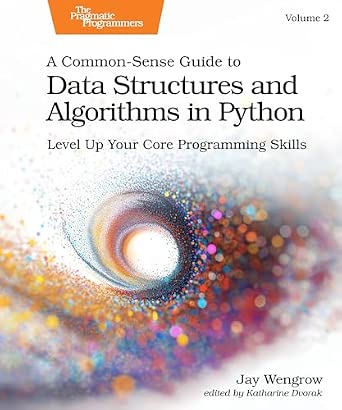
A Common-Sense Guide to Data Structures and Algorithms in Python, Volume 1: Level Up Your Core Programming Skills
Author(s): Jay Wengrow (Author)
- Publisher: Pragmatic Bookshelf
- Publication Date: January 9, 2024
- Edition: 1st
- Language: English
- Print length: 504 pages
- ISBN-10: B0CPB51GT5
- ISBN-13: 9798888650356
Book Description
If you thought data structures and algorithms were all just theory, you’re missing out on what they can do for your Python code. Learn to use Big O notation to make your code run faster by orders of magnitude. Choose from data structures such as hash tables, trees, and graphs to increase your code’s efficiency exponentially. With simple language and clear diagrams, this book makes this complex topic accessible, no matter your background. Every chapter features practice exercises to give you the hands-on information you need to master data structures and algorithms for your day-to-day work.
Algorithms and data structures are much more than abstract concepts. Mastering them enables you to write code that runs faster and more efficiently, which is particularly important for today’s web and mobile apps. Take a practical approach to data structures and algorithms, with techniques and real-world scenarios that you can use in your daily production code.
The Python edition uses Python exclusively for all code examples, exercise, and solutions.
Use Big O notation to measure and articulate the efficiency of your code, and modify your algorithm to make it faster. Find out how your choice of arrays, linked lists, and hash tables can dramatically affect the code you write. Use recursion to solve tricky problems and create algorithms that run exponentially faster than the alternatives. Dig into advanced data structures such as binary trees and graphs to help scale specialized applications such as social networks and mapping software. You’ll even encounter a single keyword that can give your code a turbo boost. Practice your new skills with exercises in every chapter, along with detailed solutions.
Use these techniques today to make your Python code faster and more scalable.
Algorithms and data structures are much more than abstract concepts. Mastering them enables you to write code that runs faster and more efficiently, which is particularly important for today’s web and mobile apps. Take a practical approach to data structures and algorithms, with techniques and real-world scenarios that you can use in your daily production code.
The Python edition uses Python exclusively for all code examples, exercise, and solutions.
Use Big O notation to measure and articulate the efficiency of your code, and modify your algorithm to make it faster. Find out how your choice of arrays, linked lists, and hash tables can dramatically affect the code you write. Use recursion to solve tricky problems and create algorithms that run exponentially faster than the alternatives. Dig into advanced data structures such as binary trees and graphs to help scale specialized applications such as social networks and mapping software. You’ll even encounter a single keyword that can give your code a turbo boost. Practice your new skills with exercises in every chapter, along with detailed solutions.
Use these techniques today to make your Python code faster and more scalable.
Editorial Reviews
About the Author
Jay Wengrow, an experienced educator and software engineer, is the founder of Actualize, an award-winning US coding bootcamp. He is passionate about simplifying the complex, and making software development more accessible by breaking the complex down into its simpler, easier parts.