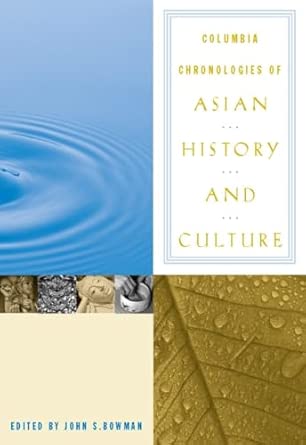
Columbia Chronologies of Asian History and Culture
Author(s): John Bowman (Author)
Publisher: Columbia University Press
Publication Date: 19 Sept. 2000
Language: English
Print length: 751 pages
ISBN-10: 0231110049
ISBN-13: 9780231110044
Book Description
Containing more information on Asian culture than any other English-language reference work, Columbia Chronologies of Asian History and Culture is the first of its kind: a set of more than thirty chronologies for all the countries of Asia-East, South, Southeast, and Central-from the Paleolithic era through 1998. Each entry is clearly dated and, unlike most chronologies found in standard history texts, the entries are complete and detailed enough to provide virtually a sequential history of the vast and rich span of Asian cultures. The contributing writers and editors have ensured the book’s usefulness to general readers by identifying individuals and groups, locating places and regions, explaining events and movements, and defining unfamiliar words and concepts. The thirty-two chronologies on individual countries, in conjunction with a detailed index, allow readers to find specific information quickly and efficiently, whether they seek the date for the invention of the iron plow or gunpowder, the fall of the Han Dynasty in China, or Ho Chi Minh’s declarations of Vietnamese independence. This invaluable reference culminates with three appendices: “National/Independence Days,” “Scientific-Technological Achievements in Asia,” and “Asia: A Chronological Overview,” which provides an accessible summary of key events and developments in various fields of activity throughout the continent. The Columbia Chronologies of Asian History and Culture features: * three discrete chronologies on (1) Politics/History, (2) Art/Culture/Religion, and (3) Science/Economics/Everyday Life for each of Asia’s three major cultures-China, India, and Japan-as well as a combined chronology for each of the other nations; * detailed entries of thousands of historical events as well as important milestones in religion, philosophy, literature, and the arts; * entries on technological developments and natural events (famines, floods, etc.) affecting the lives of ordinary people; and * authoritative and accessibly written entries by a team of Asian scholars from Columbia, Harvard, and other major research universities. Beyond its detailed accounting of Asia’s political history, Columbia Chronologies of Asian History and Culture also gives full recognition to religious, intellectual, artistic, and general cultural achievements, as well as to scientific, technological, industrial, agricultural, and economic developments. Concise yet complete, it will stand as an indispensable reference work in the field of Asian studies.
Editorial Reviews
Review
This book is the first to fully chronicle Asia, with more than 30 chronologies for all its countries… Though this is very much a bird’s-eye view, there is a surprising amount of detail.–Donald Richie “The Japan Times”
This reference work breaks new ground in the scope of its coverage; both historic and geographic; its 32 chronologies span from 2,000,000 B.C.E. to 1998 C.E. and include not only China, Japan, and India, as expected, but also Malaysia and the countries composing Southeast Asia and Central Asia…. This one of a kind work belongs in all libraries where patrons have an interest in Asia.– “Library Journal”
This volume offers chronologies for the countries of Asia from the paleolithic era through 1998… Although academic libraries may seem to be the natural home for this comprehensive chronology, it would be a good choice for reference collections in large public libraries as well.– “Booklist”
From the Back Cover
CONTAINING more information on Asian Culture than any other English-language chronological reference work, Columbia Chronologies of Asian History and Culture is the first of its kind: a set of more than thirty chronologies for all the countries of Asia — East, South, Southeast, and Central — from the Paleolithic era through 1998. Each entry is clearly dated and, unlike most chronologies found in standard history texts, the entries are complete and detailed enough to provide virtually a sequential history of the vast and rich span of Asian cultures. The contributing writers and editors have ensured the book’s usefulness to general readers by identifying individuals and groups, locating places and regions, explaining events and movements, and defining unfamiliar words and concepts.
The thirty-two chronologies on individual countries, in conjunction with a detailed index, allow readers to find specific information quickly and efficiently, whether they seek the date for the invention of the iron plow or gunpowder, the fall of the Han Dynasty in China, or Ho Chi Minh’s declarations of Vietnamese independence. This invaluable reference culminates with three appendices: “National/Independence Days”, “Scientific-Technological Achievements in Asia”, and “Asian History: A Chronological Overview”, which provides an accessible summary of key events and developments in various fields of activity throughout the continent.
The Columbia Chronologies of Asian History and Culture features: — three discrete chronologies on (1) Politics/History, (2) Art/Culture/Religion, and (3) Science/Economics/Everyday Life for each of Asia’s three major cultures — China, India, and Japan — as well as acombined chronology for each of the other nations; — detailed entries of thousands of historical events as well as important milestones in religion, philosophy, literature, and the arts; — entries on technological developments and natural events (famines, floods, etc.) affecting the lives of ordinary people; and — authoritative and accessible entries edited by a team of Asian scholars from Columbia, Harvard, and other major research universities.
Beyond its detailed accounting of Asia’s political history, Columbia Chronologies of Asian History and Culture also gives full recognition to religious, intellectual, artistic, and general cultural achievements, as well as to scientific, technological, industrial, agricultural, and economic developments. Concise yet complete, it will stand as an indispensable reference work in the field of Asian studies.
About the Author
John Bowman has been an editor and writer for over forty years, beginning at Natural History Magazine and then at the Book of Knowledge before becoming an independent editor. Among the many works he has edited are The Cambridge Dictionary of American Biography, The Almanac of the Vietnam War, and Chronicle of the Twentieth Century. He contributed chronologies of Asian religions to the Chronology of World Religions.
 Wow! eBook