 Wow! eBook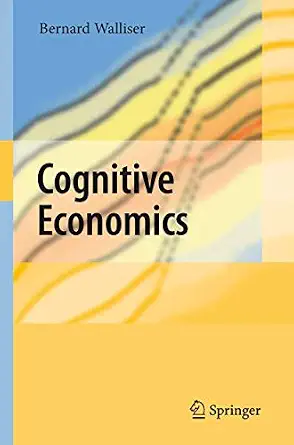
Cognitive Economics Softcover reprint of hardcover 1st ed. 2008 Edition
Author(s): Bernard Walliser (Author)
- Publisher: Springer
- Publication Date: October 15, 2010
- Edition: Softcover reprint of hardcover 1st ed. 2008
- Language: English
- Print length: 192 pages
- ISBN-10: 3642090508
- ISBN-13: 9783642090509
Book Description
Cognitive economics is concerned with the beliefs and mental operations held by actors placed within a dynamical and strategic environment. It appears as a synthesis of an eductive research program dealing with crossed expectations of actors and of an evolutionist research program dealing with collective learning processes. It first aims at extending the framework of game theory in order to better fit with the results of rapidly increasing laboratory experiments concerned with individual choices and collective interactions. Cognitive economics also aims at better explaining some original economic phenomena involving boundedly rational agents in an institutional setting such as financial bubbles, job search or technological innovation.
Written in an informal way, this book is addressed to philosophers or cognitive scientists curious of how economics deals with cognition and to graduate students in economics eager to discover how economics evolves.
Editorial Reviews
From the Back Cover
As a manifestation of a 'cognitive turn' observable in all social sciences, Cognitive Economics Softcover reprint of hardcover 1st ed. 2008 Edition is concerned with the beliefs and mental operations held by actors placed within a dynamical and strategic environment. It appears as a synthesis of an educative research program, dealing with crossed expectations of actors, and an evolutionist research program on collective learning processes.
The book mainly aims at extending the framework of game theory in order to better fit the results of rapidly increasing laboratory experiments concerned with individual choices and collective interactions. It also seeks to better explain some original economic phenomena involving boundedly rational agents in an institutional setting such as financial bubbles, job search or technological innovation.
Written in an informal way, the book is addressed to philosophers or cognitive scientists curious of how economics deal with cognition, as well as graduate students in economics eager to discover how economic science evolves.


