Wow! eBook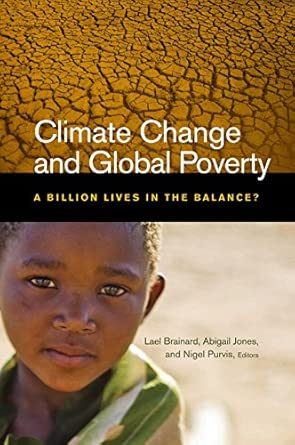
Climate Change and Global Poverty: A Billion Lives in the Balance?
Author(s): Lael Brainard
- Publisher: Brookings Institution Press
- Publication Date: 15 July 2009
- Language: English
- Print length: 311 pages
- ISBN-10: 0815702817
- ISBN-13: 9780815702818
Book Description
Editorial Reviews
Review
” Climate Change and Global Poverty provides a much needed blueprint forovercoming the two great crises of our time. This book defines what needs tobe done and how to do it. It is a welcomed resource.” Helene D. Gayle, President and CEO, CARE USA
|
” Climate Change and Global Poverty is an urgently needed source of excellentanalysis and compelling ideas. We no longer have the luxury of viewing climatechange and poverty as disconnected, and this book spurs us to tackle two ofthe greatest challenges of our time with informed and innovative solutions.” Nancy Lindborg, President, Mercy Corps
|
“This book breaks new ground by showing how solutions to climate changeand global poverty are intertwined. The authors define what needs to be donewith refreshing clarity, and offer practical recommendations that are at onceidealistic and yet firmly grounded in political realities and national interests.” Frank Loy, former Under Secretary of State for Global Affairs
About the Author
Excerpt. © Reprinted by permission. All rights reserved.
Climate Change and Global Poverty
A Billion Lives in the Balance?
BROOKINGS INSTITUTION PRESS
Copyright © 2009 THE BROOKINGS INSTITUTION
All right reserved.
ISBN: 978-0-8157-0281-8
Contents
Foreword Strobe Talbott………………………………………………………………………………………………………………………………………………………viiIntroduction…………………………………………………………………………………………………………………………………………………………………11 Double Jeopardy: What the Climate Crisis Means for the Poor Abigail Jones, Vinca LaFleur, and Nigel Purvis…………………………………………………………………………..102 Climate Change Impacts in the Developing World: Implications for Sustainable Development Anthony Nyong………………………………………………………………………………433 Toward a New International Climate Change Agreement Elliot Diringer……………………………………………………………………………………………………………..654 Greenhouse Gas Mitigation Efforts in China: Progress and Opportunities Ned Helme………………………………………………………………………………………………….795 Linking Communities, Forests, and Carbon Michael Jenkins……………………………………………………………………………………………………………………….876 Integrating Climate Change into Development: Multiple Benefits of Mitigation and Adaptation Atiq Rahman……………………………………………………………………………..1047 Development in the Balance: Agriculture and Water Robert Mendelsohn……………………………………………………………………………………………………………..1208 Public Health Adaptation to Climate Change in Low-Income Countries Kristie L. Ebi…………………………………………………………………………………………………1309 Linking Adaptation and Disaster Risk Reduction Saleemul Huq and Jessica Ayers…………………………………………………………………………………………………….14210 The Climate-Security Connection: What It Means for the Poor Joshua W. Busby……………………………………………………………………………………………………..15511 Financing Adaptation to a Warmer World: Opportunities for Innovation and Experimentation Manish Bapna and Heather McGray……………………………………………………………..18112 Exploring the Potential for Public-Private Insurance to Help the World’s Poor to Adapt and Thrive as the Climate Changes Ian Burton and Thea Dickinson…………………………………..20713 Corporate Action on Climate Adaptation and Development: Mobilizing New Partnerships to Build Climate Change Resilience in Developing Countries and Communities Jane Nelson…………………22314 Mobilizing Action for Climate Change Adaptation in the North and South Heather K. Coleman, Raymond C. Offenheiser, and David Waskow……………………………………………………260Contributors…………………………………………………………………………………………………………………………………………………………………277Index……………………………………………………………………………………………………………………………………………………………………….287
Chapter One
Double Jeopardy: What the Climate Crisis Means for the Poor
Abigail Jones, Vinca Lafleur, and Nigel Purvis
As the twenty-first century unfolds, humanity faces two defining challenges: lifting the lives of the global poor and stabilizing the Earth’s climate. Our success or failure in meeting these challenges will shape the future for our children and successive generations, and many choices we make today will drive consequences for years to come.
Around the world, extreme poverty fuels a volatile mix of desperation and instabilityexhausting governing institutions, depleting resources, weakening leaders, and crushing hope. Conscience demands that we confront the facts that 10 million children under five years old still perish each year of largely preventable causes; that more than 850 million people are hungry; and that in an era of dazzling medical accomplishment, a woman still dies in childbirth each minute. Global security also demands that the fight against global poverty become a fight of necessity, for in this age of blurring borders and interdependence, human suffering anywhere poses risks to stability everywhere.
Taking action to reverse climate change is no less urgent an imperative. The planet is warming at an alarming rate, primarily as a result of fossil fuel use, deforestation, and other human activity; left unchecked, the thermometer could rise by 6 °C this centurya variation as great as the mean temperature change between ice ages and warm interglacial periods. Eleven of the past thirteen years have been the warmest ever recorded. Adverse impacts are already apparent in extreme weather, melting glaciers, and altered ecosystems, exacerbating human suffering from the Irrawaddy River Delta to Darfur.
Swift, substantial reductions in greenhouse gas emissions are essential to stabilize the climatea daunting task that will require the transformation of economic and energy paradigms worldwide. But because these gases warm the planet for many years after they are emitted, the emissions legacy of prior years and the unavoidable emissions of tomorrow mean that additional climate change is certain. Thus, while preventing the risk of a future climate catastrophe means cutting emissions immediately, we have passed the point of preventing the consequences of climate change in the decades ahead. The challenge now is to avoid the unmanageable and manage the unavoidable.
Independent Agendas for Poverty and Climate Change
It has been twenty-two years since Gro Harlem Brundtland’s report Our Common Future put the concept of sustainable development on the map. Yet, for most of the past two decades, the poverty and climate change agendas have proceeded independently. Development experts have viewed climate change as marginally relevant to their efforts to raise the living standards of the 1.4 billion people in the developing world who exist on less than $1.25 a day. Climate experts have focused primarily on mitigating greenhouse gas emissions in developed countries rather than on bolstering climate resilience or encouraging sustainable development; some have worried that promoting adaptation to climate change would suggest that the battle was already lost, while others have felt that devoting attention to adaptation would detract from the existential imperative of halting climate change itself.
Even governments have failed to make the obvious connection: Neither the Millennium Development Goals nor the official indicators of progress toward these goals mention climate change, and global development has been secondary in the Kyoto Protocol. A Nobel Prizewinning scientific advisory body, the Intergovernmental Panel on Climate Change (IPCC), has raised public awareness about the reality and effects of climate change, but it has had less success in mobilizing action for sustainable development solutions.
Meanwhile, the policy and funding priorities of the climate change community and the development community have been at odds for years. Many climate experts have feared the environmental consequences of the development community’s quest to raise living standards with the attendant demands for energy. Indeed, in China, while economic growth has lifted millions out of poverty over the past thirty years, a new coal-fired plant or two is coming online almost every weeka major reason for the developing world’s projected doubling of carbon dioxide emissions by 2030, as compared with 2005. The increase in China’s annual emissions alone during the next few years will be greater than the current emissions produced by either the United Kingdom or Germany;1 already, the emissions of China’s electric power sector have surpassed those of the United States (though on a per capita basis, U.S. power-sector emissions are still far greater).
At the same time, many development experts see actions aimed at stabilizing the climate as negatively affecting the poor. For example, the recent push to grow crops that can be used to make biofuels contributed to the surge in food prices that forced 50 million people into hunger in 2007. And some development advocates worry that the financial strain of responding to the climate crisis will “hijack” official development assistancenoting that emergency aid already accounted for roughly 8.5 percent of bilateral donor disbursements in 2007.
Converging Interests
Upon deeper examination, the interests of the climate change and development communities converge more than they conflict. Though global climate negotiations properly seek to assign the greatest responsibility to those nations that have both contributed most historically and are most capable of implementing large-scale solutions, there can be no sustainable long-term solution to climate change without the full participation of today’s poor countries. While developed countries have been responsible for the bulk of industrial emissions thus far, developing nations now emit roughly half of greenhouse gases worldwide and are expected to account for most emissions growth in the years ahead.
From a climate change perspective, how these nations grow will be decisivethat is, whether they pursue the same unsustainable, carbon-intensive path that led to the industrial world’s prosperity or adopt new, clean technologies that fuel nonpolluting growth. But whether they grow will also be critical in determining the world’s ability to confront the climate crisisfor as difficult as the challenge is, its burden will be magnified if developing countries are too poor to invest in protecting their own people.
In turn, the fate of the Earth’s climate has enormous implications for the lives of the poorest people. Already, the world is struggling to meet the Millennium Development Goals (MDGs)the human development targets agreed on by 189 world leaders in 2000. Today, for example, while the world as a whole may succeed in meeting MDG 1halving the proportion of people living on less than $1 a day by 2015at least 47 countries monitored by the World Bank are seriously off track; and in sub-Saharan Africa, Western Asia, and Southern Asia, there are more undernourished people today than there were in 1990. Meanwhile, no sub-Saharan African country is on track to meet MDG 2, which pledges to cut child mortality by two-thirds by 2015; tragically, in 12 countries, child mortality has actually gone up since 1990.
It is also disturbing that the hard-fought progress in human development achieved so far may be retarded or even reversed by climate changeas new threats emerge to water and food security, agricultural production and access, and nutrition and public health. What is in store for the poor will depend in part on how much mitigation is secured in the coming yearsbut we already know that such climate effects as sea-level rise, droughts, heat waves, floods, and rainfall variation could, by the 2080s, push another 600 million people into acute malnutrition, increase the number of people facing water scarcity by 1.8 billion, and increase those facing coastal flooding by many millions.
Africa, by virtue of its size, population, and poverty, may prove to be ground zero in a warming world. According the IPCC’s Fourth Assessment Report, in some African countries, agricultural yields could drop as much as 50 percent by 2020further impoverishing small-scale farmers and jeopardizing the continent’s food security. Already, roughly a quarter of Africa’s population is under high-water stress; by 2020, the population at risk is projected to be 75 to 250 million people. By the 2080s, Africa’s arid and semiarid terrain may expand by 5 to 8 percent, and its wheat production may cease entirely. Sea-level rise will imperil coastal areas. Malaria will spread.
Yet wherever they live, the poor are especially vulnerable to climate shocks because they have such meager resources to fall back on. When faced with rising prices of food or fuel, the wealthy can cope by curbing consumption or dipping into savings. But for the poorest families, which spend 50 to 80 percent of their income just to get enough food to survive, rising prices force life-altering choices like pulling children out of school or selling precious livestockchoices that tighten the shackles of poverty beyond any chance of escape. Similarly, the wealthy can avoid encroaching threats to their physical safety by investing in protective infrastructure or by moving to another location. But the global poor lack the resources to adapt or retreatand the citizens of the world’s fifty-one small developing island states have literally nowhere to go.
Human Survival, Human Solidarity
Choices about the Earth’s climate thus will have an enormous impact on the poor, and choices determining the path out of poverty will greatly influence the fate of the climate. Against this backdrop, climate experts and development advocates increasingly agree that either they must work together or risk failing separately.
The initial seeds of collaboration have been planted and are taking root. International humanitarian nongovernmental organizations (NGOs) like Mercy Corps and Oxfam are incorporating climate concerns into their development programs. Environmental organizations, including Conservation International and the World Wildlife Fund, are striving more than ever to ensure that their conservation and climate protection programs create sustainable livelihoods for local communities. But more work remains to align the antipoverty and climate agendas in mutually reinforcing ways. So far, most developing nations and donor institutions, whether bilateral or multilateral, have failed to truly integrate sensitivity to climate change into their primary operations. And though encouraging climate resilience, or adaptation, is a prominent topic in the climate negotiations due to conclude at the UN Climate Change Conference in Copenhagen at the end of 2009, “overall, progress on integrating adaptation in development is still more aspirational than operational,” as Shardul Agrawala and Florence Crick of the Organization for Economic Cooperation and Development (OECD) have aptly observed.
In fostering a closer partnership between the climate change and development communities, one place to start is by emphasizing the similarities in the two communities’ strugglestheir shared sense of urgency, passion, and commitment; their need to build political support both at home and on the global stage; their recognition that solutions must come from every sector of society; and their understanding that national security and global stability are both at stake. But perhaps most compelling, the climate change and development communities are both fighting for human survivalfor a world where people’s well-being is assured, and where people ensure the world’s well-being.
Climate concerns add a whole new dimension to the mission of human development, for unless we cease fraying what Al Gore calls “the web of life on which we depend,” we will imperil civilization itself. At the same time, the humanitarian community brings heart to the climate challenge, reminding the world that the climate crisis is not an abstract scientific dilemma but a burden that will exact the cruelest toll from those who have done the least to create it. An inclusive framework for cooperation might therefore be one of survival and solidarityrecognizing not only our obligation to protect our common planet, but also our need to look out for one another, wherever our homes may be.
A Common Agenda
Within this framework, how might we begin to conceive of an integrated agenda for the climate change and development communities? Visually, one might imagine a diagram with three circlesone each for the mitigation, adaptation, and development endeavorswith the focus on where the three circles intersect (see figure 1-1). An alternative concept, proposed by the World Resources Institute (WRI), is a continuum of adaptation activitiesranging from those geared primarily toward reducing vulnerability in general, which would thus be valuable for development even without the threat of climate change, to those explicitly targeting the effects of climate change, which would not likely be undertaken without it.
Both of these models illustrate that some adaptation measures are highly climate-specificbuilding seawalls, for example, or preventing the bleaching of coral reefs. As WRI explains, activities like these “tend to require new approaches that fall outside of the relatively well-understood set of practices that we might think of as a development ‘comfort zone.'” Likewise, some mitigation efforts fall outside the realm of development practices, and vice versa. Indeed, sometimes mitigation and development goals might seem to conflict.
But at the same time, the two models bring into focus significant areas of overlapping interests. They show that in many instances the best form of adaptation is mitigation, and also that adaptation and development objectives are frequently the samethings like better public health systems, more productive agriculture, and stronger resilience in the face of natural disaster. Indeed, as the WRI experts Manish Bapna and Heather McGray have argued, focusing exclusively on how climate adaptation creates new needs may be counterproductive: “Adaptation is not just additional to development but often is development.” Frequently, climate change adds additional urgency to the development agenda without altering its fundamental direction.
This complex situation requires metrics that will capture the full benefits of addressing these common objectives, and thereby mobilize the resources and political will to pursue double and triple wins. Yet the accounting is still flawed. First, the world lacks established means for valuing environmental assetsthings like the standing forests, unspoiled rivers, biodiversity, and ecosystem services on which humankind’s well-being depends. All these assets have important livelihood, health, and sustenance benefits for the poor, yet their development benefits are rarely calculated. At the same time, traditional measures of economic growth fail to fully capture the costs of environmental degradation. Improving ways to analyze costs and benefits is a prerequisite for wise decisionmaking. Developing nations are understandably preoccupied with raising their people’s living standards, and they are unlikely to willingly mitigate greenhouse gas emissions if doing so could constrain their ability to grow (see box 1-1).
But if better accounting mechanisms can be designed, they could prompt a shift in policy prioritiesto build more climate awareness into development activities, to adopt more pro-poor climate solutions, and to take advantage of co-benefits for both development and the environment wherever possible to stimulate funding and support. These co-benefits are apparent in a number of areas where new alliances for action might be forgedin particular, tropical forests, agriculture, health, clean energy, and disaster preparedness.
Conserving Tropical Forests
Tropical forestswhich hold most of the world’s forest carbonare disappearing globally at the alarming rate of 5 percent each decade. Every year, more than 13 million hectares of forest are lost, along with countless, largely unknown species and ecosystem functions. And this problem is very concentrated; Indonesia and Brazil together are responsible for 50 percent of global deforestation, placing these two countries among the top five climate polluters. More than 90 percent of global deforestation occurs in just two dozen countries with tropical forests.
Astonishingly, tropical deforestation contributes roughly 20 percent of global greenhouse gas emissions, a share larger than the transportation sector. In other words, deforestation is doing more to deepen the climate crisis than all the cars, trucks, ships, and planes in the world. Slowing this process would seem an obvious target for mitigation efforts. Though significant research and investment are still needed to make affordable, efficient, and safe zero-emission cars and power plants, we do not need new technologies to conserve and restore the Earth’s forests.
(Continues…)
Excerpted from Climate Change and Global Poverty Copyright © 2009 by THE BROOKINGS INSTITUTION. Excerpted by permission of BROOKINGS INSTITUTION PRESS. All rights reserved. No part of this excerpt may be reproduced or reprinted without permission in writing from the publisher.
Excerpts are provided by Dial-A-Book Inc. solely for the personal use of visitors to this web site.