 Wow! eBook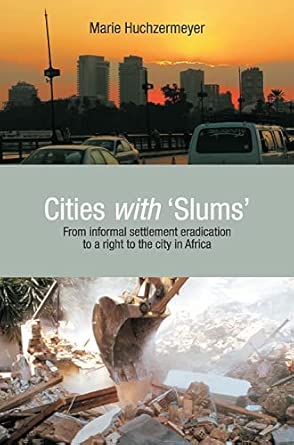
Cities with slums: From informal settlement eradication to a right to the city in Africa
Author(s): M. Huchzermeyer (Author)
- Publisher: UCT Press
- Publication Date: 10 July 2010
- Language: English
- Print length: 256 pages
- ISBN-10: 1919895396
- ISBN-13: 9781919895390
Book Description
Editorial Reviews
About the Author
Excerpt. © Reprinted by permission. All rights reserved.
Cities with ‘Slums’
From Informal Settlement Eradication to a Right to the City in Africa
By Marie Huchzermeyer, Karen Press
Juta and Company Ltd
Copyright © 2011 UCT Press
All rights reserved.
ISBN: 978-1-919895-39-0
Contents
List of acronyms,
Acknowledgements,
Introduction,
Part One: The urban context in the new millennium,
Chapter One Informal settlements, global governance and Millennium Development Goal Seven Target 11,
Chapter Two Urban competitiveness or improving poor people’s lives: why ‘Cities Without Slums’?,
Chapter Three Informal settlements in the discourse on urban informality,
Part Two: ‘Slum’ eradication in action,
Chapter Four [‘Slum’ elimination in Zimbabwe and Nigeria,
Chapter Five South Africa’s drive to eradicate informal settlements by 2014,
Chapter Six Flagship ‘slum’ eradication pilot projects: flaws and controversies in the N2 Gateway in Cape Town and Kibera-Soweto in Nairobi,
Part Three: The struggle against ‘slum’ eradication in South Africa,
Chapter Seven A new target-driven upgrading agenda: space for rights-based demands?,
Chapter Eight A challenge to legal regression in the KwaZulu-Natal Elimination and Prevention of Re-emergence of Slums Act of 2007,
Chapter Nine A challenge to the state’s avoidance of upgrading: the Harry Gwala informal settlement,
Chapter Ten Towards a right to the city,
References,
Index,
CHAPTER 1
Informal settlements, global governance and Millennium Development Goal Seven Target 11
[T]here are important differences between the MDGs and human rights, having to do with agency, accountability, the analysis of causes, and symptoms of poverty, including political and civic freedoms.
(Paul Nelson, 2007: 2042)
Informal settlements sit at the intersection of various dimensions of globalisation and local political decisions and processes. They are a complex manifestation of more than just poverty, yet poverty as well as a human resolve to live in the city are intertwined with and reinforced by many of the causes of informal settlements. There is a political and bureaucratic tendency to blame the existence and growth of informal settlements on simplistic ‘problems’ and to focus only on elimination of the symptoms. This tendency is fuelled by the ‘Cities Without Slums’ campaign, which, as I show in this chapter and the next, is closely linked to global agencies’ promotion of neoliberalism, and therefore of economically competitive cities in the ‘developing’ world. Global governance bodies on the one hand promote human rights, yet on the other hand they encourage a reductionist and symptom-oriented approach to poverty and informality, while also unintentionally fuelling stigmatisation. This is manifested in MDG Seven Target 11 with its official slogan ‘Cities Without Slums’ and the implicit norm that cities should not have ‘slums’. However, global governance agencies’ work in relation to this norm is an example of a larger dysfunctionality within the global governance system in which norms and targets play a particular role.
Informal settlements, cities and globalisation
The causes of ‘slums’ or informal settlements are poorly researched, particularly as regards the African continent. The current global development focus is almost exclusively on measurable symptoms rather than on the multiple and varied causes, and this has discouraged any serious attempts to understand why informal settlements proliferate. Not encouraged to do otherwise, governments resort to simplistic and convenient c


