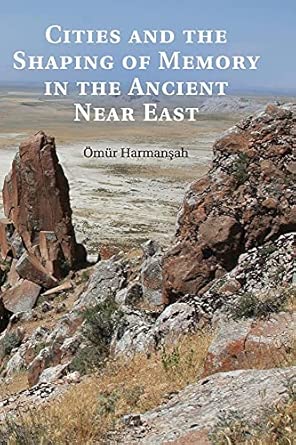
Cities and the Shaping of Memory in the Ancient Near East
Author(s): Ömür Harmanşah (Author)
Publisher: Cambridge University Press
Publication Date: 23 May 2013
Edition: New
Language: English
Print length: 372 pages
ISBN-10: 1107027942
ISBN-13: 9781107027947
Book Description
This book investigates the founding and building of cities in the ancient Near East. The creation of new cities was imagined as an ideological project or a divine intervention in the political narratives and mythologies of Near Eastern cultures, often masking the complex processes behind the social production of urban space. During the Early Iron Age (c.1200–850 BCE), Assyrian and Syro-Hittite rulers developed a highly performative official discourse that revolved around constructing cities, cultivating landscapes, building watercourses, erecting monuments and initiating public festivals. This volume combs through archaeological, epigraphic, visual, architectural and environmental evidence to tell the story of a region from the perspective of its spatial practices, landscape history and architectural technologies. It argues that the cultural processes of the making of urban spaces shape collective memory and identity as well as sites of political performance and state spectacle.
Editorial Reviews
Review
‘Well written and illustrated, this work is must-reading for students and scholars of the ancient Near East as well as urbanization in general. Summing up: highly recommended.’ Choice
‘Cities and the Shaping of Memory in the Ancient Near East is a much-needed and welcome project, investigating through the lens of archaeology the built environment of this cosmopolitan and still relatively poorly understood area together with that of northern Iraq.’ Journal of the Society of Architectural Historians
‘… the book is a well researched and undeniably analytical, making use of a variety of sources and case studies from a substantial geographic area … the book persuasively supports its central argument: that focusing on architectural spaces rather than architectural plans, sections and abstract representations is a far more effective means for demonstrating the dynamic relations of constructed spaces.’ Georgia Marina Andreou, Archaeological Reviews from Cambridge
‘… this book offers some useful summaries of major archaeological sites, asks significant social questions, and advances new ideas in interpreting ancient Near Eastern cities.’ The Bulletin of the American Schools of Oriental Research
‘The author’s focus on bringing ancient cities to life is commendable, and he has in my view succeeded in making some interesting and new points on a subject that has arguably been a focus of research for 175 years.’ American Journal of Archaeology
‘This book takes a fresh approach to some of the issues addressed, deeply embedded in theoretical considerations from recent general archaeological and anthropological literature.’ Landscape History
Book Description
This book investigates the practice of constructing cities in the ancient Near East, bringing together architecture and cultural history.
About the Author
Ömür Harmanşah is Associate Professor of Art History at the University of Illinois, Chicago. His research focuses on the history of architecture and cities in the ancient Near East, as well as questions of place, landscape and memory. He has been directing the Yalburt Yaylasi Archaeological Landscape Project, a regional survey in west-central Turkey since 2010. In the past he has worked on archaeological projects in Turkey and Greece, including Gordion, Ayanis, Kerkenes Dağ and Isthmia. His articles have been published in journals such as the Journal of Mediterranean Archaeology, Archaeological Dialogues and the Bulletin of the American Schools of Oriental Research.
 Wow! eBook