 Wow! eBook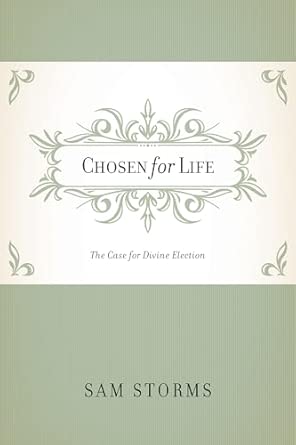
Chosen for Life: The Case for Divine Election
Author(s): Sam Storms (Author)
- Publisher: Crossway
- Publication Date: 25 Jan. 2007
- Language: English
- Print length: 240 pages
- ISBN-10: 1581348436
- ISBN-13: 9781581348439
Book Description
Divine election is certainly one of the more profound―and controversial―doctrines in the Bible. Does God elect people because they believe in the Lord Jesus Christ, or does God elect people in order that they will believe in Christ? Much of the disagreement and controversy concerning this doctrine proceeds from a fundamental misunderstanding of what it means.
This is why Storms begins his analysis of divine election with an attempt to clarify precisely what is at stake and, at the same time, correct misrepresentations of it. He takes a thorough look at the doctrine as it is presented in Romans 9 as well as the rest of the New Testament. He also explores freedom of will and the order of salvation. Appendixes address “Three Problem Passages” and “Who Can and Cannot Pray for God to Save the Lost?”
Editorial Reviews
Review
“I can’t know and love and serve God if I don’t know truth about God. This book describes God the way he really is.”
―John Piper, Founder and Teacher, desiringGod.org; Chancellor, Bethlehem College & Seminary; author, Desiring God
“Sam Storms’s Chosen for Life is well-conceived, well-reasoned, and well-written, with its arguments anchored in the Scriptures. It is fair, thorough, and up-to-date regarding the controversies that swirl around this vital biblical doctrine.”
―Mark Talbot, Associate Professor of Philosophy, Wheaton College; author, Suffering and the Christian Life series
“This new edition of Chosen for Life has everything one could want on the topic of election. Those who agree will be heartily encouraged; those who disagree will be respectfully challenged; the hearts of all will marvel at the glorious grace of God in the gospel.”
―C. J. Mahaney, Senior Pastor, Sovereign Grace Church, Louisville, Kentucky
“Storms’s offensive against Arminian-type views of election among evangelicals is a very solid piece of work. The thoroughness of its arguments gives it conclusive force.”
―J. I. Packer, Late Board of Governors’ Professor of Theology, Regent College
“I am delighted that a revised and expanded edition of Sam Storms’s book Chosen for Life is now available. When students have asked me for a concise, clear, pastoral, and practical explanation of election, I have said that Chosen for Life is my top choice.”
―Thomas R. Schreiner, James Buchanan Harrison Professor of New Testament Interpretation, The Southern Baptist Theological Seminary
“This extraordinarily clear and courteous book makes its case without stooping to caricature or invective. It is a fine model of exactly how theological disagreements should be resolved: with respectful listening, careful distinctions, historical awareness, deep reverence for Scripture, and patient exegesis.”
―D. A. Carson, Theologian-at-Large, The Gospel Coalition
About the Author
Sam Storms (PhD, University of Texas at Dallas) has spent more than four decades in ministry as a pastor, professor, and author. He is the pastor emeritus at Bridgeway Church in Oklahoma City, Oklahoma, and was a visiting associate professor of theology at Wheaton College from 2000 to 2004. He is the founder of Enjoying God Ministries and blogs regularly at SamStorms.org.
Excerpt. © Reprinted by permission. All rights reserved.
Chosen for Life
The Case for Divine Election
By Sam Storms
Good News Publishers
Copyright © 2007 C. Samuel Storms
All rights reserved.
ISBN: 978-1-58134-843-9
Contents
Acknowledgments, 11,
Introduction, 25,
1 What Is Divine Election, and Why Is It So Controversial?, 19,
2 The Arminian Concept of Election, 25,
3 The Calvinistic Concept of Election, 39,
4 Freedom of the Will (?), 53,
5 Faith and Repentance: Gifts of God or the Fruit of Free Will?, 69,
6 Amazing Grace, 77,
7 Unconditional Election (1): The Gospels and Acts, 87,
8 Unconditional Election (2): The Epistles and Revelation, 101,
9 Unconditional Election (3): Romans 9:1-13, 115,
10 Unconditional Election (4): Romans 9:14-23 (1), 125,
11 Unconditional Election (5): Romans 9:14-23 (2), 137,
12 The Order of Salvation, 145,
13 Crucial Questions Concerning Election (1), 159,
14 Crucial Questions Concerning Election (2), 169,
15 A Defense of a Defense of Divine Election, 179,
Conclusion, 193,
Appendix A: Three Problem Passages, 195,
Appendix B: Who Can and Who Cannot Pray for God to Save the Lost?, 201,
Appendix C: The Divine Decrees, 213,
General Index, 221,
Scripture Index, 227,
CHAPTER 1
WHAT IS DIVINE ELECTION, AND WHY IS IT SO CONTROVERSIAL?
Divine election is certainly one of the more profound and controversial doctrines in Holy Scripture. To some it is an idea conceived in hell, a tool of Satan to thwart the evangelistic zeal of the church and thus responsible for populating hell with those who otherwise would have been reached with the gospel. To others divine election is the heart and soul of Scripture, the most comforting and reassuring of biblical truths, apart from which grace loses its power and God his glory. To the former, then, election is a primary reason why people are in hell. To the latter, it is the only reason why people are in heaven!
This radical difference of opinion concerning the doctrine of election and predestination is illustrated beautifully (and humorously) in a poem that appeared in The Continental Journal, March 11, 1779. It was entitled “On Predestination”:
If all things succeed as already agreed,
And immutable impulses rule us;
To preach and to pray, is but time thrown away,
And our teachers do nothing but fool us.
If we’re driven by fate, either this way or that,
As the carman whips up his horses,
Then no man can stray — all go the right way,
As the stars that are fix’d in their courses.
But if by free will, we can go or stand still,
As best suits the present occasion;
Then fill up the glass, and confirm him an ass
That depends upon Predestination.
Two weeks later an answer appeared in the same newspaper:
If an all perfect mind rules over mankind,
With infinite wisdom and power;
Sure he may decree, and yet the will be free,
The deeds and events of each hour.
If scripture affirms in the plainest of terms,
The doctrine of Predestination;
We ought to believe it, and humbly receive it,
As a truth of divine revelation.
If all things advance with the force of mere chance,
Or by human free will are directed;
To preach and to pray, will be time thrown away,
Our teachers may be well rejected.
If men are deprav’d, and to vice so enslav’d,
That the heart chuses nothing but evil;
Then who goes on still by his own corrupt will,
Is driving post haste to the devil.
Then let human pride and vain cavil subside,
It is plain to a full demonstration,
That he’s a wild ass, who over his glass,
Dares ridicule Predestination.
Much of the disagreement and most of the animosity concerning this doctrine proceeds from a fundamental misunderstanding of what it means. Our analysis of divine election must, therefore, begin with an attempt to clarify precisely what is at stake and, at the same time, to correct misrepresentations of it.
I’m often asked, “Sam, are you a Calvinist?” Honesty may require me to answer with an immediate, “Yes, I am.” But wisdom dictates a more hesitant and informed response. “Explain to me what you mean by the label ‘Calvinist,'” I reply, “and I’ll tell you if I am one.”
What comes next is both shocking and disappointing. It is shocking because the response I hear reveals an amazing ignorance of the Reformed tradition and its beliefs. But I’m also disappointed to realize that what I cherish and celebrate as biblical truth suffers from such widespread caricature and misrepresentation.
Often people proceed to define “Calvinism” as an inflexible, fatalistic system of theology, devoid of life and joy, in which God is portrayed as a celestial bully who takes sadistic glee in sending people to hell whether they deserve it or not. Or they describe a perspective that is more concerned with logical coherency than with biblical fidelity. Some argue that Calvinists empty human choices of all moral relevance and reduce men and women to robotic automatons. “Needless to say,” I will then reply, “if that is what you mean by ‘Calvinist,’ then I most assuredly am not one!”
Arminians often run into an equally distressing caricature of their own position. Sadly, many Calvinists think of Arminianism as an intellectually flabby, overly sentimental view of the Christian faith that borders on liberalism, if not universalism. The “God” of Arminianism, I once heard someone sarcastically say, is actually “man” spoken of in a very loud voice. I hope this book will go a long way in dispelling such unkind and terribly misleading caricatures of what people really believe.
The Point of Dispute
Whereas much may and will be said of election in this book, the point of dispute between Calvinists and Arminians is surprisingly simple. No one who believes in the Bible questions the fact that election is taught there. It isn’t the reality of election, or even its source, author, time, or goal that has elicited so much venom among professing Christians. The point of primary dispute, rather, is the basis of divine election, that is to say, why and on what grounds some are elected to salvation and life and others are not. There are essentially only three options, the first of which is more pagan than Christian.
First, someone might want to argue that God elects those who are good. In this view, election is a debt God is obliged to pay, not a gift he graciously bestows. God elects men and women on the basis of inherent or self-generated righteousness. This is a view consistent with ancient Pelagianism, named after the British monk Pelagius, who became famous in the fifth century due primarily to his dispute with the famous church father Augustine. One would be hard-pressed to find an advocate of this perspective within the professing Christian church today.
Second, others contend that God has elected some who are bad who, notwithstanding their being bad, chose to exercise faith in Jesus Christ. It is on the basis of this foreseen faith that God elects them. This is the doctrine of Arminianism, named after the Dutch theologian James Arminius (1560– 1609). It has also been called Wesleyanism because of the influence of John Wesley in popularizing this perspective.
Third, there is the view that God has elected some who are bad who, because of their being bad, are not of themselves able to exercise faith in Christ. It is on the basis of his own sovereign good pleasure that God elects them. This is the doctrine of Calvinism, named after the French theologian John Calvin (1509–1564).
We are concerned with the latter two options. The question reduces to this: Does God elect people because they believe in the Lord Jesus Christ, or does God elect people in order that they shall believe in Christ?
Sorting Out the Options
Jack W. Cottrell, an Arminian, rightly points out that “the Calvinistic mind sees election as bringing about the transition from unbelief to belief, hence making unbelievers the object of election. The Arminian says that this transition is made by a free act of will; election then is an act of God directed toward the believer after the transition has been made.”
Thus the Calvinist says that God elects unbelievers and predestines them to become believers. The Arminian, on the other hand, says that God elects believers and predestines them to become his children.
The issue is not whether there is a cause or basis of God’s choice of people, but whether that cause is some condition (such as faith) fulfilled by an individual acting from free will or the sovereign good pleasure of God. Does God elect a person because that person wants God, or does God elect a person because God wants that person in spite of the fact that the person does not want God? We are not disputing whether faith and repentance are necessary for salvation. Indeed, one may even speak of faith and repentance as the condition for salvation, in the sense that one must believe and repent in order to be saved. The question, rather, is this: Are faith and repentance produced by free will and thus the cause of election, or are they produced by the Holy Spirit and thus the effect of election?
According to Arminianism, election is that act of God whereby he foreordains to eternal life those whom he foresees will respond in faith to the gospel. According to Calvinism, election is that act of God whereby he foreordains to eternal life those who, because of sin, cannot respond in faith to the gospel. Which of these two views is the one the Bible teaches? Or is there a third, mediating option? That is the question I have set myself to answer in this book.
Addendum: The Biblical Terminology of Election
As I pointed out above, there really is no dispute over the reality of divine election, only its basis. Nevertheless, it might prove helpful to see just how pervasive the concept of election is in the Bible. Here I focus exclusively on the New Testament.
1. The verb “to choose” or “to elect” (eklego) is found twenty-two times in the New Testament. It is used eight times of Christ’s choosing or electing his disciples (Luke 6:13; John 6:70; 13:18; 15:16 [twice], 19; Acts 1:2, 24). On one occasion Jesus is himself the person chosen (Luke 9:35). Six times it is used in a context that does not pertain to salvation (Luke 10:42; 14:7; Acts 6:5; 15:7, 22, 25). The remaining seven occurrences refer to men and women as the objects of election to eternal life (Mark 13:20; Acts 13:17; 1 Cor. 1:27 [twice], 28; Eph. 1:4; James 2:5).
2. The noun “elect” (eklektos) is also used twenty-two times in the New Testament. On three occasions Jesus is the “elect” one (Luke 23:35; 1 Pet. 2:4, 6), and in one text the word refers to angels (1 Tim. 5:21). There is also one passage in which the word has no bearing on salvation (Rom. 16:13). In the seventeen remaining cases the word is used of men and women as God’s “elect,” those chosen to eternal life (Matt. 22:14; 24:22, 24, 31; Mark 13:20, 22, 27; Luke 18:7; Rom. 8:33; Col. 3:12; 2 Tim. 2:10; Titus 1:1; 1 Pet. 1:1; 2:9; 2 John 1, 13; Rev. 17:14).
3. The word which means “election” (ekloge) is used seven times, all of which refer to salvation (Acts 9:15; Rom. 9:11; 11:5, 7, 28; 1 Thess. 1:4; 2 Pet. 1:10).
4. The word frequently translated “to predestine” or “to predestinate” (proorizo) is found six times in the New Testament. It is used once with reference to Christ’s sufferings (Acts 4:28), once of the predestination of God’s redemptive plan (1 Cor. 2:7, nasb), and four times of the predestination of people to salvation (Rom. 8:29, 30; Eph. 1:5, 11).
5. Another word which means “to choose” (haireo) is used three times, only one of which refers to God’s “choosing” people to salvation (2 Thess. 2:13).
6. The word that means “to place, appoint, ordain” (tasso) is used eight times in the New Testament. Only one of these usages (Acts 13:48) is applicable to our study.
7. One other word is often translated “to appoint” or “to determine” (horizo), but none of its eight occurrences pertain to the salvation of men and women (Luke 22:22; Acts 2:23; 10:42; 11:29; 17:26, 31; Rom. 1:4; Heb. 4:7).
Clearly the terms used in the New Testament do not of themselves tell us anything definitive about the basis of divine election. One cannot appeal to any alleged intrinsic meaning in a particular Greek word to prove either the Arminian or the Calvinistic perspective. That issue must be determined by the way in which each term is used, as well as other relevant statements in each context.
CHAPTER 2
THE ARMINIAN CONCEPT OF ELECTION
Neither Arminianism nor Calvinism is monolithic, as if all who embrace either label agree on everything related to the sovereignty of God in salvation. For our purposes it is enough to note that there are two primary ways in which Arminians conceive of divine election. Roger T. Forster and V. Paul Marston argue for what has come to be known as corporate or class election. They contend that “there is no such thing in the New Testament as personal (individual) election of believers. Christ is the chosen One, and believers are elect because they are in him.” As they explain,
The prime point is that the election of the church is a corporate rather than an individual thing. It is not that individuals are in the church because they are elect, it is rather that they are elect because they are in the church, which is the body of the elect One [i.e., Jesus Christ]. … A Christian is not chosen to become part of Christ’s body, but in becoming part of that body [by free will, exercising faith] he partakes of Christ’s election. Although God, in his foreknowledge, doubtless knew which individuals would repent and so be joined by him to Christ’s body, this is not at all the same thing as picking them out to make them repent. God’s choice is not an individual one of who should repent; it is a corporate choice of the church in Christ.
Bruce Demarest, not himself an advocate of this view, defines it this way: “[These] interpreters view election passively as God’s purpose to save the class of people who trust Christ. In other words, election is a statement about the divine plan of salvation; it concerns God’s appointment of the believing community to everlasting glory.”
A recent advocate of this view is William Klein, who contends that “God has chosen the church as a body rather than the specific individuals who populate that body.” The concern of the New Testament regarding predestination, says Klein, “is not how people become Christians nor who become Christians” but “what God has foreordained on behalf of those who are (or will be) Christians.”
While not denying corporate or class election, other Arminians affirm that God also chooses individuals to eternal life. In the following representation, observe that according to corporate election the object or focus of God’s sovereign choice is the church or Christ himself. Men and women, by an act of free will, become united to Christ, who is himself the elect one of God. According to individual election, the object of God’s action is the person:
CORPORATE ELECTIONGOD -> ELECTS -> “CHURCH/CHRIST” <- FREE WILL <- INDIVIDUALS
INDIVIDUAL ELECTIONGOD -> ELECTS -> INDIVIDUALS -> “CHURCH/CHRIST”
As important as corporate election is to many Arminians, I will be concentrating on its soteriological cousin, individual election. Individual election, in the Arminian tradition, is “the idea that God predestines to salvation those individuals who meet the gracious conditions which he has set forth.” When a person by free will meets these conditions (faith and repentance), we must not think of him as performing meritorious works of righteousness, because the conditions are sovereignly and graciously established by God. Since man did not deserve to have these conditions made available to him whereby he might be saved, the election which results from his meeting those conditions remains wholly of grace. “Thus,” Cottrell concludes, “having set forth these conditions for being in Christ, God foreknows from the beginning who will and who will not meet them. Those whom he foresees as meeting them are predestined to salvation.”
The crucial point in this Arminian concept of election is this: If and when a person fulfills the condition of faith and repentance, it is he or she alone who does so. It is not God but the individual himself who is the ultimate cause of the decision.
The Arminian, contrary to the Calvinist, insists that this approach to election does not undermine the sovereignty of God. An arrangement in which God reacts to man’s decision would violate God’s sovereignty, says Cottrell,
only if God were forced into such an arrangement, only if it were a necessity imposed upon God from without. But this is not the case. It was God’s sovereign choice to bring into existence a universe inhabited by free-willed creatures whose decisions would to some extent determine the total picture. When God established the system of conditional election, it was God alone who sovereignly imposed the conditions.
Furthermore, says Cottrell, only with the doctrine of conditional election does God’s justice remain unimpeached. God’s justice, he explains, “leads him to treat all persons alike, and to bestow no special favors with respect to salvation.” He concludes that
the very thing that would violate this principle of justice would be deciding on an individual’s eternal destiny without taking account of anything in him. But this is exactly what the [Calvinistic] doctrine of unconditional election asserts. Only the doctrine of conditional election, where God elects to salvation those who comply with his graciously given and announced terms of pardon, can preserve the justice and the impartiality of God.
(Continues…)Excerpted from Chosen for Life by Sam Storms. Copyright © 2007 C. Samuel Storms. Excerpted by permission of Good News Publishers.
All rights reserved. No part of this excerpt may be reproduced or reprinted without permission in writing from the publisher.
Excerpts are provided by Dial-A-Book Inc. solely for the personal use of visitors to this web site.


