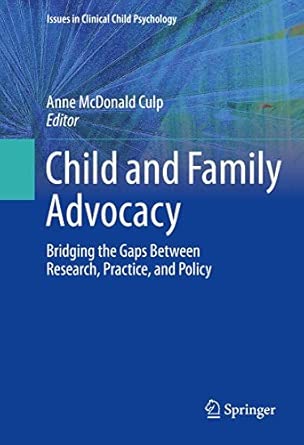
Child and Family Advocacy: Bridging the Gaps Between Research, Practice, and Policy 2013th Edition
Author(s): Anne McDonald Culp
Publisher: Springer
Publication Date: 25 Jun. 2013
Edition: 2013th
Language: English
Print length: 324 pages
ISBN-10: 1461474558
ISBN-13: 9781461474555
Book Description
Current statistics on child abuse, neglect, poverty, and hunger shock the conscience―doubly so as societal structures set up to assist families are failing them. More than ever, the responsibility of the helping professions extends from aiding individuals and families to securing social justice for the larger community.
With this duty in clear sight, the contributors to ChildandFamilyAdvocacy assert that advocacy is neither a dying art nor a lost cause but a vital platform for improving children’s lives beyond the scope of clinical practice. This uniquely practical reference builds an ethical foundation that defines advocacy as a professional competency and identifies skills that clinicians and researchers can use in advocating at the local, state and federal levels. Models of the advocacy process coupled with first-person narratives demonstrate how professionals across disciplines can lobby for change.
Among the topics discussed:
Promoting children’s mental health: collaboration and public understanding.
Health reform as a bridge to health equity.
Preventing child maltreatment: early intervention and public education
Changing juvenile justice practice and policy.
A multi-level framework for local policy development and implementation.
When evidence and values collide: preventing sexually transmitted infections.
Lessons from the legislative history of federal special
education law.
ChildandFamilyAdvocacy is an essential resource for researchers, professionals and graduate students in clinical child and school psychology, family studies, public health, developmental psychology, social work and social policy.
Editorial Reviews
Review
“Child and Family Advocacy describes the process of advocacy using current scientific knowledge. It is very useful and hopeful to know that research knowledge can have an impact on policy and government funding to actually help the children we are studying… Although the scientific community has emphasized the need to connect research to practice, this is one of the first books to add the critical link to advocacy and the need to provide funding for evidence-based programs and treatment processes.” (Linda C. Caterino, PsycCRITIQUES, February 24, 2014, Vol. 59, No. 8, Article 4)
From the Back Cover
Current statistics on child abuse, neglect, poverty, and hunger shock the conscience―doubly so as societal structures set up to assist families are failing them. More than ever, the responsibility of the helping professions extends from aiding individuals and families to securing social justice for the larger community.
With this duty in clear sight, the contributors to ChildandFamilyAdvocacy assert that advocacy is neither a dying art nor a lost cause but a vital platform for improving children’s lives beyond the scope of clinical practice. This uniquely practical reference builds an ethical foundation that defines advocacy as a professional competency, and identifies skills that clinicians and researchers can use in advocating at the local, state, and federal levels. Models of the advocacy process coupled with first-person narratives demonstrate how professionals across disciplines can lobby for change.
Among the topics discussed:
Promoting children’s mental health: collaboration and public understanding.
Health reform as a bridge to health equity.
Preventing child maltreatment: early intervention and public education
Changing juvenile justice practice and policy.
A multi-level framework for local policy development and implementation.
When evidence and values collide: preventing sexually transmitted infections.
Lessons from the legislative histor
y of federal special education law.
ChildandFamilyAdvocacy is an essential resource for researchers, professionals, and graduate students in clinical child and school psychology, family studies, public health, developmental psychology, social work, and social policy.
About the Author
Anne McDonald Culp, Ph.D., is Professor in the Department of Child, Family and Community Sciences at the University of Central Florida. She has taught at three universities and conducted research as a principal investigator and co-investigator on several federally funded and state-funded grants, most of which evaluated early intervention effects with young mothers and their infants and studied children and families of Head Start programs. She is past President of Division 37 of the American Psychological Association and has been a lifetime advocate for children and families.
 Wow! eBook