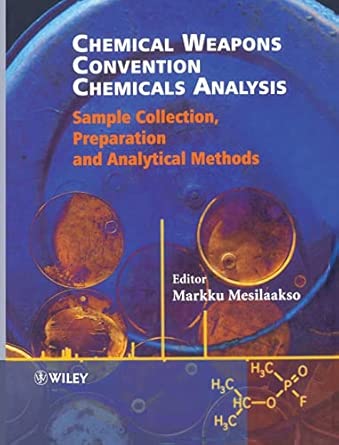
The States Parties to the Chemical Weapons Convention (CWC) have established the Organization for the Prohibition of Chemical Weapons (OPCW) in order to achieve the object and purpose of the Convention. It aims to ensure the implementation of the CWC’s provisions, including those for international verification of compliance with it, and to provide a forum for consultation and cooperation among States Parties. The aim of this book is to give a comprehensive view of how to internationally verify compliance with the CWC, in principle, using analytical chemistry and related strategies and methods.
There are currently eighteen analytical laboratories that have established capability, and obtained recognized competence in, the analysis of samples for CWC-related chemicals; these laboratories are the OPCW designated laboratories. The majority of the chapters in this book discuss the analytical methods used in these off-site laboratories. The methods discussed are for the identification of target chemicals from environmental and human origin samples. The procedures and strategies for on-site sampling and analysis are also discussed.
A variety of topics are covered, including:
- the requirements of the CWC for verification, sampling, mobile laboratories and their equipment and software;
- sample preparation from environmental samples;
- official inter-laboratory proficiency tests arranged by the OPCW;
- the OPCW Central Analytical Database (OCAD);
- monitoring of hazardous chemicals;
- analysis strategies and quality assurance;
- analytical methods including gas and liquid chromatography hyphenated with mass spectrometry or other detectors, nuclear magnetic resonance spectroscopy, infrared spectroscopy and capillary electrophoresis, and the detection of exposure to toxic scheduled chemicals.
This book is aimed at researchers from the fields of environmental and analytical chemistry, and researchers in civil and military laboratories. The National Authorities of the States Parties to the CWC will find the book useful as it covers developments in the area of CWC chemicals analysis. The approaches are practical and the chapters are particularly useful for those people responsible for developing their laboratory analysis methods and work instructions.
From the Back Cover
The States Parties to the Chemical Weapons Convention (CWC) have established the Organization for the Prohibition of Chemical Weapons (OPCW) in order to achieve the object and purpose of the Convention. It aims to ensure the implementation of the CWC’s provisions, including those for international verification of compliance with it, and to provide a forum for consultation and cooperation among States Parties. The aim of this book is to give a comprehensive view of how to internationally verify compliance with the CWC, in principle, using analytical chemistry and related strategies and methods.
There are currently eighteen analytical laboratories that have established capability, and obtained recognized competence in, the analysis of samples for CWC-related chemicals; these laboratories are the OPCW designated laboratories. The majority of the chapters in this book discuss the analytical methods used in these off-site laboratories. The methods discussed are for the identification of target chemicals from environmental and human origin samples. The procedures and strategies for on-site sampling and analysis are also discussed.
A variety of topics are covered, including:
- the requirements of the CWC for verification, sampling, mobile laboratories and their equipment and software;
- sample preparation from environmental samples;
- official inter-laboratory proficiency tests arranged by the OPCW;
- the OPCW Central Analytical Database (OCAD);
- monitoring of hazardous chemicals;
- analysis strategies and quality assurance;
- analytical methods including gas and liquid chromatography hyphenated with mass spectrometry or other detectors, nuclear magnetic resonance spectroscopy, infrared spectroscopy and capillary electrophoresis, and the detection of exposure to toxic scheduled chemicals.
This book is aimed at researchers from the fields of environmental and analytical chemistry, and researchers in civil and military laboratories. The National Authorities of the States Parties to the CWC will find the book useful as it covers developments in the area of CWC chemicals analysis. The approaches are practical and the chapters are particularly useful for those people responsible for developing their laboratory analysis methods and work instructions.
About the Author
Markku Mesilaakso, VERIFIN, Finland.
 Wow! eBook