Wow! eBook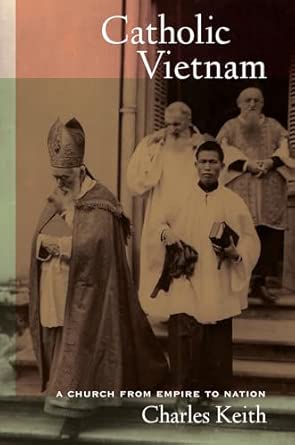
Catholic Vietnam: A Church from Empire to Nation: 5
Author(s): Charles Keith (Author)
- Publisher: University of California Press
- Publication Date: 18 Oct. 2012
- Language: English
- Print length: 328 pages
- ISBN-10: 0520272471
- ISBN-13: 9780520272477
Book Description
Editorial Reviews
Review
From the Inside Flap
“In
Catholic Vietnam, Charles Keith challenges a deeply entrenched body of flawed conventional wisdom about the modern history of Vietnamese Catholicism. Free from the biases and tendentious assumptions that distorted scholarship on the topic during the Vietnam War era and armed with a massive arsenal of difficult-to-access primary sources in French and Vietnamese, Keith provides the most thorough and even-handed historical treatment currently available of the Vietnamese Catholic community under French rule, while telling a gripping story about a fascinating but neglected political and cultural process that he calls Catholic decolonization. Beautifully written, exhaustively researched, and persuasively argued, Catholic Vietnam sets a new standard within the field.” Peter Zinoman, author of The Colonial Bastille: A History of Imprisonment in Vietnam, 1862-1940In this nuanced, wide-ranging, and lively account, Charles Keith establishes how Vietnamese Catholics positioned themselves and were perceived over time. Challenging binary and orthodox narratives, Keith s meticulously researched book successfully interrogates and ultimately debunks notions of Catholicism s inherent foreignness to Vietnam.
Catholic Vietnam provides very important and timely contributions to the histories of Vietnam, of religion, and of French colonialism. Eric T. Jennings, author of Imperial Heights: Dalat and the Making and Undoing of French IndochinaFrom the Back Cover
“In
Catholic Vietnam, Charles Keith challenges a deeply entrenched body of flawed conventional wisdom about the modern history of Vietnamese Catholicism. Free from the biases and tendentious assumptions that distorted scholarship on the topic during the Vietnam War era and armed with a massive arsenal of difficult-to-access primary sources in French and Vietnamese, Keith provides the most thorough and even-handed historical treatment currently available of the Vietnamese Catholic community under French rule, while telling a gripping story about a fascinating but neglected political and cultural process that he calls Catholic ‘decolonization.’ Beautifully written, exhaustively researched, and persuasively argued, Catholic Vietnam sets a new standard within the field.” –Peter Zinoman, author of The Colonial Bastille: A History of Imprisonment in Vietnam, 1862-1940“In this nuanced, wide-ranging, and lively account, Charles Keith establishes how Vietnamese Catholics positioned themselves and were perceived over time. Challenging binary and orthodox narratives, Keith’s meticulously researched book successfully interrogates and ultimately debunks notions of Catholicism’s inherent foreignness to Vietnam.
Catholic Vietnam provides very important and timely contributions to the histories of Vietnam, of religion, and of French colonialism.” –Eric T. Jennings, author of Imperial Heights: Dalat and the Making and Undoing of French IndochinaAbout the Author
Excerpt. © Reprinted by permission. All rights reserved.
Catholic Vietnam
A Church from Empire to Nation
By Charles Keith
UNIVERSITY OF CALIFORNIA PRESS
Copyright © 2012 The regents of the University of California
All rights reserved.
ISBN: 978-0-520-27247-7
Contents
List of Illustrations, viii,
Acknowledgments, ix,
Foreword, xiii,
Introduction, 1,
1. A Church between the Nguyen and the French, 18,
2. A Colonial Church Divided, 55,
3. The Birth of a National Church, 88,
4. Vietnamese Catholic Tradition on Trial, 118,
5. A National Church Experienced, 147,
6. The Culture and Politics of Vietnamese Catholic Nationalism, 177,
7. A National Church in Revolution and War, 208,
Epilogue. A National Church Divided, 242,
Notes, 249,
Bibliography, 289,
Index, 305,
CHAPTER 1
A Church between the Nguyen and the French
At the end of the Sino-French War, the beginning of French control over all Vietnamese territories, about seven hundred thousand Catholics made up roughly 6 to 7 percent of Vietnam’s population. About three-quarters lived in the Red River Delta in Tonkin, modern-day northern Vietnam and the historical heartland of Vietnamese Catholicism. Most of these lived in a small area spanning the modern provinces of Nam Dinh, Ninh Bình, and Hai Duong and in the ancient capital of Hanoi. In the central region of Annam, most of the roughly one hundred thousand Catholics lived in the provinces of Nghe An and Thua Thiên near the city of Vinh and the royal capital of Hue. In the French colony of Cochinchina, most of the roughly one hundred thousand Catholics lived in and around the growing urban center of Saigon, in provinces around the city along the coast, and in the coastal plains near Qui Nhon, with fewer in the western Mekong Delta near Cambodia. There were also small communities in non-kinh regions to the west and north of Nam Dinh and Thanh Hóa and around Kontum in the central highlands. However, missionaries did not encounter most people in upland areas until the mid-nineteenth century or later, and geography, low population density, and language differences made it difficult to evangelize in these regions. Even by the 1930s, non-kinh peoples were probably no more than thirty thousand of a Catholic population that by then was well over a million.
Who were these Catholics? In his study of Catholic missions in Tonkin until the late eighteenth century, Alain Forest argues that a number of factors made it possible for the growth of what is still one of the most significant Christian minorities in Asia. The sixteenth-century civil wars in the kingdom of Dai Viet, which produced a dynastic split and widespread social unrest, weakened the authority of the fifteenth-century neo-Confucian Lê restoration and led to new forms of popular Buddhism. Forest argues not only that this made Tonkin’s population receptive to a new form of belief, but that Catholicism may even have seemed
a synthesis that reconciled in itself the elements of Tonkin’s principal traditional religious expressions … by assuring a peaceful future for all departed souls regardless of how they died, by appearing to revitalize the Buddhist message of future bliss through faith in the mercy of the saviors, by proclaiming the existence of a powerful protective entity in the present, and by advocating, as a means of satisfying the expectations of happiness and salvation, rules of conduct similar to the major commands of the Confucian ethics.
Whether this is a plausible explanation or not, it is clear that many in Tonkin quickly came to believe that Catholicism had considerable power to affect the spirit world and to cure the sick or the possessed. Forest notes that missionaries before the mid-eighteenth century were nearly unanimous in their belief that “it was healing or hope of healing sickness that constituted the principal vectors of conversion.” Catholic sacred objects such as holy water, medals, sacramentals, images, rosaries, medals, and statues, in Nola Cooke’s words, “won a reputation for magical efficacy. Regarded as powerful healing and protective charms, they quickly became highly desirable spiritual prophylactics for Christians and non-Christians alike.” Although social and political barriers to conversion were meaningful enough for Forest to view Catholicism in this era as a “site of ‘formalized dissidence'” to “the literati/peasant dyptich,” he does not believe that its message of protection and promise of eternal happiness appealed only to outcasts. Indeed, he notes the religion’s considerable success among social figures such as soldiers, fishermen, boatmen, artisans, sorcerers, healers, and women, suggesting that some degree of freedom from corporate social structures is as important as dispossession in understanding the new faith’s appeal. Equally important was the adaptation of Catholicism to local practices such as collective prayers, processions, theatrical representations, group readings, and other forms of popular piety that made the new religion more familiar and accessible. By the 1780s there were as many as 350,000 to 400,000 Catholics in Tonkin. Especially for the precolonial era, it is crucial to understand that many of the people whom missionaries counted as “Catholics” viewed the religion as but one part of a broader spirit world with which they were in constant interaction.
Forest’s study has no equal for Cochinchina, where Catholicism was not nearly as successful as it was in Tonkin: in the 1780s there were but ten to fifteen thousand Catholics in the region. In part, this is simply due to the smaller and less dense population, which posed real challenges to evangelization. In the seventeenth century, Cochinchina also became a site of bitter internecine struggles between the MEP and Jesuits, which both alienated some believers and radicalized the behavior of others toward competing communities and belief systems. As Cooke argues, these conflicts “contained the seeds of changes that would help define Christian life in the Cochinchina mission until 1750, when all foreign missionaries were expelled and a violent persecution thinned Christian ranks.” By the 1820s, however, a more lenient official stance toward the religion under the emperor Gia Long had brought the Catholic population of Cochinchina to about eighty thousand. An English visitor to Saigon at this time noted a church in the center of Cho Lon, Pigneau de Béhaine’s impressive tomb near the Gia Dinh citadel, and a missionary strolling the streets “with a red face caused by wine.”
At first glance, population statistics do not suggest meaningful growth in the Vietnamese Catholic population in the nineteenth century. Tonkin’s missions grew from roughly 350,000 in the 1780s to 460,000 in the 1890s, while Cochinchina’s did not appreciably change (it was about eighty thousand in the 1820s and roughly the same in the 1890s). However, the nineteenth century was, of course, a time of widespread and severe repression of Catholicism in Vietnam, both official and popular, which not only strongly discouraged conversions but also led to as many as one hundred thousand Catholic deaths across the Nguyen kingdom. How, then, to explain the continued growth of the religion in this context? Although further research on the subject is sorely needed, the best explanation is likely the administrative expansion and financial strength of Catholic missions in a time when the consolidation of Nguyen rule and the wars with France led to widespread social unrest, hardship, and dislocation. Forest notes that Tonkin’s missions survived almost entirely thanks to local resources until the mid-eighteenth century; it was “a community of mutual aid more than a community of assistance.” Thereafter, and especially in the nineteenth century, organizational reforms and a rise in money and manpower from Europe made Catholic missions, in Jacob Ramsay’s words, “an oasis of modest stability, both social and economic, in a country where the threat of devastation through drought, plague, or disease was ever present. Conversion not only promised membership in a tightly organized, self-supporting community, it enfranchised the destitute and most desperate.” It is important to underscore here that the prosperity and unity of Catholic missions were not only appealing as a social safeguard, but they also seemed to many to be a manifestation of the religion’s virtue and spiritual potency.
Available statistical evidence, though admittedly thin and problematic, suggests that the colonial era brought relative demographic stability to Catholic life after a history of fluctuation. Mission statistics from 1939 place the Catholic population at roughly one and a half million, about twice what it was in the 1890s. Philippe Langlet calculates that Vietnam’s population grew from between nine and ten and a half million in the 1860s to between twenty and twenty-five million in 1945. This suggests, tentatively, that over nearly four generations, the number of Catholics grew at a rate that was roughly equal to population growth in general and did so in a way that did not meaningfully alter their geographic distribution. This should not suggest that communitarian identity was fixed or stable: people, families, and entire communities continued to join and leave the Church for many reasons, and some missions experienced more success than others. But the Catholic population simply did not fluctuate like it had in the past. Indeed, although many missions often reported more than ten thousand annual baptisms of “pagans” (païens), virtually all of these came at the time of death (in articulo mortis), a common practice intended to save souls that nevertheless did little to bolster mission ranks on earth. The reasons for flattening conversion rates during the colonial era must remain speculative here. Missionaries often blamed lingering anti-Catholicism and anticlerical colonial policies, both of which were clearly a factor, but they also admitted ruefully that anti-French feelings made it much harder to achieve conversions than in the past. Although missions prospered during the colonial era, it is also possible that, especially in Tonkin, their relative influence declined after the rise of French rule in light of the collapse of political authority and widespread social hardship in this region in the late Nguyen era. Finally, internal conflicts in Catholic life that resulted from the surge in the missionary presence, as well as powerful new physical and cultural boundaries between Catholics and others from the conquest era, also limited conversions.
By the late nineteenth century, most Catholics in Tonkin and northern Annam lived in so-called “Catholic villages” (làng dao, làng giáo) set apart from other villages (làng luong). Catholic villages had their roots in the powerfully corporate nature of villages in these regions, which made conversion of extended social networks more likely than in Cochinchina and offered a communal foundation to maintain conversions. Catholic villages were crucial for community defense in times of violence, which helped cluster Catholics in these regions even more closely together by the beginning of French rule. Although the resultant barriers were considerable, these were never worlds entirely unto themselves: interactions between làng dao and làng luong, especially in the densely populated Red River Delta, were a regular part of life during the colonial era. Few làng dao were in fact entirely Catholic, and even Catholics in Annam and Tonkin at times lived in villages where they were a minority. Although Catholics often lived in a specific part of these villages and avoided some village rituals, they were often well integrated into local life.
Catholic community structures were quite different in lower Annam and Cochinchina. During the first two centuries of evangelization in these regions, fluid social structures and low population density made conversions in Cochinchina fewer and less communally based than they were in Annam or Tonkin. At the time of the Nguyen defeat of the Tây Son in 1802, far fewer Catholics in Cochinchina lived in tightly clustered socioreligious units than in Annam or Tonkin. Minh Mang’s first edicts against Catholics in the 1830s were applied most strictly in Cochinchina, a frontier region where tensions between the Nguyen state and local society were high. This first meant that many Catholic population centers were further dispersed, not concentrated. However, continued violence in the two decades preceding the French invasion helped concentrate many Catholics around large towns such as Saigon, where many Catholics from southern provinces fled in the 1850s and early 1860s. By the early colonial era, decades of violence and a pro-Catholic French military regime in Cochinchina had largely eroded communitarian coexistence and had begun to concentrate Catholics together more than in the past. Still, religious geography below central Annam differed in basic ways from further north throughout the colonial era.
The basic religious unit in Catholic life in Vietnam was the congregation (ho). A parish (xu dao / giáo xu) contained a number of congregations, and a district (hat) a number of parishes. A mission (giáo phan or dia phan), the largest unit of religious life, contained a number of districts. The practical nature of these designations varied widely. A congregation in Tonkin and northern Annam was most often within a single village; further south, it could be many small groups of Catholics spread out over a number of villages. In other words, religious and social structures did not always overlap. This was also true of parishes and districts, administrative designations within missions that, in practice, varied significantly based on the number of clergy available to minister to them. There were only three missions in Vietnam before the mid-nineteenth century. The area north of the Gianh River, near Hue, was divided into West Tonkin (Tonkin Occidental or Tây Dàng Ngoài), which included areas west of Hanoi south through the modern province of Nghe An and was administered by the MEP (Hoi Thua Sai Paris); and East Tonkin (Tonkin Oriental or Dông Dàng Ngoài), which included the coastal provinces of the Red River Delta and fell under Spanish Dominicans (Dòng Da Minh) from the Province of the Most Holy Rosary of the Philippines (Provincia del Santísimo Rosario de Filipinas). Areas south of Hue were the Cochinchina mission (Cochinchine or Dàng Trong), which was administered by the MEP. The number of missions grew in the colonial era; there were eight by the 1880s, eleven by 1902, and sixteen by the end of French rule, all spanning progressively smaller territories.
Catechists or lay ministers (thay giang) and sisters were on the lowest rung of the religious hierarchy. They assisted the clergy in their ministries and directed religious instruction and ritual life in communities without a permanent priest or missionary. A variety of different catechists had a wide range of responsibilities: thay xu handled the day-to-day issues of village life; thay cai worked with children and youth; thay giáo were responsible for religious education and ministry; and thay quan were supervisors. Catechists (all of whom were men) and sisters could be virtually any age. “First-class” catechists received formal ecclesiastical training, took a vow of celibacy, traveled with the clergy or alone to minister to Catholics, and often became candidates for the priesthood. “Second-class” catechists were lay Catholics whose age, status, wealth, or knowledge gave them authority as religious leaders (giáo truong); their communities often viewed them less as “catechists” than as teachers or notables. Sisters, whose responsibilities lay principally in education and caring for the sick and elderly, lived communally. Many were part of the Lovers of the Holy Cross (Dòng Men Thánh Gía), the first Catholic order founded in Vietnam, founded in 1670 by Pierre Lambert de la Motte. As Nhung Tuyet Tran has shown, “by entering the sisterhood, many poor women combined their resources in a community that afforded them housing, mutual aid, and educational opportunities unavailable to women of most class backgrounds in that era.” This “afforded these women mobility that they would not have had within the structures of family life” through a “self-reliant alternative world that called upon practical worldly knowledge, spiritual devotion, and a relatively egalitarian environment.”
(Continues…)Excerpted from Catholic Vietnam by Charles Keith. Copyright © 2012 The regents of the University of California. Excerpted by permission of UNIVERSITY OF CALIFORNIA PRESS.
All rights reserved. No part of this excerpt may be reproduced or reprinted without permission in writing from the publisher.
Excerpts are provided by Dial-A-Book Inc. solely for the personal use of visitors to this web site.