Wow! eBook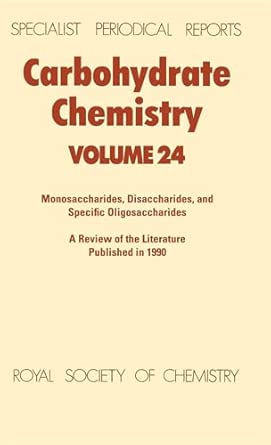
Carbohydrate Chemistry: Volume 24 Edition. ed. Edition
Author(s): R Blattner (Other Contributor)
- Publisher: CRC Press
- Publication Date: 18 Nov. 1992
- Edition: Edition. ed.
- Language: English
- Print length: 364 pages
- ISBN-10: 0851866727
- ISBN-13: 9780851866727
Book Description
Carbohydrate Chemistry provides review coverage of all publications relevant to the chemistry of monosaccharides and oligosaccharides in a given year.
Editorial Reviews
Excerpt. © Reprinted by permission. All rights reserved.
Carbohydrate Chemistry Volume 24
Monosaccharides, Disaccharides, and Specific Oligosaccharides
By R. J. Ferrier
The Royal Society of Chemistry
Copyright © 1992 The Royal Society of Chemistry
All rights reserved.
ISBN: 978-0-85186-672-7
Contents
Chapter 1 Introduction and General Aspects, 1,
Chapter 2 Free Sugars, 3,
Chapter 3 Glycosides, 17,
Chapter 4 Oligosaccharides, 58,
Chapter 5 Ethers and Anhydro-sugars, 72,
Chapter 6 Acetals, 79,
Chapter 7 Esters, 84,
Chapter 8 Halogeno-sugars, 103,
Chapter 9 Amino-sugars, 107,
Chapter 10 Miscellaneous Nitrogen Derivatives, 123,
Chapter 11 Thio- and Seleno-sugars, 138,
Chapter 12 Deoxy-sugars, 146,
Chapter 13 Unsaturated Derivatives, 154,
Chapter 14 Branched-chain Sugars, 163,
Chapter 15 Aldosuloses, Dialdoses, and Diuloses, 171,
Chapter 16 Sugar Acids and Lactones, 174,
Chapter 17 Inorganic Derivatives, 188,
Chapter 18 Alditols and Cyclitols, 193,
Chapter 19 Antibiotics, 211,
Chapter 20 Nucleosides, 224,
Chapter 21 N.M.R. Spectroscopy and Conformational Features, 257,
Chapter 22 Other Physical Methods, 274,
Chapter 23 Separatory and Analytical Methods, 289,
Chapter 24 Synthesis of Enantiomerically Pure Non-carbohydrate, 302,
Author Index, 320,
CHAPTER 1
Introduction and General Aspects
The renaissance being enjoyed by carbohydrate chemistry is reflected in the world-wide strength of the 1990 literature of the subject, biology and improved methodologies stretching research further and faster.
While the evolved format of these Reports largely allows for the handling of new material, some adaptation is desirable and (after some debate) treatment of chain-extended sugar derivatives is now included in Chapter 2. Carbohydrates as chiral auxiliaries is another aspect that the normal format does not accommodate too readily; it is treated in Chapter 24, and Chapter 4 now includes brief reference to chemical aspects of the cyclodextrins.
A monograph on carbohydrate chemistry has appeared in Topics in Current Chemistry, the history of the subject from its origins has been surveyed in a Chinese language publication and a data bank of the structures of all complex carbohydrates larger than disaccharides has been set up. Reports of papers given at an American Chemical Society Symposium on computer modelling of carbohydrate compounds have appeared in a collected volume.
The nomenclature committee of the International Union of Biochemistry has recommended that the early method used to number the atoms of myo-inositol be relaxed. According to the proposal substituents need not necessarily be numbered so that the smallest possible locant is used; authors may use alternative designations to bring out structural relationships.
An extensive review has appeared on the anomeric and exo-anomeric effects in carbohydrate chemistry. A further review of the anomeric effect asserts that n[right arrow]σ* contributions to the former effect are small relative to those of n[right arrow]n** destabilising ccomponents. Further consideration has been given to the effect following analysis of 529 crystal structures of carbohydrates, in particular the C-O bond lengths and C-O-C and O-C-O bond angles as they depend on dihedral angles in the sequence C-O-C-O-C. The work is an extension of an earlier study (Vol. 18, p.2, ref. 4).
Reviews have also been published on the following chemical aspects of carbohydrates: thermal decomposition, DMSO-dependent oxidation of hydroxyl groups, and reactions in liquid hydrofluoric acid.
Thermodynamic data on aqueous solutions of mono- and oligo-saccharides have been surveyed; new hypotheses on the state of water in the hydration shells of sugars were considered in the light of interactions with third species.
CHAPTER 2
Free Sugars
Reviews have been published on the chemistry of sucrose and its derivatives (90 refs.), on the synthesis of stable isotope enriched D-glucose (61 refs.), and on the interaction between saccharides, metal ions and polyamines (44 refs.).
1 Theoretical Aspects
Earlier reports of unusually large parity-violating energy differences between enantiomers of sugar precursors (see Vol. 20, p. 2, ref. 4 and Vol. 22, p. 4, ref. 8) have now been shown to be wrong.
Correlated variations of bond lengths in pseudorotating furanose rings have been estimated by a theoretical method, and the quantisation of hydrogen bond lengths in carbohydrate crystals has been investigated by use of a 1-dimensional anharmonic oscillator model.
The kinetic effects of various aldohexoses, ketohexoses, and aldopentoses as solutes on the hydrolysis of 1-benzoyl-3-phenyl-1,2,4-triazole, a reaction which is catalysed by water, have been studied. All the sugars tested caused retardation of the hydrolysis. The results were evaluated in terms of stereochemical features and hydration of the monosaccharides.
2 Synthesis
A summary has been presented on the 2-(trimethysilyl)thiazole method of ascent in the aldose series (see Vol. 23, p. 4, ref. 15 and p. 11, ref. 48). A review on the synthesis of stable isotope enriched D-glucose is referred to above (ref. 2).
The autocatalytic synthesis of carbohydrates from formaldehyde was found to require the presence of trace amounts of acetaldehyde. It was assumed that the initial condensation of formaldehyde with acetaldehyde, followed by retroaldol splitting of the condensation products, furnishes glycolaldehyde and low molecular carbohydrates which further condense with formaldehyde. The self-condensation of glycolaldehyde phosphate in aqueous NaOH is covered in Chapter 7.
2.1 Pentoses and Hexnses. – The transketolase-catalysed synthesis of D-threo-pentulose from L-serine reported in Vol. 21, p. 6, ref. 31, has now been carried out with doubly 13C-labelled starting material to give D[1,2-13C2] threo-pentulose. In a preliminary publication, the cloning and overproduction of bacterial fuculose 1-phosphate aldolase (EC 4.1.2.17) has been described. This enzyme catalyses the aldol reaction between dihydroxyacetone phosphate and various aldehydes to give, as shown in Scheme 1, products with 3R, 4R stereochemistry. The commonly used rabbit muscle fructose 1,6-diphosphate aldolase (RAMA) furnishes 3R, 4S-configurated products. The synthetic utility of a bacterial 2-deoxyribose 5-phosphate aldolase (DERA, EC 4.1.2.4) has been assessed. DERA catalyses the reversible aldol condensation between acetaldehyde and D-glyceraldehyde 3-phosphate, Scheme 2, i.e., between two aldehydes, which is unusual. Many alternative aldehydes, including sugars and their phosphates are accepted as substrates.
High yielding and highly stereoselective aldol condensations involving simple or α,β-unsaturated aldehydes (1), the silylenol ether (2), and the chiral catalyst (3), have been employed to prepare free sugars via aldonolactones. As illustrations, the syntheses of D-ribose and 6-deoxy-L-talose are given in Scheme 3.
The reaction of 2,3-O-cyclohexylidene-D-glyceraldehyde with the α-hydroxyacetyl anion equivalent (4), prepared from benzyl chloromethyl ether, 2,6-xylyl isocyanide and SmI2, proceeded with excellent stereoselectivity to furnish, after acetylation and imine hydrolysis, the D-erythro-pentulose derivative (5). Deprotection gave the free sugar (6) as shown in Scheme 4.
Full experimental details have been published for the synthesis of all eight L-hexoses from 2-butene-1,4-diol by a reiterative two-carbon extension cycle consisting of four key steps (asymmetric epoxidation, epoxide opening with benzenethiol accompanied by epoxide migration, Pummerer rearrangement, and Wittig olefination) which was outlined in Vol. 17, p. 4, Scheme 4. A ten step synthesis of the β-D-tagatopyranose 1,2-acetonide (8) from D-fructose involved epimerisation at C-4 of an appropriately protected intermediate (7) by an oxidation – reduction sequence, and the key step in the preparation of L-gulose (10) and L-galactose (11) from D-glucose and D-galactose, respectively, shown in Scheme 5, was the Pummerer rearrangement of the peracetylated 6-deoxy-6-phenylsulphinyl-D-hexitoIs (9).
The release of free sugars by selective deprotection at C-1 of perbenzylated and peracetylated hexopyranoses is referred to in Chapters 5 and 7, respectively.
2.2 Chain-extended Compounds. – De Las Heras et al. have presented a summary of their contributions to the synthesis of branched-chain and higher sugars and nucleosides.
The lactone (12) (see Vol. 23, p. 8, ref. 31) has been converted to the 5-C-hydroxymethyl-D-threo-D-allo-octose derivative (14) and its D-threo-L-talo isomer (15) by dihydroxylation of the known methylidene intermediate (13). Deprotection and reduction gave the 4-C-hydroxymethyl octitols (16) and (17), respectively. The 4-deoxy analogue (18) was available by direct reduction of the lactone (12) with LiBH4 and subsequent acetal hydrolysis.
The synthesis of KDO and related structures from monoepoxides of divinylcarbinols, which proceeds via tetra-O-benzyl-aldehydo-D-ribose is covered in Chapters 16 and 18, and the preparation of a 2-deoxy-L-galacto-heptose derivative from ascorbic acid via methyl L-threonate in Chapter 12.
A variety of methods have been used to prepare higher sugars from suitably protected dialdehydo-pentoses and -hexoses: the synthesis of the L-glycero-D-manno-heptose derivative (20) involved a one-carbon extension at C-6 of the hexodialdehydo precurson (19) by stereoselective reaction with vinyl magnesium bromide and ozonolysis of the terminal alkene thus formed, followed by reductive work-up. Two-carbon homologation was achieved by use of either 2-thiazolymethylene triphenylphosphorane (21) or the more traditional Wittig reagent (22). As an illustration, the preparation of the di-O-isopropylidene dideoxyoctose (25) from diacetone D-galacto-dialdose (23) is shown in Scheme 6. With the former method an E/Z mixture of alkenes (24) was first obtained, the double bond being reduced during the subsequent thiazole unmasking procedure.
Compound (25) was further extended by condensation with 4-butenylmagnesium bromide, and the resulting terminal alkene (26) was converted, by a known procedure as shown, to 8-azi-6,7,8,9,10-pentadeoxy-D-galacto-undecose (27). Use of 2-(trimethylsiloxy)furan (28) in the presence of BF3 etherate as reagent for chain extension allows the addition of a four carbon unit to aldehydes with high disastereoselectivity. An example is given in Scheme 7.
In an attempt to increase the water solubility of carborane – antibody complexes, the dialdehyde (23) and several other sugar aldehydes were treated with lithiated dicarba-closo-dodecaboranes (29). The reactions were reasonably stereoselective, giving erythro- and threo-products, e.g., compounds (30) in ca. 4:1 ratios. From the same starting compound (23) the 1,6-C-linked disaccharide (33) was prepared by fluoride ion mediated condensation with peracetylated β-C-glucopyranosyl nitromethane (31) followed by elaboration of the resulting nitroalkene (32) as shown in Scheme 8. By a similar reaction sequence, the C-linked β,β,-trehalose analogue (35) was available from the acyclic glucose derivative (34).
Mixed Kolbe electrolysis of the sugar carboxylic acids (36) and (38) with fatty acids gave moderate yields of the single product (37) and the mixture (39), respectively, with long unfunctionalised alky! branches. 1-Deoxy-1-(indolin-3-yl)-α-L-sorbopyranoses (41) were formed from ascorbigen and its derivatives (40) in ca. 30% yield on treatment with aqueous alkali.
A method for the preparation of higher sugars with an aromatic branch has been developed which involves a Michael addition – aldol condensation sequence and uses carbohydrate silylenol ethers, e.g. compound (42), as starting materials. As is demonstrated in Scheme 9, the Michael addition product was obtained as the stable silylenol ether (43). On desilylation, aldol condensation took place to give the cyclic hydroxyketone (44) which aromatised under acetylation conditions. The introduction of an aromatic branch by Diels-Alder cyclisation of a carbohydrate diene is referred to in Chapter 19.
Chain elongation has been accomplished intramolecularly, by addition of the radical derived from the bromoacetal group at O-3 of the 5,6-dideoxy-hex-5-enofuranose derivative (45) to the exocyclic double bond (Scheme 10). The addition was stereoselective but lacked regioselectivity, the isomeric functionalised furano-oxepan (46) and furano-pyran (47) being formed in approximately equal amounts. The analogous radical cyclisation of the alkyne (48) on the other hand gave, after hydrogenation, the exo addition product (47) exclusively. In another intramolecular chain extension, which is outlined in Scheme 11, the nitrone (50), easily prepared from the 6-aldehydo-D-glucopyranoside derivative (49) with N-benzylhydroxylamine, underwent 1,3-dipolar addition to the double bond of its 4-O-allyl group to give, after deprotection, the chiral pyrano-pyran- and pyrano-oxepan-derivatives (51) and (52) as the major and minor products, respectively, in 2:1 ratio.
3 Physical Measurements
Recommended values for the thermodynamic and transport properties of pentoses and hexoses and their phosphates, in both the condensed and aqueous phase, have been presented and critically evaluated. The partial molar volumes and expansibilities of some pentoses and hexoses in aequeous solution have been determined, and the viscosities of similar solutions have been measured up to 2.5 mol kg-1 at 293.15 -318.15 K; the molar thermodynamic activation parameters for viscous flow were found to be linearly dependent on the solute mol fraction, indicating that the partial molar contributions by the solutes to the activation are independent of their concentration.
The enthalpies of dilution of aqueous solutions containing an oligomer of glycine and either L-arabinose, D-ribose, D-xylose, or D-lyxose have been measured. The glass-to-rubber transition temperature of glucose/fructose and sucrose/fructose binary melt mixtures were determined by differential scanning calorimetry (DSC), and the same technique was used to record the state diagram for aqueous galactose; in addition, the heat of fusion of H2O in sugar solutions, which can be very different from that of pure water, was calculated.
A symposium report has been published on adsorption and x-ray photoelectron spectral data for a glucose/alumina system, aimed at deriving new information about glucose mutarotation catalysis over basic alumina surfaces. The sorption of galactose by Na-Y, K-Y, and Ba-Y zeolites has been investigated by isopiestic equilibration at 25°C, and in a study of the absorption kinetics for glucose and fructose on KU-2 calcium cation exchange resin, the equilibrium adsorption isotherms were found to depend on the temperature, the degree of crosslinking, and grain size.
18O-Isotope shifts in 13C-n.m.r. spectra have been used to follow the kinetics of the oxygen exchange reactions at the anomeric centres of D-glucose, D-mannose, and D-fructose which are catalysed by acids and bases. The exchange rates were slow relative to mutarotation. Evidence from g.c. data on trimethylsilyl derivatives of 2-deoxy-D-glucose and 2-deoxy-D-maltose suggested that the disaccharide in the crystalline state contains 83% of the α and 17% of the β form. The enthalpy and entropy of interaction of cations with hexoses and pentoses is referred to in Chapter 17.
4 Isomerisation
The light-promoted mutarotation of α-D-glucose in DMSO in the presence of aromatic hydrocarbon sensitisers has been reported. It has been confirmed, by use of h.p.l.c, that the mutarotation of α- and β-D-glucopyranose in dilute, neutral aqueous solution is a slow process, taking approximately three hours at ambient temperature to reach completion. The mutarotation rate of the β-compound was 1.4 times that of the α-isomer, and the α:β ratio at equilibrium was 37.2:62.8. In addition, it was found that α-D-glucopyranose complexes more strongly with Ca++ ions then does β-D-glucopyranose.
The tautomeric equilibrations of D-erythro-2-pentulose and of D-threo-2-pentulose in aqueous solution have been studied by 13C-n.m.r. spectroscopy. The α- and β-furanoses and acyclic keto forms were detected at all temperatures, whereas the acyclic gem-diols were not observed. Thermodynamic and kinetic parameters for the interconversions were determined and a comparison with the corresponding data for the structurally related aldotetrofuranoses indicated that replacement of H-1 in the latter compounds by hydroxymethyl group significantly decreases the ring-opening and ring-closing rate constants of furanose anomerisation. The furanose-pyranose equilibria of trehalulose, maltulose, and some other α-D-glucopyranosyl-D-fructoses in water, pyridine, and DMSO have been determined with the help of 1H-n.m.r. methodology. Similar studies on the tautomeric equilibria of ribose, glucose, fructose, and related sugars are covered in Chapter 21.
Epimerisation at C-2 of aldoses in alkaline, aqueous or methanolic solution proceeded more rapidly when Ca salts were added. This Ca(II) -promoted epimerisation involved a stereospecific C-1 – C-2 skeletal rearrangement, D-[1-13C] glucose giving D-[2-13C] mannose, and the formation of fructose from either glucose or mannose (Lobry-Alberda rearrangement) was slowed down by the presence of the salt. The previously reported epimerisation and isomerisation of D-glucose by the tetramethylethylene diamine (tetmen) complexes of Ni(II) and Ca(II) (see Vol.21, p.4, refs.22-24 and Vol.23, p.10, ref.45) has been extended to additional monosaccharides. The Ni complex was found to be superior for promoting C-2 epimerisations to give near equilibrium mixtures of, for example, D-galactose and D-talose, or D-ribose and D-arabinose, the isomer with cis-disposed OH-2 and OH-4 generally predominating. Ca-tetmen, on the other hand, promoted aldose – ketose isomerisation, for which an intermediate has been postulated. A review covering this area is referred to at the beginning of this Chapter (ref.3).
In aqueous solutions of ammonium molybdate, acyclic D-xylose, D-lyxose, D-glucose, and D-mannose formed binuclear bidentate molybdate complexes involving the hydrated carbonyl group as well as the hydroxy groups at C-2, C-3, and C-4. Epimerisation via these complexes was accompanied by skeletal rearrangement; thus D-[2,3,4,5,6-13C5] mannose isomerised to D-[1,3,4,5,6-13C5] glucose.
(Continues…)Excerpted from Carbohydrate Chemistry Volume 24 by R. J. Ferrier. Copyright © 1992 The Royal Society of Chemistry. Excerpted by permission of The Royal Society of Chemistry.
All rights reserved. No part of this excerpt may be reproduced or reprinted without permission in writing from the publisher.
Excerpts are provided by Dial-A-Book Inc. solely for the personal use of visitors to this web site.