Wow! eBook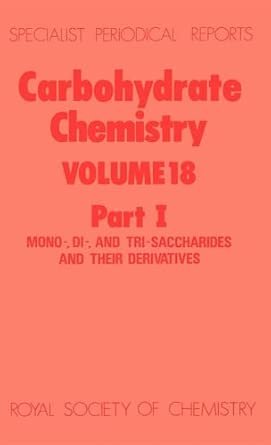
Carbohydrate Chemistry: Volume 18 Edition. ed. Edition
Author(s): N R Williams
- Publisher: Royal Society of Chemistry
- Publication Date: 1 Feb. 1986
- Edition: Edition. ed.
- Language: English
- Print length: 294 pages
- ISBN-10: 0851862020
- ISBN-13: 9780851862026
Book Description
Carbohydrate Chemistry provides review coverage of all publications relevant to the chemistry of monosaccharides and oligosaccharides in a given year.
Editorial Reviews
Excerpt. © Reprinted by permission. All rights reserved.
Carbohydrate Chemistry Volume 18
Part 1 Mono-, Di-, and Tri-saccharides and Their Derivatives
By N. R. Williams
The Royal Society of Chemistry
Copyright © 1986 The Royal Society of Chemistry
All rights reserved.
ISBN: 978-0-85186-202-6
Contents
1 Introduction and General Aspects, 1,
2 Free Sugars, 3,
3 Glycosides and Disaccharides, 15,
4 Oligosaccharides, 42,
5 Ethers and Anhydro-sugars, 50,
6 Acetals, 58,
7 Esters, 63,
8 Halogeno-sugars, 78,
9 Amino-sugars, 88,
10 Miscellaneous Nitrogen Derivatives, 105,
11 Thio-sugars, 116,
12 Deoxy-sugars, 120,
13 Unsaturated Derivatives, 127,
14 Branched-chain Sugars, 135,
15 Aldosuloses sind Dialdoses, 145,
16 Sugar Acids sind Lactones, 148,
17 Inorgsinic Derivatives, 157,
18 Alditols sind Cyclitols, 163,
19 Antibiotics, 176,
20 Nucleosides, 190,
21 N.M.R. Spectroscopy and Conformational Features, 212,
22 Other Physical Methods, 225,
23 Separatory and Analytical Methods, 238,
24 Synthesis of Enantiomerically Pure Non-carbohydrate,
Author Index, 262,
CHAPTER 1
Introduction and General Aspects
This report follows the format of Volume 17 and reflects the continued wide interest in the chemistry of carbohydrates and their application to other areas of chemical and biochemical research. Three quarters of the chapters contain over 40 references, with particularly extensive interest being shown in glycosides, oligosaccharide synthesis, amino-sugars, antibiotics, nucleosides, and, increasingly, the use of carbohydrates as chiral synthons for a wide range of chiral natural products and their analogues. The demarkation between carbohydrate and non-carbohydrate compounds is increasingly difficult to see, and in particular we have had problems in the selection of references covering the necessarily vague boundary between mono-, di-, and tri-saccharides on the one hand and polysaccharides on the other. There does not seem to be any logical boundary between these two extremes, and hitherto we have somewhat arbitrarily concentrated on the synthesis and more chemical aspects of boundary compounds, including the structural analysis of naturally occurring oligosaccharides, while omitting degradation fragments of polysaccharides, or more purely biochemical aspects. Likewise our coverage of antibiotics and nucleosides focusses on the structure, synthesis, and reactions of the carbohydrate components of these materials. We would be interested to have your opinions both on the area and limits of coverage of Part I of this report, bearing in mind the overall cost effectiveness of the product, and also on the most sensible title for it; we are aware that the present title lacks precision, since we do mention some higher oligosaccharides in Chapter 4, and such units also occur in many antibiotics. It is much to be regretted that it has not proved possible to produce Part II of this report simultaneously, which might alleviate the problem.
An appreciation of the life of Dexter French has been published.
A survey of regio-, stereo-, and chemo-selective reactions in carbohydrate chemistry includes discussion of phase transfer reactions in partial substitution reactions, selective halogenation and conversion to unsaturated sugars, and the selective cleavage of acetals giving partially substituted sugar derivatives.
A statistical analysis of oxygen-hydrogen-oxygen hydrogen bonds in carbohydrate crystals has been made, indicating that all hydroxy groups and most oxygen atoms are involved in hydrogen bonding, and cooperative effects of these govern crystal structures. A study of the anomeric effect has investigated 111 carbohydrate structures relationships between bond lengths and bond angles in the C-O-C-O-C grouping were analysed, and interpreted in terms of the anomeric and exo-anomeric effect, aiding understanding of these effects and some hitherto problematic observations.
CHAPTER 2
Free Sugars
Reviews on the subjects of the composition of reducing sugars in solution, hydrophobic nature of some sugar derivatives, and aspects of the commercial chemical conversion of glucose, e ,g. alkaline isomerism, oxidation, and degradative oxidation, have appeared.
It has been shown that patients with multiple sclerosis have elevated levels of fructose and glucitol in their cerebrospinal fluid.
1 Theoretical Aspects
Ab initio SCF LCAO-MO calculations on β-D-fructopyranose and α-L -sorbopyranose using crystallographic data as the geometrical input have been carried out. Properties such as orbital energies, total energy, ionization potentials, Mulliken population analysis, and electrostatic potentials were considered in relation to sweetness; it was concluded that non-bonded overlap between oxygen and hydroxy hydrogen correlated with taste. Force field calculations covering intra- and inter-molecular interactions have enabled the development of a model for α-D-glucose surrounded by specific water molecules.
The relationship between molecular rotations and bond refractions has been used in calculations for a range of α-D-glucopyranose analogues with sulphur, nitrogen, or phosphorus as the hetero-ring atom. Strengths of inter-molecular bonds in aqueous solutions have been calculated for D-glucopyranose, D-mannose, D-galactose, D-xylose, and maltose, confirming the effect of chiral centre interactions. The strengths of the bonds associated with α-anomers is greater than those of β-anomers. A careful analysis of the reaction between 2,3,4, 6-tetra-O-benzyl-α-D-glucopyranose and trichloromethyl cyanide in the presence of sodium hydride yielding the anomeric imidate (see Chapter 7) led to the interesting conclusion that the anomeric β-D-oxide ion (1) is more nucleophilic than the corresponding α-oxide (2) because enhanced orbital repulsions in (1) make the electrons on the anomeric oxygen more accessible; thus the anomeric effect operates kinetically as well as thermodynamically.
2 Synthesis
Reviews of the total synthesis of carbohydrates, the synthesis of monosaccharides from non-cyclic compounds and their stereoselective glycosidations, and of the use of carbon-carbon bond-forming reactions and stereoselective introduction of heteroatom functionality in the synthesis of free sugars, deoxysugars, aminosugars, alditols, and branched-chain sugars have been published. The synthesis of monosaccharides from simple organic molecules such as 2,3-0 -isopro-pylidene-D-glyceraldehyde and L-tartaric acid is the subject of a review, which includes new glycosylation reactions using glycosyl fluorides, internal cyclizations, and direct introduction of alkoxy groups to the 2-position of the keto-function in sugars.
In a simulation of probiotic conditions the formose reaction has been carried out using a wet discharge or u.v. irradiation. It was found that the presence of the mercury(II) ion increased the yield of sugars and their precursors, glycolaldéhyde, glyoxal, and formic acid. A comparison of photo- and [??]-irradiation in the formose reaction in the presence of base showed that the former produced penta-erythritol as a single product, while the latter resulted in glycolaldehyde as the main product. When boric acid was used as the catalyst, the favoured formation of D,L-arabinitol in the formose reaction was shown by g.l.c. analysis. Selective formation of DL-dendroketose in good yield in the formose reaction can be achieved by using thiazolium salts, followed by treatment with aqueous alkali. The course of the reaction is probably via the first-formed dihydroxyacetone, which is known to give dendroketose on reaction with base. The products of the formose reaction using calcium hydroxide – bismethylene glycolate complex as catalyst have been analyzed by l.c., u.v., 13C-n.m.r., and g.c.-m.s. A kinetic analysis has led to the suggested mechanism for the formation of sugars from glycolaldéhyde, glyceraldehyde, and dihydroxyacetone in the calcium hydroxide-mediated final phase of the formose reaction. Carrying out the formose reaction in the presence of thallium(I) hydroxide at pH>12 gave mainly pentoses, whereas lower pH values gave Cannizzaro products. Twenty carbohydrates have been identified and a further nine tentatively identified in the mixture of linear, deoxy- and branched-chain carbohydrates formed in the formose reaction with the latter making up the major portion of the mixture.
U.v. irradiation of the iron(III) complexes with monosaccharides gives rise to lower sugars. D-Fructose and D-arabinose both give D-erythrose in 80% yield, while D-glucose and D-mannose produced D-arabinose initially, which was then converted into D-erythrose. D-Ribose yielded D-erythrose and D-glyceraldehyde. Aldehydo-sugars may be obtained by oxidative removal of the dithioacetal group from acetylated, methylated, tritylated, or N-tosylated sugars using N -bromosuccinimide in aqueous acetone or tert-butanol – acetone. The reaction, which was also applied to protected 2-acylamino-2-deoxy -sugars, proceeded rapidly at 0 °C, and generally gave yields equal to or better than the usual mercury(II) ion methods.
The best conditions for acid hydrolysis of 5,6-anhydro-1,2-O-isopropylidene-β -L-idofuranose (3), leading either to L-idose, or 1,2-0 -isopropylidene-β-L-idofuranose, or 1,6-anhydro-L-idopyranose, have been determined. L-Glucose has been synthesized from 1,2:5,6-di -O-isopropylidene-α-D-glucofuranose by the route shown in Scheme 1, 1,3-di-O-benzyl-D-glycero-tetrose (4) has been prepared from the D-erythritol derivative (5) as summarized in Scheme 2, and L-fucose and [4-2H] fucose have been synthesized from L-rhamnose as shown in Scheme 3
The Bilik molybdate reaction has been used to prepare labelled carbohydrates. Thus D-[U-14C]glucose, from acid hydrolysis of the α-[U-14C]glucan of the alga Chlorella sp grown in 14CO2, was converted to D-[U-14C]mannose. D-[U-14C]-Erythrose,- threose, -galactose,-arabinose,-xylose, and-lyxose were also prepared.
The deuterated acetylene derivative (6) has been used to synthesize D-(6R)- and D-(6S)-[6-2H1]glucose by deprotection of the intermediates (7) and (8) shown in Scheme 4. Regio- and stereo-specific photobromination of 1 ,6-anhydro-2,3,4-tri-O-benaoyl-β-D -galactopyranose to yield the (6S)-bromo-derivative (9) was the key step in the synthesis of D-(6S)-[6-2H1]galactose. Inversion of this via the 6-O-tosyl compound led to the (6R)-isomer.
G.l.c.-m.s. of the isopropylidenated product mixture obtained by aldol condensation of glycolaldehyde and 1,3-dihydroxypropan-2-one allowed identification of erythro-2-pentulose, erythrose, threose, xylose, dendroketose and threo-2-pentulose. The ratio of these products varied with the base used, which included calcium, barium, and sodium hydroxides and the hydroxide ion form of Dowex-1 and Amberlite IRA-4.00.
The formation of 1-deoxy-D- and -L-threo-pentulose by cell-free extracts of microorganisms has been reported. A new enzymatic acyloin-type condensation between pyruvate (or acetoin or methyl-acetoin) and D-glyceraldehyde was found to be catalyzed by cell-free extracts of a transketolase mutant of Bacillus pumilus IFO 12089, giving 1-deoxy-D-threo-pentulose. The same condensation using L-glyceraldehyde gave the L-isomer. Similar enzyme activities were detected in cell-free extracts of a variety of microorganisms, including yeasts, moulds, bacteria, and actinomycetes, suggesting that the enzyme responsible has an important role in the biosynthesis of thiamine, since the deoxy-pentulose is a precursor of the 5-carbon unit of the thiazole ring.
3 Physical Measurements
Measurements of coupling constants and 13C spin lattice times for 13C-enriched tetroses and tetrofuranosides have enabled conformational changes and ring dynamics to be determined; a very thorough analysis of the furanose and acyclic species was made.
The apparent ratios of β-pyranose and α- and β-furanose anomers in aqueous solutions have been determined by light scattering detection of h.p.l.c. peaks.
Electro-osmosis and streaming potential measurements of aqueous D-glucose solutions across testosterone-plug membranes have been used to determine zeta potentials and to examine the influence of H -bonding between water molecules and those of D-glucose.
The hydrogen-bonding in aqueous solutions of D-ribose and 2-deoxy-ribose has been examined by determining the enthalpies of transfer for these sugars from pure water to aqueous solutions of ethanol and urea, significant differences in enthalpies being observed between the two sugars. The excess enthalpies of nine aqueous ternary -solutions of urea and monosaccharides have been determined by micro-calorimetry, and it has been shown that there are differences between the behaviour of saccharides and that of cyclic or linear polyols. The specific heat capacities of D-xylose and D-glucose in aqueous ethanol of different compositions have been measured. A report of a study of the thermal behaviour of carbohydrates using heat flow calorimetry in the temperature range 20 – 270 °C included enthalpy data for 44 sugars and polysaccharides. The temperature range for thermal decomposition varied widely for different carbohydrates.
The mutarotation of α-D-glucopyranose is catalyzed by borate, tungstate, molybdate, and bicarbonate species. It was proposed that specific aquation around the anions enhances their nucleophilicity in the rate-determining formation of the aldehydo intermediate. α-Aminoacids are widely held to be catalysts for sugar mutarotation, particularly histidine. However, 0.014M histidine only increased rate of glucose mutarotation by 3 – 4%, although in molar ratio of 1:10; it was also non-stereospecific with respect to the absolute stereochemistry of the amino-acid. Thus the action appears to be limited to general increase in buffer concentration and not to any concerted acid-base catalysis. The use of a stopped flow polarimetry technique for the study of the base-catalyzed mutarotation of D-glucopyranoses in water is referred to in Chapter 22. In the presence of borate, there is a substantial increase in the proportion of the acyclic form of a number of sugars as determined by circular dichroism. The amount of acyclic form increased with alkalinity or temperature. In going from phosphate to borate buffer at 25° the open chain form increased 9.1 times for D-glucose, 2.9 times for galactose, and 2.2 times for D-mannose.
Primary paramagnetic products of the radiolysis of β-L-arabinose between 77 and 430K were identified by e.s.r. as stabilized electron and alkoxy radicals with electrons localized at 0-2. Free radicals, formed by thermal decomposition of primary products, were identified and their mechanism of formation and subsequent transformation proposed. U.v., i.r., optical rotation, and magnetic susceptibility data on [??]-irradiated fructose have been reported. E.s.r. has been used to study production of free radicals during the autoxidation of simple monosaccharides via spin-trapping with 5,5-dimethyl -1-pyrroline N-oxide. The monosaccharides produced hydroxy and hydroxymethyl radical-derived spin adducts. At high pH, both hydroxy and hydroxyalkyl radicals were formed, while at low pH only hydroxy-alkyl radicals were detected. D-Ribose and D-glucose autoxidize very slowly without production of free radicals, whereas glycolaldéhyde, glyceraldehyde, and dihydroxyacetone, which readily form the intermediate enediol, autoxidize with the production of radicals.
The i.r. spectrum of D-fructose in deuterium oxide solution has been recorded; From the intensity of Vc=o, it was deduced that 0.9% open chain form was present. The assignment of bands to furanose and pyranose forms by Mathlouthi (see Vol.14, p.202, ref.8) were disputed since they were found to occur in the crystalline fructo-furanose.
The effect of crystallinity of lactose samples on their mechanical and structural properties has been examined.
Temperature effects on rates of hydrolysis of sucrose in hydrochloric acid solution over the range 10 – 40 °C have been reinvestigated using polarimetry and h.p.l.c. analysis to measure sucrose concentration and g.l.c. analysis to estimate glucose. Activation energies were the same using all three methods and were temperature independent. Values of pKa for lactose and lactulose of use in the base-catalyzed isomerization of the former to the latter have been measured by means of 13C-n.m.r. titration: the similarity of the values to those of D-glucose and D-fructose led to the conclusion that the extra galactose unit has little influence on the ionization. G.l.c. analysis of monosaccharides involving dehydration by distillation followed by oximation has been used to show the presence of sugar impurities in commercial samples of sugars.
4 Anomerization
A convenient, practical conversion of α-D-glucose to β-D-glucose in 92% yield, using mutarotation in acetic acid at 100 for one hour, and crystallization from acetic acid with seeding, has been described. Pressure effects on the anomerization of α-D-glucose by the enzyme mutarotase over a pH range of 5.50 to 6.75 have been studied over the range 1 to 1000 Bar; the reaction was found to be unaffected, in contrast to the acid-base catalyzed isomerization, thus invalidating the accepted view that the two reactions have identical mechanisms. The Lineweaver-Burke values support a histidine unit being at the active site of the enzyme.
5 Oxidation
Simple monosaccharides have been shown to autoxidize under physiological conditions to yield dicarbonyl compounds and hydrogen peroxide via reactive free radicals, the rate of enolization of the sugar being the rate-limiting step of this spontaneous process.
(Continues…)Excerpted from Carbohydrate Chemistry Volume 18 by N. R. Williams. Copyright © 1986 The Royal Society of Chemistry. Excerpted by permission of The Royal Society of Chemistry.
All rights reserved. No part of this excerpt may be reproduced or reprinted without permission in writing from the publisher.
Excerpts are provided by Dial-A-Book Inc. solely for the personal use of visitors to this web site.