Wow! eBook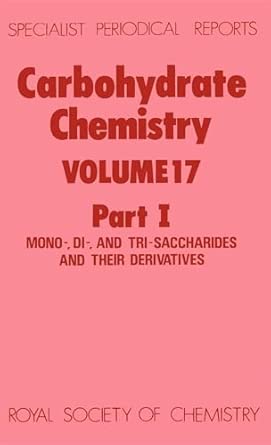
Carbohydrate Chemistry: Volume 17
Author(s): N R Williams
- Publisher: Royal Society of Chemistry
- Publication Date: 1 May 1985
- Edition: 1st
- Language: English
- Print length: 286 pages
- ISBN-10: 0851861822
- ISBN-13: 9780851861821
Book Description
Carbohydrate Chemistry provides review coverage of all publications relevant to the chemistry of monosaccharides and oligosaccharides in a given year.
Editorial Reviews
Excerpt. © Reprinted by permission. All rights reserved.
Carbohydrate Chemistry Volume 17
Part I Mono-, Di-, and Tri-saccharides and Their Derivatives
By N. R. Williams
The Royal Society of Chemistry
Copyright © 1985 The Royal Society of Chemistry
All rights reserved.
ISBN: 978-0-85186-182-1
Contents
1 Introduction, 1,
2 Free Sugars, 2,
3 Glycosides and Disaccharides, 15,
4 Oligosaccharides, 44,
5 Ethers and Anhydro-sugars, 54,
6 Acetals, 63,
7 Esters, 67,
8 Halogeno-sugars, 81,
9 Amino-sugars, 90,
10 Miscellaneous Nitrogen Derivatives, 104,
11 Thio-sugars, 116,
12 Deoxy-sugars, 120,
13 Unsaturated Derivatives, 125,
14 Branched-chain Sugars, 131,
15 Aldosuloses, Dialdoses, and Diuloses, 141,
16 Sugar Acids and Lactones, 146,
17 Inorganic Derivatives, 154,
18 Alditols and Cyclitols, 159,
19 Antibiotics, 171,
20 Nucleosides, 186,
21 N.M.R. Spectroscopy and Conformational Features, 205,
22 Other Physical Methods, 219,
23 Separatory and Analytical Methods, 229,
24 Synthesis of Enantiomerically Pure Non-carbohydrate Compounds, 244,
Author Index, 257,
CHAPTER 1
Introduction
We have abstracted over 1400 references in carbohydrate chemistry for 1983. The areas of interest reflected in these references have confirmed the trends apparent in recent years. Besides the well-established fields of glycoside, nucleoside, and antibiotic chemistry, there has been a rapid increase in papers reporting the synthesis of chiral natural products from carbohydrate precursors, and a separate chapter on oligosaccharides has clearly justified its inclusion. Incidentally, these last two chapters have both resulted from suggestions made to us by interested readers, and we would like to encourage further participation of this kind. The emphasis in these areas should not obscure the fact that many other aspects of monosaccharide and oligosaccharide chemistry continue to attract much interest, as is demonstrated by the fact that only six of the twenty-four chapters in this volume contain fewer than thirty references.
An appreciation of the life and work of J.K.N.Jones has been published.
Reviews covering general aspects of carbohydrate chemistry have included a survey of nucleophilic substitution reactions in carbohydrate derivatives, discussions of the role of lone-pair interactions in the selective functionalization of hexopyranosides in esterification and etherification reactions, and a review of some studies in asymmetric synthesis, Diels-Alder reactions, and stereospecific sugar synthesis.
CHAPTER 2
Free Sugars
A review of the structures and nomenclature of the sugars of honey has appeared.
1 Synthesis
Two reviews on the synthesis and utilization of sugars produced by the formose reaction have appeared. The use of chemical ionization – m.s. to characterize the products of the formose reaction has been described. A report of a study on the catalytic activity of rare earth element hydroxides, M(0H) 3, where M is Er, Pr, Sm, Ho or Ce, together with calcium hydroxide on the formose reaction, includes measurements of the ratios of three- and four-carbon products to those containing five- and seven-carbon atoms, when glucose was used as co-catalyst. The factors affecting formation of 2,4,-bis (hydroxymethyl)-3-pentulose in the formose reaction when carried out in methanol or water in the presence of various alkaline earth salts and potassium hydroxide have been investigated: the optimum yields were obtained with strontium salts in methanol. In the formose reaction catalyzed by N,N-diethylethanolamine, it was shown that addition of monosaccharides and of organic bases such as quinuclidine and 3-quinuclidinol increased the amount of conversion, whereas a decrease in pH caused a decrease in conversion. It was suggested that the bases inhibited the competing Cannizzaro reaction. In the related formoin reaction, in which the autocondensation of formaldehyde catalyzed by the thiazolium salt (1) and a tertiary amine in an aprotic solvent such as DMF occurs, the effect on the yields of the resultant glucose, galactose, xylose, and arabinose of varying the conditions has been studied.
Reaction of 2,3-O-isopropylidene-D-glyceraldehyde with carboxyl-containing active methylene compounds gave products of type (2), which were decarboxylated to triols (3) and then dehydrated to yield the unsaturated derivatives (4). Dihydroxylation of the appropriate derivatives of (4) was carried out to give 1-deoxy-D-sorbose and -fructose. 2,3-O-Isopropylidene-D-glyceraldehyde (5) has been converted into 2-deoxy-D-erythro-pentose (6) using the route shown in Scheme 1. When reagent (7) was used the ratio of (9) to (10) was 1:4, whereas when chiral reagent (8) was employed this ratio increased to 1:24- Chain extension using the cis and trans-2-buten-1-yl reagents (11) and (12) corresponding to the allyl reagent (8) gave the diastereomeric products, (13) and (14), (15) and (16) in the ratios shown in Scheme 2.
Aldol-type condensation of 4-O-benzyl-2,3-O-isopropylidene-L-threose (17) with the tin(II) enediolate (18), derived from methyl-glyoxal, gave the C-3 epimers (19) in high yield. Both of these epimers, upon reaction with N, N-carbonyldiimidazole gave the same cyclic carbonate (20), probably due to imidazole-catalyzed isomerization at the (α-position (Scheme 3). The carbonate (20) is a new precursor for L-sugar synthesis. Base-catalyzed condensation of formaldehyde with D-threo-pentulose gave rise to the epimeric 3-uloses (21) which were converted as a mixture to the di-O-isopropylidene derivatives (22) and (23). Separation by column chromatography allowed examination of the products by mass spectrometry and i.r. spectroscopy. Condensation of ethyl acetoacetate with either D-ribose or D-arabinose has been shown to yield the erythrotriol (24), while the epimeric threo-product (25) was obtained from D-xylose.
A procedure for the synthesis of L-hexoses by a reiterative two-carbon extension cycle of four steps has been described, traced in Scheme 4. The products were enantiomerically pure. The cycle can be repeated, leading to higher sugars.
Indirect electrochemical oxidation of D-glucono-(1 [right arrow] 5)-lactone to yield D-arabinose with 65% yield has been achieved at low temperature and low current densities by using cerium sulphate as mediator in aqueous sulphuric acid and platinum electrodes.
Conventional means have been employed to synthesize some L-idose derivatives (26) from 1,2:5,6-di-O-isopropylidene-α(-D-glucofuranose via the 5>6-epoxide. Several routes leading to 3,5,6-tri-O-acetyl-1, 2-O-isopropylidene-β-L-idofuranose required on 100g scale, have been evaluated. A successful synthesis is shown in Scheme 5.
D-Fructose has been produced in over 90% selectivity by catalytic hydrogenation of D-glucosone using 5% Pd/C. In conjunction with enzymic oxidation of D-glucose to D-glucosone this represents a patented conversion of D-glucose to D-fructose. A procedure for raising the efficiency of enzymic conversion of lactose into glucose and galactose has been described. The overall conversion was raised to 80-90% by separating unreacted lactose by crystallization after passage over the β-galactosidase used; since galactose inhibits this enzyme the conversion is limited per pass so that re-passage is required. The solubilities of lactose, glucose and galactose were determined at various temperatures and sugar ratios, as were the effects of rates of cooling, thus leading to convenient and simple processes for the isolation of lactose from the hydrolysis products. The reduction of methyl (methyl-3-deoxy-2-aldulosid)-onates with sodium borohydride to yield methyl 3-deoxy-2-ketosides, followed by resin-H catalyzed hydrolysis of the glycoside, has been used to synthesize free 3-deoxy-2-ketoses.
Sugars enriched with carbon isotopes have been prepared by reaction of aldoses with labelled potassium cyanide, the epimeric aldononitriles being hydrogenated over palladium-barium sulphate to yield the epimeric alditolylimines. The latter spontaneously hydrolyse to yield the requisite labelled aldose with one more carbon atom. The epimers were separated on Dowex 50(Ba2+ or Ca2+) columns. By using deuterium gas in the hydrogenation step these same authors prepared doubly labelled sugars. Carrying out the Kiliani-Fischer reaction in H 0 led to the oxygen labelled products. Using these methods variously labelled D – erythrose and D-threose were prepared from D-glyceraldehyde and D-[22- 180]arabinose and D-[2- 180] ribose were prepared from D-erythrose. A remote semiautomated synthesis for routine production of 1-[11C]-2-deoxy-D- glucose by reaction of H11CN with 1-O-triflyl-2,3:4,5 -di-O-iso-propylidene-D-arabinitol has been described. The purity was better than 98% and the yield 24 – 30%. A stereospecific synthesis of (6S)-D-glucose-6-2H via Ferrier photobromination of 1,6-anhydro – 2,3,4-tri-O-benzoyl-β-D-glucopyranose has been reported (Scheme 6).
A similar sequence was used to prepare the (6R) isomer by starting with the [6,6-2H2]isomer of (27) and carrying out the reduction with unlabelled tri-n-butyltin hydride.
Reference to conversion of 2-methoxyethyl glycosides of benzyl-protected sugars to free sugars by means of titanium tetrachloride will be found in chapter 3.
2 Physical measurements
Calorimetric methods have been used to determine the integral enthalpies, partial molal heat capacities, and apparent molal volumes of sugars and polyols in water at low concentrations. The structure-forming abilities of sugars, as evidenced by their activity coefficients, viscosities, and apparent molal volumes have been determined, and shown to be in the order glucose > mannose ~ galactose, and maltobiose > maltose > glucose. The data obtained from measurements of excess enthalpies of aqueous solutions of monosaccharides at 298.15 K suggest that the behaviour is governed primarily by solute-solvent interactions. The solubilities of several mono- and disaccharides in 2-methoxyethanol has been shown to be greatly enhanced in the presence of 5 – 20% w/w of lithium chloride. The dissociation of ammonium hydroxide in water was increased by the presence of amylose, D-glucose, and poly(ethylene glycol). A near i.r. differential spectrophotometric method of determining hydration numbers of solutes in aqueous solution has been applied to eight different sugars; the effect of concentration and temperature were examined.
Kinetic parameters have been determined for the mutarotation of D-xylose between pH 1.2 and 1.7 and 3.6 – 4-.4- at 25°, 160° or 180° C. It was shown that increasing the pH decreased the rate at 25° but increased it at 180 °C. A detailed further study of mutarotation of 2,3,4,6-tetra-O-methyl-D-glucose in benzene catalyzed by 2-gyridinone has been carried out using O-2H, N- 2H, and C(1) – H labelled compounds. A mechanism involving hydrogen bonding of the sugar hydroxy group to the carbonyl of the catalyst with the 0-5 forming a hydrogen bond with the NH and simultaneous transfer of the two hydrogens was envisaged. The effects of pressure on the mutarotation of α- and β-D-glucopyranose have been studied; rate constants and activation volumes were determined for the uncatalyzed reaction and for the reaction catalyzed by copper perchlorate. The mechanism was discussed. Hydroxide ion-catalyzed mutarotation of a series of glucopyranoses in water has been studied by stopped-flow polarimetry. Glucose was shown to differ remarkably from its substituted analogues, probably due to dissociation of two hydroxy groups as the hydroxide ion concentration was increased. The data suggested coupled proton transfer in water alone, whereas for the hydroxide ion a stepwise mechanism, involving formation of a sugar anion (or dianion for glucose), was more likely. The kinetic data were best explained by assuming a second dissociation constant of glucose to be no larger than 10-14.6and those for the substituted compounds to be considerably smaller.
A study of the vacuum thermal dehydration of sucrose and cellobiose between 150 °C and 250 °C showed that water is the major decomposition product together with small amounts of one- and two-carbon fragments. The so-called melting with decomposition of sugars is in reality a high temperature dissolution in the water or alcohol produced. Values for Arrhenius activation energies, In A and orders of reaction for the thermal decomposition of D -xylose have been obtained. The thermal stabilities of D-xylose, D-glucose, D-galactose and D-fructose in the presence of zinc chloride, with which they form unstable complexes, was shown to be decreased: the temperatures for the onset of decomposition and for the maximum gas evolution were decreased.
A study of X-irradiated single crystals of L-rhamnose has shown that an electron is trapped in an interstitial site formed by two hydroxy groups of the sugar and one hydroxy group of the water molecule. The trapped electron decays by cleavage of an oxygen – hydrogen bond to yield a hydrogen atom, which in turn abstracts a hydrogen atom from carbon to which the hydroxy group was attached; this produces a hydroxyalkyl radical. The electron trap pre-exists in the crystal and no dipole reorientation is necessary to stabilize the electron. Radicals induced in polycrystalline α-D-glucose by [??]-rays were trapped in aqueous ethanol solution of 2-nitroso-2 – methylpropane. By means of specific labelling of the D-glucose and by e.s.r., five long-lived nitroxide spin-adducts were tentatively assigned. E.s.r. measurements in the free radicals generated by irradiation of lactose confirmed a lyoluminescent reaction of singlet oxygen, involving a ring-cleaved intermediate and the formation of a carboxyl group with a localized electron. The luminescence occurs at λ max 630 nm. Reaction of D-xylose and D-ribose with hydroxy radicals gave radicals which were examined by e.s.r.; the spectra were interpreted in terms of non-selective hydrogen abstraction from the ring carbon atoms. A range of other carbohydrates including sucrose were also examined, and it was concluded that hydrogen abstraction from positions adjacent to the ring oxygen were facilitated in furanose derivatives.
The fluorescence observed in 0.1 M glucose at pH 10 and 70 ° has been ascribed to fluorescent substances derived from the sugars themselves, whether or not air or asparagine are present. A further paper from the same authors reports the separation of the fluorescent compounds and their u.v. and fluorescence spectra, but structures were not assigned.
3 Isomerization
Lactulose has been prepared in 25 – 30% yield by isomerization of lactose with alkaline sodium sulphite. Maltulose and cellobiulose have been prepared in about 90% yield by the alkaline isomerization of maltose or cellobiose in the presence of an equivalent of boric acid. Using aqueous sodium hydroxide, high concentrations, up to 4-0% w/v, of disaccharides could be efficiently transformed. The high yields result from the specific complexation of the products while only weak complexation occurs with the starting materials, whose reducing moieties cannot exist in furanose forms due to the 4-O-substituent. The product mixtures were analyzed by h.p.l.c. on primary amine-bound silica columns using amine modifier in the eluant; semi-preparative h.p.l.c. on Ca2+ resin columns were used for isolation of the pure ketodisaccharides. Epimerizations of aldoses at C-2 and C-3 catalyzed by molybdic acid have been reviewed. D-Mannose has been prepared by molybdate-catalyzed epimerization of D-glucose; after crystallization of the excess D- glucose, the D-mannose was isolated as either N-phenyl-D-mannosyl – amine or as methyl α-D-mannopyranoside. Although the yield from one cycle is only 10%, the glucose recovered materials may be recycled. In a study of D-glucose isomerase which produces D-fructose from D-glucose, it has been shown that 3-, 5-, and 6-deoxy -D-glucose and 3-O-methyl- and 6-O-methyl-D-glucose are also substrates, whereas 4-O-methyl and 4-deoxy-D-glucose are not. Specific ally deuterated D-glucoses (28) and (29) on treatment with D-glucose isomerase gave the [1 -2]-fructoses (30) and (31) respectively.
The results of an optical rotation study of the complexation of D- glucose and D-fructose with germanate ion have been used to predict suitable conditions for improving the yield of D-fructose from D-glucose by means of D-glucose isomerase. The autohydrolysis of 1,2-O-isopropylidene-α-D-glucofuranose 5-(hydrogen sulphate) led not to the expected D-glucofuranose 5-sulphate, but to D-fructopyranose 5-sulphate in high yields.51
4 Oxidation
In the oxidation of maltose by cupric ions in ammoniacal solution in which the tetra-ammine copper(II) ion is formed, the rate was found to be independent of the concentration of copper(II) ion, to be proportional to that of maltose and to have a dependence on the square root of the concentration of ammonia. A common ion effect was observed by retardation of rate on addition of ammonium chloride. The mechanism proposed included the rate determining formation of an intermediate enediol. A similar conclusion on the mechanism of oxidation of D-glucose by hexacyanoferrate(III) in the presence of ethylenadiamine was supported by a zero order dependence on the transition metal ion concentration and measurements showed that the rate of enolization to yield the intermediate enediolate ion was the rate of oxidation. The kinetic parameters for the pseudo-first order oxidation of pentoses and hexoses using Cu2+ have been reported; Arrhenius energies fell in the range 136 – 143 kJ mol . The kinetics and mechanism of the oxidation of D-galactose by manganese(III) sulphate have been reported. A further investigation of the oxidation of D-glucose to D-gluconic acid by hexachloroiridate(IV) and by tetrachloroaurate(III) has led to the proposal that the rate determining step is the reaction of -D-glucopyranose with oxidant to produce a free radical and an Ir(III) or Au(II) species. This free radical reacts with a further molecule For the oxidation of L-cule of oxidant to give sorbose by cerium(IV) in aqueous perchloric acid, in which the reactive species is the hydrated cerium(IV) ion, the reaction is first order in the oxidant and in the sugar but the pseudo-first order constants decrease with an increase in the initial concentration of cerium(IV) ion. The enthalpy and entropy of activation were determined and a mechanism, involving no complexation between cerium(IV) and the sugar, was proposed. The conversion of D-gluconic acid, or its lactone into D-arabinose by electrochemical oxidation in aqueous sulphuric acid in the presence of ceric sulphate has been described.
(Continues…)Excerpted from Carbohydrate Chemistry Volume 17 by N. R. Williams. Copyright © 1985 The Royal Society of Chemistry. Excerpted by permission of The Royal Society of Chemistry.
All rights reserved. No part of this excerpt may be reproduced or reprinted without permission in writing from the publisher.
Excerpts are provided by Dial-A-Book Inc. solely for the personal use of visitors to this web site.