Wow! eBook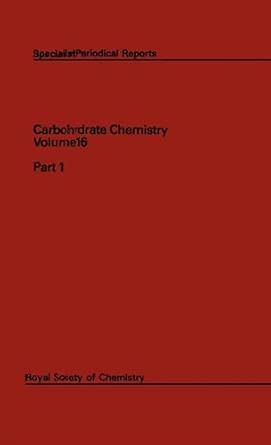
Carbohydrate Chemistry Volume 16 Edition. Edition
Author(s): N R Williams
- Publisher: CRC Press
- Publication Date: 1 Mar. 1988
- Edition: Edition. ed.
- Language: English
- Print length: 298 pages
- ISBN-10: 0851861628
- ISBN-13: 9780851861623
Book Description
Carbohydrate Chemistry provides review coverage of all publications relevant to the chemistry of monosaccharides and oligosaccharides in a given year.
Editorial Reviews
Excerpt. © Reprinted by permission. All rights reserved.
Carbohydrate Chemistry Volume 16 Edition. ed. Edition
Mono-, Di-, and Tri-saccharides and Their Derivatives
By N. R. Williams
The Royal Society of Chemistry
Copyright © 1984 The Royal Society of Chemistry
All rights reserved.
ISBN: 978-0-85186-162-3
Contents
1 Introduction, 1,
2 Free Sugars, 3,
3 Glycosides and Oliqosaccharides, 17,
4 Ethers and Anhydro-sugars, 51,
5 Acetals, 63,
6 Esters, 68,
7 Halogeno-sugars, 82,
8 Amino-sugars, 88,
9 Miscellaneous Nitrogen Derivatives, 107,
10 Thio- and Seleno-sugars, 117,
11 Deoxy-sugars, 122,
12 Unsaturated Derivatives, 130,
13 Branched-chain Sugars, 141,
14 Dicarbonyl Compounds and Their Derivatives, 153,
15 Sugar Acids and Lactones, 156,
16 Inorganic Derivatives, 165,
17 Alditols and Cyclitols, 172,
18 Antibiotics, 184,
19 Nucleosides, 205,
20 N.M.R. Spectroscopy and Conformational Features, 224,
21 Other Physical Methods, 240,
22 Separatory and Analytical Methods, 249,
23 Synthesis of Enantiomerically Pure Non-carbohydrate Compounds from Carbohydrates, 261,
Author Index, 27 3,
CHAPTER 1
Introduction
This report continues the format adopted in previous volumes. Some account has been taken of criticism regarding the unsatisfactory coverage of oligosaccharides in this series of annual reviews, so that the chapter on glycosides now contains a section devoted to oligosaccharides. In view of the expanding interest in the chemistry of oligosaccharides following the advent of versatile and efficient methods for their synthesis, it is intended in future issues to devote a separate chapter in Part I to chemical aspects of oligosaccharides, including syntheses, leaving more biochemical aspects, and in particular their isolation as characteristic components of polysaccharides and glycoconjugates, to be treated in Part II. It is inevitable that this group of carbohydrates falls between the principal areas of monosaccharides and polysaccharides covered in the two sections, and we would welcome suggestions on ways in which the coverage could be improved.
The papers mentioned in this report show that traditional areas of research have continued to be well supported, but there is clearly growing interest in glycoside and oligosaccharide synthesis, in the synthesis and modification of carbohydrate antibiotics and nucleoside analogues, and in the application of carbohydrates as chiral templates for the synthesis of a wide range of important natural products and their biologically active analogues. The chapter on amino-sugars reflects the very varied approaches now being used to prepare these important compounds, and here and elsewhere the report demonstrates that carbohydrates provide fertile ground for the application of new ideas and methods for synthesizing polyfunctional chiral compounds.
A monograph on advanced sugar chemistry has been published, and reviews of general interest dealing with the synthesis of sugars from non-carbohydrate substrates and the selective removal of protecting groups in carbohydrate chemistry have appeared.
Recommendations for the abbreviations to be used when naming oligosaccharide chains have been published.
CHAPTER 2
Free Sugars
The nomenclature of monosaccharides and related compounds has been reviewed Reviews have also appeared on the chemistry of maltose, the chemistry and biochemistry of D- and L-fucose, the morphology of sucrose cry~tals, and the utilization of disaccharides by yeasts. [U-14G]Xylose, [U-14C]glucose, and [U-14C]sucrose have been used to demonstrate that sugars are the major carbon source for triterpene synthesis by the plant Euphorbia lathysis.
1 Synthesis
The formose reaction continues to attract attention. Detailed product analysis has been carried out on the autocatalytic condensation of formaldehyde using capillary g.l.c.-mass spectrometry. In addition to the previously reported sugars, pent-2-uloses, hex-3-uloses, DL-apiose and other branched hexoses were found. U.v. irradiation of formaldehyde on zeolites of types A and X has been shown to produce sugars. A formose reaction carried out in the presence of hydroxyoxo compounds at high pH has been described. Equilibrium constants were evaluated in water and aqueous methanol solution saturated with calcium hydroxide or sodium hydroxide in a unimolecular ratio with formaldehyde and known accelerators, such as 2-hydroxyacetophenone, DL-glyceraldehyde, 1,3-dihydroxyacetone, D-glucose, D-fructose or 2,3-dihydroxyprop-iophenone. The initial rate of conversion was measured and shown to correspond with hydroxide ion-catalyzed aldol reactions at these pH values. Quaternized poly[p-[2-(diethylamino)ethyl]styrene) gel has been shown to be a high efficiency catalyst for the formose reaction. Formaldehyde consumption was high when the catalyst had a high extent of quaternization or low degree of cross-linking.
The synthesis of sugars from non-carbohydrate substrates has been reviewed. Nucleophilic addition to 2,3-O-isopropylidene-D-glyceraldehyde has been used in syntheses of tetroses. Thus 2-deoxy-D-plycero-tetrose was prepared by reaction with nitromethane under basic conditions, followed by hydrolysis, acetylation, and hydrogenation. The nucleophilic addition was brought about by electro-reduction in the reaction sequence leading to D-erythrose and D-threose (Scheme 1). Also obtained in a similar sequence were D- and L-erythulose. Chiral induction in this type of reaction has been reviewed.
Methanolic potassium carbonate has been used to cause epimerization at C-2 of 2,3-O-isopropylidene-aldehydes (1) giving a route to the difficultly prepared 2,3-threo-sugars, (2). The same: reagent also will epimerize mixed thioxa-acetals as in Scheme 2.
D-Threose has been synthesized by periodate cleavage of 1,3-O-benzylidene-D-arabinitol and acid hydrolysis of the resulting dimer (3). The synthesis of 4-O-benzyl-2,3-O-isopropylidene-L-threose, a useful building block for the preparation of L-sugars, by the Swern oxidation (DMSO-(COCl)2) of the monobenzyl-2,3-isopropylidene-L-threitol (4), has been reported.
The sym-dimethyl ester derived from furan and dimethyl acetylenenedicarboxylate was efficiently hydrolysed by pig liver esterase to yield half esters with high optical purity. Precursors with the L-configuration were obtained by chemical transformation while chirality transfer through ester exchange led to precursors with the D-configuration; both products were used to synthesize the enantiomeric riboses. 3-O-Methyl-L-xylose (5), (found in the lipopolysaccharides of Gram-negative bacteria) has been synthesized by the route shown in Scheme 3.
A convenient synthesis of 3-deoxy-D-erythro-pentose (6) is depicted in Scheme 4.
A synthesis leading to L-idose has been achieved by inversion at C-5 of the tri-mesylate (7) using a resin in the acetate form in acetic anhydride; the resulting diacetate (8) was de-esterified without further inversion by means of methanolic sodium methoxide.
The racemic enone (91, synthesized as shown in Scheme 5, has been used in a number of sugar syntheses (Scheme 6). A similar reaction sequence was used to synthesize DL-talose (Scheme 7). Aspects of the application of the Diels-Alder reaction using heterodienophiles to the synthesis of D-talose are discussed inter alia in a review of this topic. The chelates formed from β-hydroxyketones and boron tributyl in the presence of oxygen are reduced by sodium borohydride to give meso-1,3-diols. Thus condensation of the di-methoxyacetal of propan-2-onal with 2,2-dimethyl-1, 3-dioxolane-4-carboxaldehyde gave the β-hydroxyketone (10) which was reduced via the boron chelate to give the diol (11). Hydrolysis with 0.25M sulphuric acid gave 3-deoxy-DL-ribo-hexose. 2-O-Methyl-D-rhamnose, a component of the lipopolysaccharide of Bacterium faecalis alcaligenes, has been synthesized b standard methods.
Carrying out the Kiliani reaction using H13CN on the dialdose derivative (12) followed by hydrolysis to the labelled alduronic acid, reduction to the alcohol and hydrolysis with trifluoroacetic acid gave a 2:1 mixture of [6-13C]D-glucose and [6-13C]1,6-an-hydro-β-L-idopyranose. [6-13C]-D-Glucose has also been prepared by the route shown in Scheme 8. The same paper describes syntheses of 2-amino-2-deoxy-D-[1 -13C]glucose hydrochloride and 2-[15N]amino-2-deoxy-D-glucose hydrochloride by means of the Kuhn reaction with labelled hydrogen cyanide and labelled benzylamine respectively.
Condensation of D-mannose with nitromethane gave a mixture of 1-nitro-1-deoxy-D-glycero-D-galacto-heptitol and its D-talo-isomer, which was separated and the former reduced and acetylated to give 1-acetamido-1-deoxy-D-glycero-D-galacto-heptitol, oxidation of which, using Acetobacter suboxydans, gave 7-acetamido-7-deoxy-α-L-galacto-heptulopyranose. D-plycero-D-manno-Heptose (13) has been synthesized using the Achmatowicz approach shown in Scheme 9.
L-Glyceraldehyde, readily prepared in high optical purity from L-galactono-(1–4)-lactone, was condensed with dihydroxyacetone to yield, after treatment with acetone-sulphuric acid, 2,3:4,5-di-O-isopropylidene-L-fructopyranose. Attempts to apply the thermolysis of sucrose iin DMSO to the synthesis of D-fructose derivatives gave irreproducible results; this was found to be due to the presence of an acid impurity in the solvent in variable, trace amounts. The kinetics of the acid-catalyzed reaction in DMSO, DMF and water were studied. An extension of the work reported earlier in this chapter (ref. 17) allowing the synthesis of L-tagatose (14) from 4-O-benzyl-2 ,3-O-isopropylidene-L-threose has been published (Scheme 10).
Some by-products from the previously reported reaction of ketoses with ethyl acetoacetate have been examined in order to determine the mechanism of the reaction.
A study of the formation of oligosaccharides on thermal degradation of lactose has shown that the pyrolysis proceeds via simultaneous aldose-ketose isomerization and condensation of initially-formed monosaccharides without involving any cleavage of the carbohydrate carbon skeleton.
A new cation exchange resin, obtained by grafting sulphonic acid groups onto porous silica, has been shown to possess catalytic activity comparable to that of polystyrene sulphonic acid for the hydrolysis of oligosaccharides.
2 Physical measurements
It has been demonstrated that, for D-glucose, D-mannose, D-fructose, and D-ribose the use of ordinary, partially relaxed, pulse Fourier transform 13C-n.m.r. provides tautomeric compositions with an accuracy cornarable to those obtained by more sophisticated n.m.r. techniques. On the basis of the 13C-n.m.r. of honey, the predominant form of free fructose is β-D-fructopyranose and not the β-D-fructofuranose as is unequivocally stated in most undergraduate biochemistry texts. 13C-N.m.r. spectroscopy has been used to monitor the metabolic fate of [U-13C]glucose in vivo.
The molecular rotations, [M]D, of derivatives of α-D-gluco-pyranose, α-D-galactopyranose, and α-D-xylopyranose having different substituents at the anomeric carbon atom are shown to be linearly related to the bond refractions, ΣRD by the exression: [M]D = mΣR + I, where m, I are constants. The mutarotation of D-glucose has been studied in the presence of electrolytes. With added copper (II) perchlorate in the pH range 3.5 – 4.4, the rates rise markedly. Details of the process are discussed and a reaction model is proposed involving an oriented set of hydration molecules which act as an enhanced electrophile in the aldehyde-forming step. The proton- and solvent-catalyzed rate constants for the interconversions of the pyranose, furanose and open-chain forms of D-fructose have been measured and the activation and thermodynamic parameters cal~ulated. Kinetics of the mutarotation of 2,3,4, 6-tetra-O-methyl-D-glucose in benzene at 30° using styrene – 2-pyridone as a co-polymer catalyst have been compared with those using the corresponding monomer; it was shown that pseudo-dilution with polymer chains is effective only in relatively dilute solutions and that the polymer chains rather facilitate the association in concentrated solutions.
A review, in Russian, on the nature of primary free radicals in carbohydrates has been published. α-Irradiation of oxygen-free, nitrous oxide – saturated aqueous solutions of D-fructose 1-phosphate and 6-phosphate produced many products; among those identified were hexos-2-uloses, 6-deoxy-2,5-hexodiuloses, tetruloses, and 3-deoxytetruloses. Lyoluminescence spectra of D-glucose, lactose, and L-arabinose and the effects of pH, and substances altering the lifetime of singlet oxygen, on the spectral intensity have been analyzed. Excited dimers of singlet oxyen were found to be responsible for the chemiluminescence at 630 nm. Sensitized D-glucose has been studied in lyoluminescence experiments for its possible use in radiation dosimetry. The response of glucose was compared with some other commonly used carbohydrates. D-Glucose crystallized with lumenol was found to be a better lyoluminescent dosimetric material than any other sugar. A study of X-irradiated single crystals of α-D-glucopyranose at 77K has shown that the dominant radical is a C-6 primary hydroxyalkyl which reorients slightly on warming to 200K, and converts to a C-2 primary hydroxyalkyl radical on warming to about 300K. Annealing a sample at room temperature for 16h gave several free-radical products one identified as a C-2 secondary hydroxyalkyl radical.
A series of 4-O-glycosyl-fructoses has been examined by deaterium-induced differential isotope-shift (d.i.s.) 13C-n.m.r. experiments in aqueous solution. For the compounds studied, (lactulose, cellobiulose, and maltulose) the results of the equilibrium composition were 60:30:10:2 for the β-pyranose, α-furanose, β-furanose and open-chain forms of the fructose unit respectively. At higher temperatures, the percentage of furanose and open-chain forms increased. An anomolously high d.i.s. value for C-4 in 4-O-α-D-glycopyranosyl-glycopyranoses has a predictive value for the anomeric configuration. Unidirectional rate-constants for interconversions of the furanose and open-chain forms of D-threose and D-erythrose have been obtained by 1H and 13C saturation-transfer n.m.r. spectroscopy using the [1-13C]sugars. The technique involves saturation of H-1 or C-1 of the aldehydoform and observing the saturation transfer to the α- and β-furanoses and the hydrate.
Examination of the rate of deuterium for hydrogen exchange in the Raney nickel – deuterium oxide procedure (see Vol. 11, p. 132; Vol. 12, p. 13) and its stereochemical features has led to a theory based on the approach to catalyst surfaces of various configurational isomers. The kinetics of oxygen exchange at the anomeric carbon atom of D-glucose and D-erythrose, by means of the O isotope effect which causes a δ-shift in C n.m.r., have been measured. The pseudo-first order rate constant for both the α- and β-pyranoses of D-glucose was found to be 9.5 x 10⁻⁵ s-1. The advantages of the technique are the simplicity of the data and that all forms can be studied simultaneously.
Computerized curve-fitting applied to thermogravimetric data on sugars has shown that the absence of an anomeric hydroxy group increases their thermal stability, and this is taken to indicate that this group is involved in initiating decomposition. Other conclusions were that a free secondary hydroxy group at C-4 is more reactive than the primary one at C-6, that five-membered rings are less stable than six-membered rings, and that oligomers and polymers start decomposing at higher temperatures, with a fair correlation to molecular weight. Heat flow calorimetry has also been applied to the thermal decomposition of sugars. The excess enthalpies of aqueous solutions of nine polyols have been determined.
The wall friction of lactose and sucrose powders have been investigated in connection with the preparation of pharmaceutical tablets.
Formation of mechano-radicals by ball-milling of sugars, and the crystal structure of di-D-fructose anhydride are mentioned in Chapter 21.
3 Isomerizations
An improved synthesis of D-psicose from base-catalysed isomerization of D-fructose usin$6 calcium ion cation-exchange resin chromatography has been reported.
The kinetics of base-catalsed isomerizations of D-glucose and D-fructose, and of maltose, each in aqueous ethanol, have been determined. A revised free-energy diagram for biofunctional-ly-catalysed epimerization of 2, 3, 4, 6-tetra-O-methyl-α-D-glucose (TMG) by 2-pyridinone in benzene has been obtained using microcalorimetry, polarimetry, and 13C-n.m.r. Thermodynamic parameters for complexation of the α- and β-forms with 2-pyridinone were determined. A high yield synthesis of α-TMG was also given.
Continuing earlier studies on the alkaline isomerization of sugars (see Vol. 10, p. 9; Vol. 13, p. 11), Kucar’s group have shown that 4-deoxyaldoses in alkaline medium using DCC as transforming agent yield mainly 4-deoxy-hexos-2-uloses together with some of the corresponding C-3 epimeric hexosulose.
(Continues…)Excerpted from Carbohydrate Chemistry Volume 16 Edition. ed. Edition by N. R. Williams. Copyright © 1984 The Royal Society of Chemistry. Excerpted by permission of The Royal Society of Chemistry.
All rights reserved. No part of this excerpt may be reproduced or reprinted without permission in writing from the publisher.
Excerpts are provided by Dial-A-Book Inc. solely for the personal use of visitors to this web site.