 Wow! eBook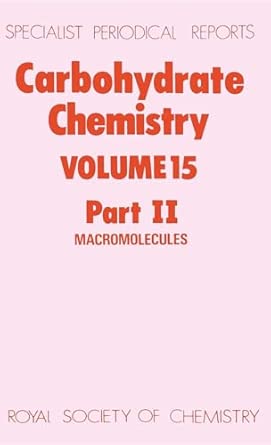
Carbohydrate Chemistry Volume 15, Part Ii
Author(s): John F Kennedy
- Publisher: CRC Press
- Publication Date: 31 Jan. 1989
- Language: English
- Print length: 833 pages
- ISBN-10: 0851861520
- ISBN-13: 9780851861524
Book Description
Carbohydrate Chemistry provides review coverage of all publications relevant to the chemistry of monosaccharides and oligosaccharides in a given year.
Editorial Reviews
From the Back Cover
Excerpt. © Reprinted by permission. All rights reserved.
Carbohydrate Chemistry Volume 15
Mono-, Di-, and Tri-saccharides and Their Derivatives
By N. R. Williams
The Royal Society of Chemistry
Copyright © 1983 The Royal Society of Chemistry
All rights reserved.
ISBN: 978-0-85186-152-4
Contents
1 Introduction, 3,
2 Free Sugars, 5,
3 Glycosides, 18,
4 Ethers and Anhydro-sugars, 50,
5 Acetals, 60,
6 Esters, 67,
7 Halogeno-sugars, 84,
8 Amino-sugars, 91,
9 Miscellaneous Nitrogen Derivatives, 106,
10 Thio- and Seleno-sugars, 117,
11 Deoxy-sugars, 124,
12 Unsaturated Derivatives, 129,
13 Branched-chain Sugars, 139,
14 Aldosuloses, Dialdoses, and Diuloses, 146,
15 Sugar Acids and Lactones, 150,
16 Inorganic Derivatives, 160,
17 Alditols and Cyclitols, 166,
18 Antibiotics, 176,
19 Nucleosides, 198,
20 N.m.r. Spectroscopy and Conformational Features, 222,
21 Other Physical Methods, 231,
22 Separatory and Analytical Methods Chromatographic Methods, 243,
23 Synthesis of Enantiomerically Pure Non-carbohydrate, 251,
Author Index, 263,
CHAPTER 1
Introduction
Although the two parts of this report are now being published separately , the general format and coverage of this section, covering the organic chemistry of mono-, di-, and tri-saccharides, has not been changed. It might be helpful to point out firstly that a hard and fast division has not been drawn between trisaccharides and higher oligosaccharides, particularly in the chapters dealing with glycosides and antibiotics, and secondly that the coverage on glycosides, antibiotics, nucleosides and related compounds containing carbohydrate units is selective for those papers where there is judged to be some specific carbohydrate interest besides any for the aglycone components; in the fringe areas, we hope this principle is acceptable in the interests of keeping the report within reasonable, economic limits.
The trends in research endeavour noted in recent reports have been continued, and the extensive sections on glycoside synthesis, antibiotics and nucleosides reflect the major interest in these areas. The synthesis of tri- and higher oligosaccharides is fast becoming a routine procedure for providing substrates of immunochemical interest. New antibiotic materials continue to be discovered consisting mainly or entirely of carbohydrate components in complex structures, and a ever widening variety of nucleoside analogues have been reported. These areas pose problems in classification, and we hope the distinctions that have been drawn between nucleosides on the one hand and miscellaneous nitrogen compounds on the other have not been too arbitrary for general acceptance. Another growth area has been the application of carbohydrates as chiral templates for the synthesis of a wide range of naturally occurring chiral compounds. Chapters 20 and 21 reflect the fruitful application of both routine and newer developments in spectroscopic techniques for the analysis of carbohydrate compounds and illustrate how much can be learned about relatively complex materials without actually doing any chemistry on them.
Recommendations for the nomenclature of unsaturated and branched-chain sugars, and of conformations of five and six-membered rings have been published during the year.
CHAPTER 2
Free Sugars
The main pathways of reaction of primary free radicals in carbohydrates have been reviewed. A review on the use of sugars in fermentation and for preparation of sweeteners, plastics and chemicals has appeared.
The tastes of chlorinated derivatives of simple monosaccharides have been compared with those of the parent sugars and the di-saccharides maltose and trehalose in relation to existing theories of the sweetness sensation.
Isolation and Synthesis
The isolation by gel chromatography of D-threo-pent-2-ulose from the lipopolysaccharide of Pseudomonas diminuta NCTC 8545 represents the first time this sugar has been observed in a microbial polymer.
Two reviews of the formose reaction by the same authors have appeared, and in two further papers an overall model for the reaction catalysed by calcium hydroxide is described. A key observation that sublimed paraformaldehyde was not transformed into sugars led to the suggestion that carbohydrates may be naturally present in p.p.m. quantities in parraformaldehyde and cause autocatalysis. Glycolaldehyde at 3 p.p.m. is sufficient to initiate autocatalysis. In the absence of traces of sugars the Cannizzaro reaction yielding methanol and formate occurred.
A solution of formose is an effective catalyst for converting formaldehyde to monosaccharides when used in 0.25 – 0.50 wt.% quantities. The induction period was shortened to one-sixth, and the Cannizzaro reaction was reduced by half with concomitant increased yield of moonosaccharides from 42 to 60%. Optimization of carbohydrate production in the formose reaction using calcium oxide and formose as co-catalysts gave an overall yield of 76.5%, comprised of hexoses (71%), pentoses (23%) and tetroses (6%). The formose reaction has been studied at cryogenic temperatures: under u.v. irradiation at 20-80K solid formaldehyde underwent polyaddition and polymerization to give polyoxymethylene. A mixture of simple aldoses resulted. A study of the catalytic activity of inorganic bases towards the Cannizzaro reaction of formaldehyde has shown that barium hydroxide is more effective than calcium hydroxide, and both are considerably more active than magnesium hydroxide. Selectivity for the Cannizzaro reaction increased on addition of copper powder, copper sulphate, ferric sulphate, bismuth chloride, or boric acid, was unaffected by addition of iron or magnesium powder, and decreased by added tin (IV) chloride. Decreasing the temperature from 40 to 10°C reduced the induction period, reaction time and yield of Cannizzaro products but increased the yield of sugar derivatives. Zinc oxide has been shown to catalyse the formose reaction to give a complex mixture of sugars at pH 5.5 without the; Cannizzaro side reaction. Addition of D-glucose or reduction of the formaldehyde-zinc oxide ratio eliminated the otherwise long induction period. G.c. analysis of the formose products under different reaction conditions with calcium salts as catalysts has shown that the complexity of the product distribution was controlled by the ratio of calcium ion-formaldehyde concentrations. A study of the formose reaction in methanol has been conducted. 15 Amines and free amino-acids can provide a necessary complementary interaction between the asymmetric carrier, the metal catalyst, and the synthesized enantiomeric forms of sugars in the formose reaction. Thus heptulose, D-manno-oxoheptulose, and D-fructose were obtained in a process utilizing a cellulose carrier and an amino-acid, with calcium and magnesium oxides as catalyst. The product mixture contained 22% neutral and 78% acidic sugars. A study of the catalytic activity of benzoyl carbinol and its 4-methoxy-, 3-chloro-, 4-chloro-, and 2,5-di-chloro-derivatives on the condensation of formaldehyde in the presence of triethylamine and lead or calcium hydroxide has confirmed that electron-donating substituents in the organic co-catalyst decreased its catalytic activity and vice versa. The rate of condensation did not depend on the concentration of formaldehyde. A selective formose reaction occurs giving 3-C-(hydroxy-methyl)-pentofuranose (1) when the major part of the calcium ions are removed as sparingly soluble salts at the end of the induction period, followed by addition of basic lead oxide (Pb2O(OH)2] and by adjusting to pH 10 with aqueous potassium hydroxide, successively.
The synthesis of the carbohydrates of glycoproteins has been reviewed (in Japanese).
D-manno-Heptulose has been prepared by DCC-catalysed isomerization of D-glycero-D-galacto-heptose and D-glycero-D-taloheptose in yields of 57 and 30% respectively. A separable mixture of 2,3,4,6-tetra-O-benzyl-L-idopyranose and its D-glucoisomer was obtained from L-sorbose by a sequence involving reduction at C-2 and oxidation at C-6 using conventional protecting group methodology. Aldol self-condensation of D-erythrose under weakly alkaline conditions at 105°C for 2 – 5 h yielded β-D-altro-L-glycero-3-octulofuranose (2) in addition to the known α-D-gluco-L-glycero-3-octulopyranose (3) and D-glycero-tetrulose which were all isolated as their peracetates. Treatment of (2) with an acidic ion-exchange resin yielded 3,6-anhydro-β-D-altro-L-glycero-octulo-pyranose (4).
Reactions of the 1,3-dithiane anion with D-gluconolactone derivatives has enabled syntheses of 1-deoxy-ketoses and C-methyl glycosides as shown in Scheme 1.
A chemicoenzymic approach has been used to prepare enantiomerically pure D- and L-ribose via the Diels-Alder adduct (5) as shown in Scheme 2.
The cadmium complex (6) prepared in situ from 2-allyloxybenzimidazole, reacts with 2,3-O-isopropylidene-D- and -L-glyceraldehyde to give the corresponding enantiomeric adducts which were converted into D- and L-ribose by the sequence shown (for the L-enantiomer) in Scheme 3.
A stereoselective synthesis of D-ribulose has been reported (Scheme 4). Addition of metal halides to the initial reaction mixture changed the ratio of (7) and (8) produced. The best results were obtained with zinc bromide at 0°C when (7) predominated (ratio 95:5) in a total yield of 75%. Complexation as shown in (9) was postulated as the cause of stereoselectivity.
Improved methods for the synthesis of 2-deoxy-D-arabino-hexose and its methyl and benzyl glycosides have been reported.
The mechanism for the Ruff degradation has been revised following the observation that calcium D-[2-H2] gluconate gave D-[1-H2]-arabinose, thus eliminating the intermediacy of the gly-2-ulosonic acid (Scheme 5).
An enzymic method for making [5-14C] glucose and [4,5,6-14C] glucose from [2-14C] glycerol and [U-14C]glycerol respectively with D-fructose 6-phosphate uses a mixture of glycerokinase, glycerol 3-phosphate dehydrogenase, triose phosphate isomerase, transaldolase, lactate dehydrogenase and phosphoglucose kinase in the presence of pyruvate to maintain NAD+ concentration.
4-Nitrophenylhydrazones of maltose, cellobiose and lactose have been degraded to the corresponding 3-Q-(D-glucosyl or D-galactosyl)-D-arabinose disaccharide by hydrogen peroxide in the presence of molybdate ions.
Physical Measurements
The rates of protonation of the hydroxy groups of twenty-six monosaccharides have been measured in DMSO. The rates for anomeric hydroxy groups, which are, in general, lower than those of the other secondary alcohol groups, are sensitive to the axial or equatorial nature of the neighbouring hydroxy function.
Pulse radiolysis and e.s.r. have been used to study localized electrons in irradiated rhamnose. The mechanism for formation of alkoxy radicals (RCHO) is briefly discussed. The e.s.r. spectrum of Me3CNO-trapped radicals produced in standard sugars by [??]-radiolysis or aqueous solution u.v. photolysis have been reported. An e.s.r. study of the oxidation of D-glucose and related compounds with the hydroxy radical indicated that it was an indiscriminate reagent generating all six possible carbon radicals; the relative ease of their acid-catalysed fragmentation was studied, and potential fragmentation routes by glycosidic cleavage of first formed radicals identified. X-Ray diffraction of sucrose before and after [??]-irradiation has shown that the latter causes damage to the lattice.
An equation relating quantitative dependence between the rate of dehydration of pentoses and hexoses, their physical properties and the characteristics of cationic catalyst used (e.g. CrCl3 or AlCl3)has been described.
The chemiluminescence spectra of sucrose, xylose, and lactose in aqueous solution have been determined.
Hydrogenation of D-glucose over Raney nickel was found to be first order with respect to hydrogen and zero order with respect to D-glucose when the concentration of the latter was >0.16M. Between 99 and 124 °C the activation energy is 83.06 kJ mol-1. The rate increased with increase in stirring speed. In contrast, it is reported that when hydrogenation of D-fructose and D-glucose is carried out on a nickel-kieselguhr catalyst the reaction is first order in the sugar. With this catalyst the yield of mannitol is <16%. The cathodic reductions of D-glucose and D-xylose at various temperatures have been studied using lead electrodes. The rate of production of sorbitol from D-glucose was accelerated by addition of zinc ions.40 Rate constants for mutarotation and ring-opening of D-xylose were also determined. Quantitative comparisons between various catalysts in the isomerization of lactose in aqueous alkaline solutions to yield lactulose and epilactose have been made. The isomerization-degradation ratio was maximum for the alkali and alkaline earth hydroxides and it was shown that lactose degrades via intermediate formation of lactulose. The effect of molybdate on epimerization of lactose was also studied.
The most complete description to date of the mutarotation of α and β-D-galactopyranose has appeared. Three sets of conditions were used and isomer proportions were determined by g,l.c. methods. Rate constants and thermodynamic parameters were determined for the formation of furanoses and the interconversions of pyranoses and acyclic forms were also quantitatively considered. Thermo-chemistry and thermokinetics of mutarotation of D-glucose have shown that the α to β conversion is accompanied by a loss of energy while the β to α conversion takes place with absorption of energy and increased entropy. These results were taken to suggest increased hydrogen bonding for the β-anomer, which may involve intramolecular or solute-solvent interactions. Bifunctional catalysis of the mutarotation of D-glucose in mixed aqueous solvents has been investigated. Catalysts used included 2- and 4-hydroxy-pyridine, pyrazole, formic acid, and the formate ion in aqueous DMSO or dioxan. Catalytic rate constants were understandable on the basis of reactant solvation and bulk medium structure. Mutarotation of D-glucose in water and in ethylene glycol has been studied and it was shown that hydrochloric acid, acetic acid, 1,1 and 1,3-dimethylurea all accelerated the rate in both solvents. In water the velocity was at a maximum at 30-40°C whereas at this temperature the reaction was at a minimum in ethylene glycol. A calculation 47 of the specific rotation of invert syrups gives the observed value if the [α][??] of D-fructose is taken as -92.4° and that of D-glucose as +52.5. N.m.r. has been used to study the pH dependence of mutarotation of N-acetyl-D-neuraminic acid. The minimum rate was found to occur at pD 5.4 and at pD <1.3 or > 11.7 it was too fast to measure.
Specific heat capacity measurements of mono-, di-, and tri-saccharides have been taken using an isoperibol twin calorimeter. The results were discussed in relation to hydration number and diffusion constant data. The hydrodynamic and electro osmotic permeability of aqueous D-fructose, D-glucose, and sucrose solutions through a pyrex sinter and through a cholesterol-coated membrane were measured, and the data obtained were shown to be consistent with the sugars increasing the water molecule aggregation. A principle advanced by J.H. Hildebrand relating viscosity with free volume and molar volume in simple liquids has been demonstrated to provide a volumetric interpretation of the viscosities of concentrated and dilute aqueous solutions of sugars. A model of the increasing organization in aqueous solutions of D-fructose, D-glucose, and sucrose with increasing concentration has been proposed on the basis of results obtained by X-ray diffraction. The different behaviour of sucrose was attributed to the formation of intramolecular hydrogen bonds between the two monosaccharide units in concentrated solution. Heats of dilution in water of D-xylose, D-fructose, D-galactose, D-mannose, lactose, and raffinose and those of L-fucose and L-rhamnose have been determined by microcalorimetry and the data used to calculate excess enthalpy terms. The results indicate that solute-solvent interactions pre-dominate over solute-solute interactions. The structure of aqueous monosaccharide solutions has also been studied by measurement of apparent molal volumes. The conclusion in this case however was that the increase with concentration was due to solute-solute interactions. Conductance values for lactose with alkali-metal halides in water and in formamide undergo an abrupt transition on passing from unsaturated to supersaturated solution. This transitional behaviour was discussed in terms of solute-solvent interactions.
Conformations of free sugars are discussed in Chapter 20.
Oxidation
One-electron oxidation of monosaccharides has been reviewed (in Russian).
A one-electron mechanism for the oxidation of D-arabinose by copper (II) sulphate or iron (III) sulphate in ethanol or propanol, whose key step is the formation of an oxy-cation at C-1 which then reacts with solvent, has been proposed. Rate constants as their logarithms have been listed for the oxidation of several aldoses by iron (III), mercury(III), and silver(I), and shown to be linear functions of free energies. The oxidation of D-xylose, L-arabinose, and D-ribose by vanadium (V) in hydrochloric acid media was shown to be first order in both substrate and oxidant. The rate increases with increasing concentration of hydrogen ion and chloride ion. A chloro-complex of vanadium was assumed to be the active species. The kinetics of oxidation of D-glucose by thallium (III) perchlorate have been determined, and the rate shown to be first order in both thallium (III) and the sugar. Addition of chloride ion or acetate ion inhibited the reaction. 63 Formic acid and arabonic acid were the products of oxidation of D-mannose by copper (II) in the presence of hydroxylamine. Rate data suggested that enolization was the rate-determining step, and that the enediol anion was the intermediate. The kinetics of oxidation of D-glucose by potassium bromate have been measured; a mechanism was suggested based on the fact that the rate is first order in sugar and potassium bromate and second order in hydrogen ion concentration. Radicals are the proposed intermediates in the oxidation of L-sorbose by vanadium (V) ions. The authors conclude that the ketose is attacked by [V(OH)3]2+ in the rate-determining step with support for the proposed mechanism coming from linear Hammett-Zucker and Bunnett plots. Other authors have studied the kinetics of oxidation of L-sorbose by vanadium (V); the oxidation of D-fructose by the same oxidant and of the two ketoses by chromium (VI) were also investigated. From enthalpies and entropies of activation and the observations that a change of medium from water to deuterium oxide affected the rate for chromium (VI) but not for vanadium(V), it was suggested that the former proceeds without formation of an intermediate complex but the latter forms a 1:1 intermediate.
(Continues…)Excerpted from Carbohydrate Chemistry Volume 15 by N. R. Williams. Copyright © 1983 The Royal Society of Chemistry. Excerpted by permission of The Royal Society of Chemistry.
All rights reserved. No part of this excerpt may be reproduced or reprinted without permission in writing from the publisher.
Excerpts are provided by Dial-A-Book Inc. solely for the personal use of visitors to this web site.


