Wow! eBook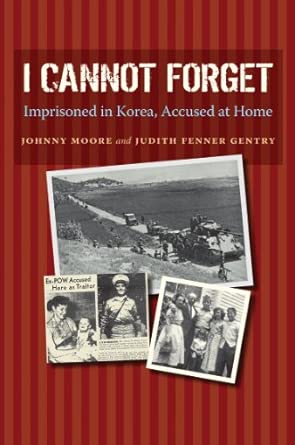
I Cannot Forget: Imprisoned in Korea, Accused at Home (Williams-Ford Texas A&M University Military History): 142
Author(s): Johnny Moore (Author), Judith Fenner Gentry (Author)
- Publisher: Texas A&M University Press
- Publication Date: 30 Oct. 2013
- Edition: Illustrated
- Language: English
- Print length: 336 pages
- ISBN-10: 1623490073
- ISBN-13: 9781623490072
Book Description
Moore and other American POWs suffered from starvation rations, bitter cold, and mental torment. Although the intense Chinese efforts to change the prisoners’ ideologies were largely unsuccessful, they were very effective in engendering distrust among the prisoners and abandonment of duty by the officers. Encouraged by an American sergeant, Moore worked with his captors to obtain better sanitation, a fairer distribution of food, and, on two occasions, medicine for the sick. Twice he tried to escape from imprisonment. Just four days after his twenty-first birthday, in 1953, the Chinese released him.
Moore cooperated fully with US military interrogators, giving as much information as he could on the prison camp and the methods his captors had used. But two years later, army officers arrested him at his home and charged him with treason. Although the charge was dropped and a Field Board of Inquiry returned him to regular duty, the army’s treatment of him left Moore further traumatized. He eventually went AWOL and turned to drinking, gambling, and other self-destructive behaviours.
Military historian Judith Fenner Gentry has worked with Moore’s memoirs of his experiences during and after the war to corroborate, clarify, elaborate, and situate his story within the larger events in Korea and in the Cold War. She has consulted records from courts-martial, newspaper interviews with returning POWs, and Freedom of Information Act documents on the Army Criminal Investigation Division and the Army Counter-Intelligence Corps.
Editorial Reviews
Review
“Johnny Moore’s Korean War recollections, including his combat experiences, mistreatment as a prisoner of war, and investigations during his postwar military service, are placed in historical context by Judith F. Gentry’s careful scholarly research. Military personnel captured in war often do not fare well in the hands of their enemies. That was certainly the case for Moore and other American prisoners of war, 1950-1953. They endured systematic starvation, intentional exposure to cold weather, and deprivation of medical care, along with extended mental tortures and psychological pressures that resulted in nearly half of them dying in the hands of their communist captors. Moore’s and Gentry’s revealing work deserves the attention of historians and students of the Cold War, the Korean Conflict, and American society of the 1950s.”–Joseph G. Dawson III, Professor of History, Texas A&M University, and editor,
The Texas Military Experience–Joseph G. Dawson III (5/2/2013 12:00:00 AM)