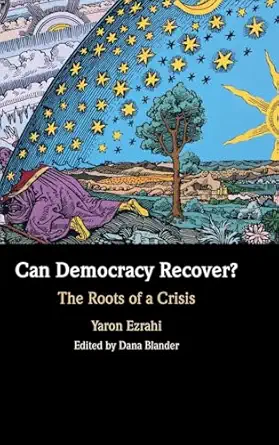
‘Can Democracy Recover?’ explores the roots of the contemporary democratic crisis. It scrutinizes the evolution and subsequent fragmentation of modern political epistemology, highlighting citizens increasing inability to make sense of the political universe in which they live, their loss of confidence in political causality, distinguishing facts from fiction and objective from partisan attitudes. The book culminates in a speculative discourse on democracy’s uncertain future. This work is the final part in Yaron Ezrahi’s trilogy. The first, ‘The Descent of Icarus’ (1990), explored the scientific revolution’s role in shaping modern democracy. The second, ‘Imagined Democracies’ (2012), examined the collective political imagination’s impact on the rise and fall of political regimes, emphasizing the modern partnership between science and democracy. ‘Can Democracy Recover?’ traces the political implications of the erosion of the Nature-Culture dichotomy, the bedrock of modernity’s cosmological imagination, and anticipates the emergence of new political imaginaries.
Editorial Reviews
Review
‘Can liberal democracy reinvent and reimagine itself? Can it be rescued from populism and authoritarianism? In this highly original book, Yaron Ezrahi, one of Israel’s leading political philosophers, argues that post-Enlightenment democracy was constructed using language and lenses borrowed from modern science. However, nowadays concepts such as “objectivity” and “fact” have lost their consensus among the public, and the outcomes and impacts of science itself are frequently regarded with apprehension. Hence, Ezrahi posits that the future of political freedom hinges on purely ethical decisions and on citizens’ capacity to collectively imagine and embrace self-constructed truths.’ Eyal Chowers, School of Political Science, Tel-Aviv University, Israel
‘An impressive and thorough investigation into the epistemological crisis of modern democracy and civic individualism. Ezrahi’s analysis elucidates the genealogical and cosmological foundations of the current crisis while offering valuable insights into the potential viability of democracy in the post-Enlightenment era.’ Wael Abu-ʿUksa, Department of Political Science, The Hebrew University of Jerusalem
‘Yaron Ezrahi may have been the most generous political and moral thinker since Montaigne. In this valedictory work he offers us an incisive, profound, and fundamentally optimistic guide to restorative democracy.’ Michael P. Steinberg, Barnaby Conrad and Mary Critchfield Keeney Professor of History and Professor of Music and German Studies, Brown University and author of The Afterlife of Moses: Exile, Democracy, Renewal
Book Description
Traces the epistemological roots of the crisis of modern democracy by exploring major cosmological shifts.
About the Author
Yaron Ezrahi (1940–2019) was an Israeli political theorist at The Hebrew University of Jerusalem. Known for his work on the relations between modern science and the rise of the modern liberal democratic state, Ezrahi was a leading voice on Israeli politics and democracy on the Israeli and the international media.
Dana Blander is a research fellow at the Israel Democracy Institute and a clinical psychologist. Her Ph.D. dissertation, Ambivalence as a Challenge to the Political Order received the Berger Prize for 2008 from the Hebrew University of Jerusalem. Blander is the co-author (with Itzhak Galnoor) of The Handbook of Israel’s Political System (Cambridge, 2018).
 Wow! eBook