Wow! eBook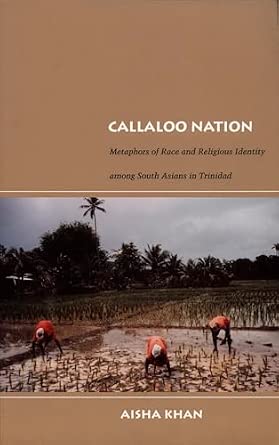
Callaloo Nation: Metaphors of Race and Religious Identity among South Asians in Trinidad
Author(s): Aisha Khan (Author)
- Publisher: Duke University Press Books
- Publication Date: 11 Oct. 2004
- Edition: Illustrated
- Language: English
- Print length: 280 pages
- ISBN-10: 0822333767
- ISBN-13: 9780822333760
Book Description
Khan combines ethnographic research she conducted in Trinidad over the course of a decade with extensive archival research to explore how Hindu and Muslim Indo-Trinidadians interpret authority, generational tensions, and the transformations of Indian culture in the Caribbean through metaphors of mixing. She demonstrates how ambivalence about the desirability of a callaloo nation—a multicultural society—is manifest around practices and issues, including rituals, labor, intermarriage, and class mobility. Khan maintains that metaphors of mixing are pervasive and worth paying attention to: the assumptions and concerns they communicate are key to unraveling who Indo-Trinidadians imagine themselves to be and how identities such as race and religion shape and are shaped by the politics of multiculturalism.
Editorial Reviews
Review
“Aisha Khan is an exceptional ethnographer.
Callaloo Nation brings to fruition her many years of ethnographic research focused on both Indo-Trinidadians and the social construction of their identities. There is nothing like this work in the literature on the Caribbean or on postcolonial societies in any region. It will be a shaping force in social science research on the Caribbean.”—Dan Segal, coauthor of Jane Austen and the Fiction of Culture: An Essay on the Narration of Social RealitiesFrom the Back Cover
About the Author
Aisha Khan is Associate Professor of Anthropology at New York University. She is a coeditor of Women Anthropologists: A Biographical Dictionary.
Excerpt. © Reprinted by permission. All rights reserved.
CALLALOO NATION
Metaphors of Race and Religious Identity among South Asians in TrinidadBy AISHA KHAN
DUKE UNIVERSITY PRESS
Copyright © 2004 Duke University Press
All right reserved.
ISBN: 978-0-8223-3376-0
Contents
About the Series………………………………………ixAcknowledgments……………………………………….xi1 “This Rainbow Has Teeth”……………………………..12 A “Crazyquilt Society”……………………………….273 Locations and Dislocations……………………………614 The Problem of Simi-Dimi……………………………..1015 Carving Knowledge from Ways of Knowing…………………1216 “No Bhakti, Only Gyan”……………………………….1597 “You Get Honor for Your Knowledge”…………………….1858 Mixing Metaphors…………………………………….221Notes………………………………………………..233Works Cited…………………………………………..241Index………………………………………………..253
Chapter One
“THIS RAINBOW HAS TEETH”
IN AUGUST 1997, on one of my return visits to Trinidad, I ran into a colleague who teaches at the University of the West Indies, St. Augustine. We talked about my project on the construction of religious identities among Muslim and Hindu Indo-Trinidadians, and how those identities are constructed in a culture profoundly influenced by racial ideologies, notably those concerned with various forms of “mixing.” Nodding appreciatively, my colleague shared with me that in her university classes students frequently “confuse,” as she put it, religion and race in their essays. Moreover, she said, on forms or questionnaires she has seen them write down their religion when asked to note race.
In much of the world today, struggles over identity-whether in regional, national, diasporic, or communal forms-persist as a tenacious element of social organization and power relations. Such struggles have become commonly glossed as the politics of identity (or identity politics), and consist of contests and debates over the construction, maintenance, and preeminence of particular emblems of culture, history, and custom. These emblems distinguish one entity-a nation, a people, a community-from another, and thereby confer rights and recognition to them. Such contests and debates are a critical expression of what matters most to people as they define livable spaces for themselves, where differing ideologies of “nation,” “people,” and “community” both challenge and accommodate the hierarchical structures that shape them.
A crucial dimension of these processes is the notion of “mixing,” a literal and metaphoric expression for all forms of experience where biogenetic, social, or cultural boundaries are challenged or transgressed. “Mixing” is among the most persevering of cultural themes in most Caribbean and Latin American countries, coming in a variety of forms, such as the Republic of Trinidad and Tobago’s ideology of a callaloo nation; Martinique’s contemporary creolite movement; Brazil’s ideology of racial democracy yet presumption of embranquecimento (whitening, or the gradual progression toward European appearance and cultural practices, concepts shared by such varied neighbors as Costa Rica, Argentina, and Colombia); nativist representations of mestizaje in Mexican nationalist movements; or mixing’s imagined undoing, as in the ideology of hispanidad so enthusiastically championed by Rafael Trujillo, dictator of the Dominican Republic from 1930 to 1961. However it is expressed, the notion of mixing holds central importance in forming interpretations of identity and self-worth, of place in the world, and therefore interpreting the quality of relations among individuals, communities, nation-states, and regions. Identities are not stable, secure, pure, or essential, and yet in diverse places and periods people have found meaning in ideas of cultural or racial purity, religious orthodoxy, and related traditions. People have multiple, and sometimes contradictory, reasons for being invested in particular identities, and thus diverse concerns about moments where identities (of all kinds) are “mixed,” or are in the process of mixing. The notion of mixing gives form and meaning to both existential and pragmatic questions about who we are and how we claim a place for ourselves.
Spanning more than a decade of ethnographic and archival research, this book investigates the ways Indo-Trinidadian Muslims and Hindus have interpreted their histories and cultural transformations in Trinidad, first as subjects of empire and then as citizens of the nation-state. My aims are several. First, I present a detailed ethnographic portrait of communities who have been only recently written about extensively (and less in ethnographic terms than in the service of theoretical discussions). Such groups have been central to the development of the cultural and political-economic character of the Caribbean region. Second, I propose that ideologies about mixing are causal forces in social processes rather than being simply consequences of other, putatively more significant dimensions of social organization. It has often been assumed that ideas about mixing are secondary in significance to, and derived from, primary (implicitly pure) interpretive categories, such as race and religion. But, as catalysts in their own right, notions of mixing and the ideologies through which they are conveyed constitute multidimensional metaphors that animate the very categories that are supposed to give rise to them. Third, I argue that religion, as a particular category of identity, is discursively constructed and contingent on other identity categories-in Trinidad, notably those of race. Finally, I seek to clarify the tension that exists between identity as a source of equality and identity as an instrument through which hierarchies are reinforced in modern, democratic, multicultural states. When they are the raison d’tre of a society, ideologies of mixing work both in tandem with and at cross purposes with ideologies of purity (and at times, authenticity) as the essential core of the individual, the nation, and the community.
The Work of Metaphors
In Trinidad the idea of mixed (or creole, or callaloo) society is both acclaimed and resisted, possessing many meanings, often contradictory, among different sectors of its population. I use the term mixing metaphors to refer to those practices, discourses, or events (rather than strictly figures of speech) where the foundational theme of mixing is communicated through analogy, metonym, images, or motifs, as well as in literal terms. Inquiring into identities requires a dynamic and tangible focus or unit of analysis. Because identities themselves are abstractions (although they are certainly experienced in corporeal ways), their construction must be located within disparate arenas: an event, an activity, a site, a discourse. And because my premise is that we cannot disaggregate the culturally implicit that undergirds all social relationships from the culturally explicit that expresses and reconfigures social relationships, I began by thinking about metaphors as windows into these processes.
By metaphor I mean simply a “figure of speech in which a term is transferred from the object it ordinarily designates to an object it may designate only by implicit comparison or analogy” (American Heritage Dictionary 1973:825). Metaphors allow people to “comprehend and draw inferences about abstract concepts” (Quinn 1991:64); they are, Naomi Quinn explains, “satisfying instantiations of a ‘conventional’ or culturally shared model, capturing multiple elements of that model” (1991:79). Thus, metaphors also permit interpreting abstractions. In their “natural context” (Fernandez 1991:9) the components of a concept gain meaning and suasion through association with each other and within particular practices and events, and the discourses they generate.
It is the idea of mixing-when transgressions of boundaries can and do occur-that gives potency and significance in local terms to identity categories like “race” and “religion.” This approach helps add a dimension of dynamism and agency in looking at the quotidian performance of interpretive categories. My aim is to avoid reified categories that imply universal meaning and applicability. Instead, I consider how certain forms of daily experience, within structured relations of power, become defined as “racial” and “religious.” In other words, I examine how power creates religion-the “authorizing process by which ‘religion’ is created” (Asad 1993:37) and how it creates “race,” without relying on the very categories I wish to interrogate. In this way I am able to treat race and religion as contingent and fluid, as “articulated discourses” (Hall 1980), as descriptive according to local criteria generated within certain kinds of power relations, rather than as prescriptive, predicting a priori what those relations ought to be.
In one sense, this is a book about religion, about the ways Indo-Trinidadian Muslims and Hindus construct their religious identities within broader ideological arenas. I am particularly concerned with mixing metaphors that are generated from, and locally meaningful to, the progeny of laborers indentured to sugar plantations. Brought from India by the British to their Caribbean colonies after emancipation (1838-1917), they are known either as “rescuers of empire” or as “scabs,” depending on the point of view. This book is about religion insofar as religion is defined and made meaningful by local practitioners, all of whom employ-intentionally or otherwise-an array of other forms of knowledge, ideology, and experience to create and recreate their religious selves within unfolding contexts of inequality. I want, therefore, to think about religion beyond its conventional analytical confines, to approach it as a culturally constructed category of experience involving other, varied factors that are not always predictably associated with it. In this way, this book is as much about race, class, and history in the lives of a diasporic Caribbean community as it is about religion.
This book is not, then, an analysis of the cosmology or theology of Hinduism and Islam. Rather, I focus on Trinidadian practitioners, Hindus and Muslims, in order to draw attention to the everyday practices and interpretations in which people engage as they define themselves as “Hindu” and “Muslim.” Over the course of the history of Hinduism and Islam in Trinidad, the emphasis has changed from what is mutually constitutive in the religions to what is mutually exclusive. Even while Indo-Trinidadians today celebrate a common “Indian” history that includes overlapping Muslim and Hindu practices, other, simultaneous forces give increased prominence to distinct identity categories, “Muslim” and “Hindu.” In certain contexts, they compete with the importance and significance of “Indian” identity. Constructed within a pervasive racial discourse that reflects the respective colonial and post-independence climates in Trinidad, Hindu and Muslim identities have become reified across an increasing expanse of the Indo-Trinidadian population over the several generations they have been in the New World. The attributes that are emblematic of their differences have transformed accordingly. Never completely replacing each other as organizing principles in identity construction, “race” and “religion” do not, however, simply stand for each other, each representing the other as alternative designations. More complexly, they are implicated within each other, a mutually defining diversity rather than simply part of an array of interchangeable interpretive categories. But what does this tell us about the ways variously disempowered communities create livable conditions for themselves while participating in a cultural worldview where identity is a source of equality and simultaneously an instrument through which social and cultural hierarchies are reinforced?
“Mixed” in Trinidad
By Trinidadians’ own accounting, as well as that of observers in the rest of the Caribbean and elsewhere, Trinidad is the epitome of cultural diversity, and Trinidadian culture is heterogeneous: callaloo, creole, mixed. Trinidadian concerns about mixing and its antithesis, purity, begin in its history as one of the “part-societies” (Mintz 1966:912) of the Caribbean, those colonial enclaves composed of uprooted “fragments,” as Derek Walcott (1993) has written, of other, prior, whole cultures. Societies create taxonomies of difference, and language to describe them, according to the particular social dilemmas that perceptions of diversity conceive. In the context of slave plantation society and European ideologies about human evolution and inequality, race has constituted a foundational theme in Caribbean societies. The structure of social relations in Trinidad had already formed when Indians arrived as indentured laborers; the ideological foundations of mixing, and its attendant anxieties, were already established as well. The idea of race possessed then, as it does now, a logic that necessarily includes its inevitable corollary: race mixing. In the first instance this came in the form of unconstrained Europeans and uprooted Africans producing socially enigmatic offspring.
Throughout the colonial period, “creole” was an identity that distinguished someone locally born in the Caribbean rather than in Europe or Africa. But it also indicated newness: emergent cultural, racial, social forms. The distinction between sides of the Atlantic in Caribbean societies had consequences for claims of ancestry and other markers of identity. For New World blacks, creole implied both a loss (or abandonment) of African heritage and the creation of a subsequent, New World identity (although based in part on aspects of African heritage). For New World whites, being creole came with another kind of newness: the suggestion of dubious lineage, a suspicion of indigenous, African, Asian, or even lower-class European ancestry. Significant numbers of Europeans, then, could claim only partial whiteness-for example, those known in Trinidad as “Trinidad White” and, at times, “French Creole.”
From the Caribbean’s beginnings, elite whites, especially, have contended with suspicions about their authenticity as proper Europeans-culturally, morally, and racially. Claims of English, French, and Spanish heritage were vulnerable to insinuation in overseas contexts, but the Portuguese did not enjoy the same dubious honor of falling from racial grace. Not only was Portuguese “whiteness” tainted by the laboring class position from which they left Madeira and in which they remained in large numbers once in the Caribbean, other Europeans held their precociousness in colonizing against them. It was said that despite the successes of their early trade ventures, their association with Africans was their intellectual, economic, and racial demise: “the dilution of Portuguese blood by Negro blood,” for example, allegedly weakened Portuguese state power while it strengthened their fertility, resulting in greater numbers of offspring with Africans “as compared with other European races” (Burns 1948:121; Gomes 1974:153). The double burden of laboring class origins and tainted blood relegated Caribbean Portuguese populations to what might be called a second-tier Europeanness. In many instances they could not claim the elite values, practices, and respectability modeled by the Caribbean “colored” (“brown,” or Afro-Euro mixed) middle class.
In Trinidad, where elites were “white” and “whites” were elite (Brereton 1998), the two bona fide elite sectors were local English and French. Well into the twentieth century both were preoccupied with, among other markers of legitimacy, birth and breeding. As in the Hispanophone colonies, they relied on the idiom of blood purity to claim distinction, as in “blue blood” or “old blood” (Brereton 1998:53). As much as local whites fetishized blood (racial) purity, relations with “black, mixed-race or East Indian women were a well-established convention,” although kept to the clandestine corners of their lives in order to maintain claims of ancestral purity (Brereton 1998:54). Despite surreptitious relationships between European men and Indian and Chinese women, mixes-combinations of so-called racial types-were in Trinidad based on a black/white axis. African and European permeations of the biogenetic kind were recorded (and by implication reified) by color terms that catalogued these combinations. Categories consisted of, notably, “brown,” but also “red.” Along with “brown” was the rubric “colored,” which contained color subcategories, as well. At either end of this color continuum were “black” and “white” (Segal 1993). In this period’s ideology and discourse, “mixed” tended to refer to “colored” or “brown.” The conventionally depicted three-tier pyramid of Trinidadian society as “white, brown, black” did not, however, generally emphasize it as a “mixed” society, although much of its population was designated as “creole.” That is, “mixed” and “creole” have not necessarily been synonymous images throughout Trinidad’s history: ideologically, “exotic” immigrants could not be mixed-as in absorbed-into the black-white continuum of race and color, yet the political developments of Trinidad’s mid-twentieth-century independence movement emphasized all racially and ethnically distinct local groups as together comprising the callaloo-creole-nation.
(Continues…)
Excerpted from CALLALOO NATIONby AISHA KHAN Copyright © 2004 by Duke University Press. Excerpted by permission.
All rights reserved. No part of this excerpt may be reproduced or reprinted without permission in writing from the publisher.
Excerpts are provided by Dial-A-Book Inc. solely for the personal use of visitors to this web site.