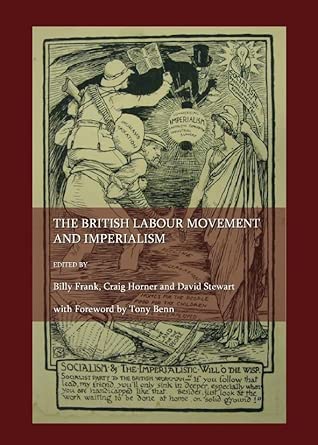
The British Labour Movement and Imperialism New edition
Author(s): Billy Frank (Author, Editor), Craig Horner and David Stewart (Author), Craig Horner (Editor), David Stewart (Editor)
Publisher: Cambridge Scholars Publishing
Publication Date: 1 Aug. 2010
Edition: New edition
Language: English
Print length: 205 pages
ISBN-10: 1443822205
ISBN-13: 9781443822206
Book Description
This edited collection explores the British labour movement’s relationship with imperialism in the period 1800-1982 through nine inter-connected articles. Labour historians have tended to neglect the labour movement’s interaction with imperialism, preferring to concentrate on industrial relations, internal factionalism, the Labour Party-trade union alliance, and economic policymaking. In order to redress the balance, this book takes a broad chronological overview of the subject and engages with key themes, ranging from trade union interaction with empire, and the influence of popular imperial culture, to post-war colonial development, and responses to post-colonialism. Taking stock both of the labour movement in a broader context and of new approaches to the history of British imperialism, the collection combines the work of leading authorities on labour history with recent scholarly research. By blending this combination of economic, social, political and cultural analyses, it makes a substantial contribution to the debates surrounding the legacy of imperialism and the evolution of the British labour movement. The book will be of interest to academics, researchers, teachers and students of modern British political, social, economic and cultural history. It will also appeal to Labour Party members and labour movement activists.
Editorial Reviews
Review
This book takes the study of the relationship between the labour movement and empire in new and innovative directions. In the past, works have tended to examine the approach of the organized labour movement, particularly the Labour Party, to imperialism. But here we have a range of studies that consider labour in its widest sense, as labouring people, even in the period before organized labour parties emerged. Thus we have studies of soldiers, of the working class and the New Imperialism of the late nineteenth century, of the relationship between Australia and Britain viewed through a transnational and comparative consideration of the labour movement, and of Gandhi s relationship with Lancashire cotton workers. In addition, there are richly thoughtful articles on post-Second World War and post-colonial issues. Like all good books, these chapters raise many intriguing questions and indicate fresh directions in which such studies should be taken. It is an indispensable addition to the literature on labour and Labour and the empire. –John M. MacKenzie, Professor Emeritus at Lancaster University and Honorary Professor at the University of St. Andrews
The word ‘pathbreaking’ is often used too easily, but this collection is truly pathbreaking in the strict sense. It shows clearly that the history of the British working class can only be written as a transcontinental history, and that the British labour movement both shaped and was shaped by imperial and Great Power politics. The present essays overcome the insularity that has been typical for much of the older labour history and help to prepare the ground for a globalized labour history. –Marcel van der Linden, Professor of Social Movement History at Amsterdam University; Research Director, International Institute of Social History, Amsterdam
About the Author
Billy Frank is a senior lecturer and course leader in the School of Education and Social Science at the University of Central Lancashire (UCLan). His doctoral thesis examined Britain’s colonial development policy in Central and Southern Africa in the trans-World War Two period with special reference to Barclays Bank. He is currently researching the lives and careers of empire bankers in the post-independence period. Craig Horner is co-editor and book reviews editor of the Manchester Region History Review. His doctoral thesis was on the middling sorts of eighteenth-century Manchester; and he has published The Diary of Edmund Harrold, a Manchester Wigmaker (Aldershot: Ashgate, 2008). He guest-edited the Manchester Region History Review special volume on early modern Manchester (2008) and is now researching early motoring and society in the United Kingdom prior to World War One. David Stewart is BA (Hons.) History course leader at UCLan and, through his position as joint UCLan-People’s History Museum Research Fellow, has played an integral role in developing their institutional partnership. His research interests traverse twentieth-century political history, labour history and Scottish history. An innovative research monograph, based upon his PhD thesis, The Path to Devolution and Change: A Political History of Scotland under Margaret Thatcher, was published by I. B. Tauris in 2009.
 Wow! eBook