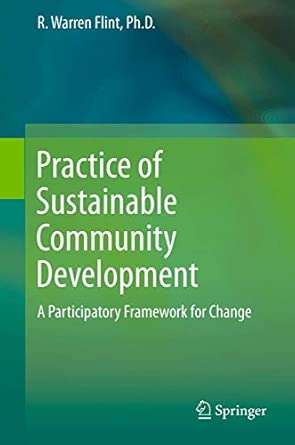
Practice of Sustainable Community Development: A Participatory Framework for Change 2013th Edition
Author(s): R. Warren Flint (Author)
- Publisher: Springer
- Publication Date: 18 Oct. 2012
- Edition: 2013th
- Language: English
- Print length: 484 pages
- ISBN-10: 1461450993
- ISBN-13: 9781461450993
Book Description
Ordinary people, community leaders, and even organizations and corporations still do not fully comprehend the interconnected, “big picture” dynamics of sustainability theory and action. In exploring means to become more sustainable, individuals and groups need a reference in which to frame discussions so they will be relevant, educational, and successful when implemented. This book puts ideas on sustainable communities into a conceptual framework that will promote striking, transformational effects on decision-making. In this book practitioners and community leaders will find effective, comprehensive tools and resources at their finger-tips to facilitate sustainable community development (SCD). The book content examines a diverse range of SCD methods; assessing community needs and resources; creating community visions; promoting stakeholder interest and participation; analyzing community problems; designing and facilitating strategic planning; carrying out interventions to improve
Editorial Reviews
From the Back Cover
This book details a systemic approach to the practice of sustainable community development (SDC) that will encourage full participatory involvement and earn confidence for all peoples. Since Brundtland there has not been a more thorough presentation of sustainable development than the first 3 chapters of Practice for Sustainable Community Development. After fully engaging in the meaning of sustainability, the reader – the student, the practitioner, and the community leader – is presented with experiences of people, relationship building, group dynamics, and community improvement methods that a practitioner of SCD would experience. Practice for Sustainable Community Development discusses, analyzes, and encourages alternative actions at the community level to promote wide-spread change, while fostering local choices that lead to more self-sufficiency and to the buffering of communities from the impacts of business as usual.
The reader is taken step-by-step through a community development procedure, that includes processes of community assessment, visioning, setting of goals and objectives, and defining strategic actions that can be pursued to achieve the measured outcome of sustainability. Through application of the tools and strategies discussed, community members are putting aside day-to-day concerns in recognition of the bigger picture that nature and people are inescapably under the influence of one another through connecting relationships. The brilliance of the sustainability movement is its demand for seeing things as interconnected and interdependent – its ability to provide a bridge between disciplines and interests, between the pieces of the whole and the whole itself.
This book’s purpose is to discuss the difficulties and opportunities of getting societies to engage with issues from an environment fraught withunforeseen events and unexpected outcomes, where the science is pretty good but the social response, from politics to economics, is focused elsewhere. The book emphasizes that if we can begin to judge proposed actions and policies for their economic value as well as for their ecological and evolutionary affects, we will be following a model of sustainability by associating different human values with the multiple dynamics of natural systems.
View on Amazon

Post-Fire Management and Restoration of Southern European Forests: 24 2012th Edition
Author(s): Francisco Moreira (Editor), Margarita Arianoutsou (Editor), Piermaria Corona (Editor), Jorge De las Heras (Editor)
- Publisher: Springer
- Publication Date: 2 Nov. 2011
- Edition: 2012th
- Language: English
- Print length: 340 pages
- ISBN-10: 9400722079
- ISBN-13: 9789400722071
Book Description
In spite of all the efforts made in fire prevention and suppression, every year about 45 000 forest fires occur in Europe, burning ca. 0.5 million hectares of forests and other rural lands. The management of these burned forests has been given much less attention than fire prevention or fire suppression issues, but the post-fire management of burned areas raises strong concerns (economic and social impacts, soil erosion and water quality, biodiversity loss, forest restoration). Although there are a few publications which address post-fire management, the focus of these has been either on general approaches to restoration or specific topics such as preventing post-fire soil erosion. This book is about the post-fire management of fire-prone forest types in southern Europe. It provides the first comprehensive overview of the topic, ranging from stand-level to landscape-level management, and from emergency actions to long-term restoration approaches.
Editorial Reviews
Review
From the reviews:
“The book disseminates scientific knowledge on post-fire management and restoration of forests mainly to a target audience of professionals (forest managers, landscape planners, forest agency staff and policy makers), graduate students and researchers. The contents are presented with technical language but understandable even to non-specialized readers. … this is a mandatory book for all those involved in restoration related to forest fires from stand to landscape-level planning, and … whose contents will be valid and taken into account for a long period of time.” (Daniel Moya Navarro, International Forestry Review, Vol. 14 (1), 2012)
From the Back Cover
In spite of all the efforts made in fire prevention and suppression, every year about 45 000 forest fires occur in Europe, burning ca. 0.5 million hectares of forests and other rural lands. The management of these burned forests has been given much less attention than fire prevention or fire suppression issues, but the post-fire management of burned areas raises strong concerns (economic and social impacts, soil erosion and water quality, biodiversity loss, forest restoration). Although there are a few publications which address post-fire management, the focus of these has been either on general approaches to restoration or specific topics such as preventing post-fire soil erosion. This book is about the post-fire management of fire-prone forest types in southern Europe. It provides the first comprehensive overview of the topic, ranging from stand-level to landscape-level management, and from emergency actions to long-term restoration approaches.
The book is divided into 2 major sections. The first includes five chapters where transversal topics such as recent changes in fire regimes in Southern Europe, the economic, legal and social aspects of post-fire management, fire hazard and flammability of different forest types, and post-fire management approaches, are addressed. The second section is divided in seven chapters, with a similar structure, each one dealing with the forest types more affected by wildfires in Europe (and other fire prone habitats such as shrublands),.
The book is targeted to an audience of professionals (forest managers, landscape planners, and forest agency staff), graduate students and researchers. It is the first publication to access in comprehensive way post-fire management issues in European forests, for which only fragmented knowledge through specialized or grey literature was available so far.
View on Amazon