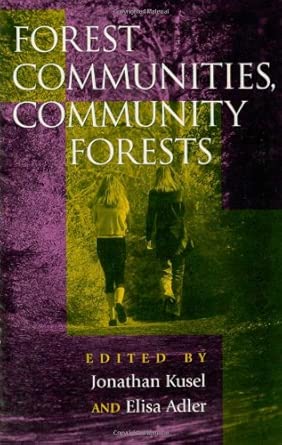
Forest Communities, Community Forests: Struggles and Successes in Rebuilding Communities and Forests
Author(s): Jonathan Kusel (Author), Jill Belsky (Contributor), Thomas Brendler (Contributor), Sam Burns (Contributor), Barb Cestero (Contributor), Gerry Gray (Contributor), Jonathan Lange (Contributor), Peter Lavigne (Contributor), Kimberly McDonald (Contributor), Rebecca McLain (Contributor), Mary Mitsos (Contributor), Ann Moote (Contributor), Tim Richard (Contributor), Ellen Stein (Contributor), Victoria Sturtevant (Contributor)
Publisher: Rowman & Littlefield
Publication Date: 1 April 2003
Language: English
Print length: 328 pages
ISBN-10: 0742525848
ISBN-13: 9780742525849
Book Description
Forest Communities, Community Forests is a collection of stories about twelve communities in the United States and their efforts to protect and restore their community forests. It explores the struggles and opportunities faced by people as they work to invest in natural capital, reverse decades of poor forest practices, tackle policy gridlock, and address community as well as ecological health. The case studies are organized by the dominant themes in American community forestry today, with the basic premise that healthy ecosystems depend on healthy communities, and vice-versa. Unlike most studies of contemporary forestry, Forest Communities, Community Forests focuses on community well-being and, more generally, community concerns. While some recent studies have examined the environmental benefits of place-based resource management or collaborative processes, few have looked at community needs and concerns-beyond the question of how to entice locals to comply with ‘new’ forestry. It is our hope that these case studies will convey the importance of community-based forestry, and contribute to the understanding and development, and ultimately the success of new community-based initiatives in the U.S.
Editorial Reviews
Review
The citizen groups, public-private partnerships, and nongovernmental organizations presented in these essays provide convincing evidence that an inclusive, collaborative approach offers hope for neglected or mismanaged forests, or for people who are locked in conflict over forest use. This optimism is the book’s greatest strength and its most important contribution. Those who are engaged in such struggles, or who are hesitant to participate, are the readers who will benefit most. ― Crm Journal
This text will likely prove quite useful to community groups that wish to take a role in ensuring the health of their forests or other natural resources, both by providing examples of what works and by giving a realistic idea of what a community organization can hope to accomplish. A major strength of the collection is that it does not present community involvement as a panacea; indeed, many of the case study authors stress that the major achievements of the groups they studied were their successes in improving communication between former opponents. Actual improvements in either forest health or economic opportunities were much less common. Nevertheless, the overall picture is one of hope for the future if local residents are willing to take a stand to improve their communities and natural environments. — Susan Hopper, Department of Geography, Pennsylvania State University
Anyone interested in the critical relationship between healthy forests and nearby communities will find this book valuable. Recommended. All levels. ―
CHOICE
About the Author
Jonathan Kusel is executive director of Forest Community Research, a research and educational organization based in the Northern California.
 Wow! eBook