Wow! eBook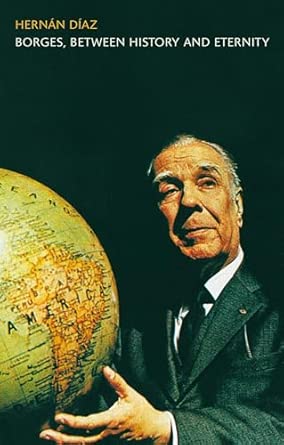
Borges, between History and Eternity
Author(s): Hernan Diaz (Author)
- Publisher: Continuum
- Publication Date: 4 Oct. 2012
- Language: English
- Print length: 208 pages
- ISBN-10: 1441188118
- ISBN-13: 9781441188113
Book Description
Editorial Reviews
Review
About the Author
Excerpt. © Reprinted by permission. All rights reserved.
Borges, between History and Eternity
By Hernán Díaz
Continuum
Copyright © 2012Hernán Díaz
All right reserved.
ISBN: 978-1-4411-8811-3
Contents
Preface: South, north, beyond………………………………………..viiiIntroduction……………………………………………………….31 God and country…………………………………………………..112 When fiction lives in fiction………………………………………34Introduction……………………………………………………….731 Edgar Allan Poe (on murder considered as metaphysics)…………………792 Walt Whitman, an American, a kosmos…………………………………116Afterword: El vaivén……………………………………………161Note on the translations…………………………………………….166Abbreviations of Borges’s titles……………………………………..167Works cited………………………………………………………..169Acknowledgments…………………………………………………….173Index……………………………………………………………..174
Preface
South, north, beyond
Two circumstances mitigate the somewhat grandiose title of this book. The first is that it is not fully mine, but a paraphrase of one of Borges’s own titles, that of his 1936 collection of essays, History of Eternity. The paradox condensed in those three words highlights the fundamental distinction that inspires my own book: the opposite of eternity is not ephemerality or brevity—after all, as Borges has shown repeatedly through Zeno’s parable, even the shortest segment of time or space can be subjected to infinite subdivisions. The opposite of eternity is history: if eternity is an abstraction, history is material; if eternity is universal, history is particular; if eternity is a smooth, unmarked continuum, history is nothing but notches. This leads to the second justification of my title: it identifies the extremes between which Borges seems to be trapped. On the one hand, the Latin American writer with his political contradictions; his profoundly Argentine language, topics, and characters (yet skirting, miraculously, becoming a folkloric curiosity); his old criollo lineage, his gaucho fetishes, and his knife-fighting obsession; his profoundly revolutionary views of literary history; and his subversive conception of the canon. On the other hand, the cosmic mystic, the labyrinth-maker, with his incorporeal enigmas; his passion for obscure metaphysical conundrums; his esoteric and apocryphal references; his universal approach to literature; his theological thought experiments; and his nesting realities that ultimately show there is no reality. In brief, the “historical” vision of Borges is context-saturated, while the “eternal” view is context-deprived.
This tension between history and eternity is not always clear-cut or irreconcilable, and in Borges’s own texts these lines often intertwine. However, among Borges scholars there tends to be an opposition between the “institutional” and “transcendental” approaches. The first position could be best illustrated by Borges’s own “The Argentine Writer and Tradition.” In this 1951 lecture, Borges reflects on the definition of “national literature,” analyzes how it relates to history, and finally overturns basic hierarchies by arguing that the periphery is a far more productive territory for a writer than the center. Although the following passage has been quoted countless times, it is worth reproducing it here once again: “What is Argentine tradition? I believe that this question poses no problem and can easily be answered. I believe that our tradition is the whole Western culture, and I also believe that we have a right to this tradition, a greater right than that which the inhabitants of one Western nation or another may have” (SF 425–26) [“¿Cuál es la tradición argentina? Creo que podemos contestar fácilmente y que no hay problema en esta pregunta. Creo que nuestra tradici ó n es toda la cultura occidental, y creo también que tenemos derecho a esta tradición, mayor que el que pueden tener los habitantes de una u otra nación occidental” (OC 272)]. Borges then quotes Veblen, who “says that Jews are prominent in Western culture because they act within that culture and at the same time do not feel bound to it by any special devotion” (SF 426) [“dice que [los judíos] sobresalen en la cultura occidental, porque act ú an dentro de esa cultura y al mismo tiempo no se sienten atados a ella por una devoci ón especial” (OC 272)]. This sets the stage for Borges’s main point: ” I believe that Argentines, and South Americans in general, are in an analogous situation; we can take on all the European subjects, take them on without superstition and with an irreverence that can have, and already has had, fortunate consequences” (SF 426) [“Creo que los argentinos, los sudamericanos en general, estamos en una situación an á loga; podemos manejar todos los temas europeos, manejarlos sin supersticiones, con una irreverencia que puede tener, y ya tiene, consecuencias afortunadas” (OC 273)]. Expanding the premises and consequences of this hypothesis occupies a great number of Borges scholars who investigate his ideas on tradition and innovation, his provocatively “minor” literature, and his appropriation of the “margins.” These contextual readings are concerned with Borges’s interventions in history—in both a political and literary sense. How (and why) does Borges connect, say, Evaristo Carriego and Heinrich Heine or Ralph Waldo Emerson and Justo Jos é de Urquiza? How does his fascination with Argentine popular myths coexist with his rabid anti-Peronism, or his obsession with an archetypal Argentina with his cosmopolitan approach to literature? How did his avant-garde writings break with Latin American modernismo, and how are these early experiments related to the classical style of his later period? How does he splice “high” and “popular” literature? How did he manage to turn a physical space (the orillas, the outskirts of Buenos Aires, a margin that is neither urban nor rural) into a literary territory that revised the contrast between the modern lettered city and the romanticized, rustic pampas? How did he turn these orillas into a synecdoche of Argentina as a whole? These are a few of the important questions that have been asked from the historical perspective over the years.
On the other hand, there is the transcendental approach, according to which Borges is an almost inexplicable celestial body orbiting in ether, a blind sage detached from tradition—any tradition. As with the contextual approach, Borges himself was to a large extent responsible for this kind of reception. Many of his stories seem to take place out of time and in an untraceable space, like “The Library of Babel” or “The Circular Ruins.” His essays too are hard to pin down to a particular period or country: where does one place the author of “A Defense of the Kabbalah,” Nine Dantesque Essays; “On Gauchesca Poetry,” “The Translators of The Thousand and One Nights,” “The Kenningar,” “Nathaniel Hawthorne,” and “Paul Valéry as a Symbol”? The span of these (randomly chosen) titles certainly makes it difficult to ascribe Borges to one single geographical and chronological domain—a difficulty that is often resolved by not associating him with any tradition at all. The grotesquely ignorant opening sentence of a review published by Time magazine in 1967 sums this up: “Argentina has no national literature, but it has produced a literary mind that is as mysterious and elusive as the fretted shadows on the moonlit grass.” This nonsense condenses, with the eloquence of a caricature, the “universalist” approach: Borges is a magical occurrence, springing from the void (“Argentina has no national literature”), to present us with enigmatic, cosmic riddles (note, also, the reviewer’s lyrically cryptic tone). Many academics have indulged in this kind of talk as well. A professor from the University of Texas declares, in his introduction to Dreamtigers, that Borges’s is “the work of a spirit so withdrawn that solitude has enlarged it and made him now see in that solitude the secret of the whole universe, now tremble before its undecipherable mysteries” (12). These farcical snippets are a reductio ad absurdum of an approach that has of course also asked valid questions. What are the philosophical implications of the nesting worlds so recurrent in Borges’s fiction, those mises en abyme where each new layer questions the authenticity of the preceding one? What does Borges’s questioning of authorship and originality tell us about the crisis of the notion of subjectivity? How do his vast metaphysical conspiracies affect the definition of “reality” and the ways in which it is represented? How do his elusive erudition and his distortion of literary genres (mainly by blurring the boundary between essay and fiction) shift the location and even challenge the presence of truth in writing? How do his essays and stories about imaginary (or outrageous) literatures and linguistic systems show the limitations of our own natural languages? These are only some of the important issues raised by the “transcendental” angle.
Both perspectives are, that is to say, equally limiting and productive, and Borges, between History and Eternity aims to intervene into one approach from the other. Nothing represents better the opposition between history and eternity than politics and metaphysics, which is the subject of “Political Theology,” the first half of this book. My general thesis is that there is a chiasmic relationship between these interests in Borges’s literature. Put differently, it is in Borges’s more “metaphysical” texts where we find his most daring political interventions—and vice versa. If, for instance, all things are (according to Plato) a degraded copy of their archetype, then there is a “more real” reality behind reality. If the world requires (as Berkeley believed) a permanent perceiver in order to be, our own existence depends on being observed by a higher instance. Philosophical problems like these, dealt with in the first chapter of this book, obsessed Borges, and they provide a blueprint for a political theory. Following (and slightly bending) the Platonic premise, everyday life is a fiction, an ideological fabrication imposed on us; and extending (and slightly distorting) the Berkeleian principle, we live under continuous surveillance, constantly scrutinized. In this sense, many of Borges’s classic allegories, like the map of an empire whose size is that of the empire, or the chessman moved by a hand moved by god moved by a god behind god, are not mere abstractions but rather reflections on how power may manipulate our perception of the world and condition our interaction with it.
Conversely, his more overtly political texts tend to be sustained by a particular take on metaphysics. A good example (analyzed in detail in this book) is his political poetry. Borges wrote many poems commemorating historical figures with clear ideological connotations and has several odes to the patria (not an easy term to translate; neither “homeland” nor “fatherland” do it justice). He even wrote poems celebrating contemporary events, such as the Revolución Libertadora, the military uprising that overthrew Perón in 1955. In each of these cases, when Borges needs to define the “patria” and the emotions it stirs, he invariably turns to metaphysics: it is an idea, an archetype; it depends on a transcendental perceiver; etc. In brief, if Borges’s take on Plato and Berkeley (to continue with the same examples) is susceptible to a political reading, it is also true that his political texts are susceptible to a metaphysical reading. Idealism supports his view of material history in the same way material determinations inform his view of idealism. However, Borges’s particular articulation between politics and metaphysics outlined in the first half of the book may have been impossible without his peculiar appropriation of a couple of North American writers.
North American literature is the foreign tradition that influenced Borges the most—although he would probably claim that the English canon made the greatest impact. Nevertheless, as I will show, Whitman’s presence alone in Borges’s literature justifies my assertion. In addition to Whitman, North American literature in general pervades Borges’s entire work. He wrote about Emerson, Hawthorne, Melville, William and Henry James, Twain, Bret Harte, Bierce, and Lovecraft, among others; he reviewed numerous American films; he was obsessed with American criminals and hoodlums, from Billy the Kid to Al Capone; he translated Faulkner’s The Wild Palms; he helped promote detective fiction as a serious literary genre, and made significant contributions to it. In fact, as I will argue, Poe was as important to Borges as Whitman. “The United States of America,” the second half of this book, explores how these two quintessential North American authors constitute the historical determinations that make some of Borges’s seemingly context-deprived, “eternal” texts possible.
The first section of this second part, “Edgar Allan Poe (On Murder Considered as Metaphysics),” shows how Borges’s more “universal” and “metaphysical” stories are, in fact, grounded in a particular take on North American history and its literature—though these, of course, are not their sole sources. Rather than viewing, as most of his forerunners and contemporaries did, the United States as the culmination of instrumental reason (for better or for worse), Borges unorthodoxly focuses on its barbaric side. This is the case with his North American stories in A Universal History of Infamy, all of which deal with hoodlums, gangsters, and killers in what seems to be a lawless state of nature or a “war of all against all.” All this, however, changes with Poe, the creator of a figure that rationalizes violence—the detective. Even the most brutal crimes (the murderer in the first detective story ever written is, in fact, literally, a brute) can be subjected to and understood through reason. And thanks to the detective, who is capable of making sense of what does not even register as a sign at all to the ordinary eye. By looking for clues and deciphering them, the detective turns the entire world into a legible surface. This is, then, a historical component of many of Borges’s “transcendental” stories: the idea of the entire universe as something readable (“The Library of Babel”), the notion that the solution to the most transcendental enigmas are encrypted in some ordinary object (“The Writing of the God”), or the perception of reality as a vast conspiracy (“The Lottery in Babylon” or “Tlön, Uqbar, Orbis Tertius”) can, in fact, be traced back to Borges’s fascination with different American criminals—a fascination later filtered through Poe.
“Walt Whitman, an American, a Kosmos,” the second part of the North American section, follows Borges’s lifelong fascination with Whitman. No other foreign author is so visible in his work, from his first book (1923) to his last (1985). Not only did he write about Whitman profusely (and translate an abridged version of Leaves of Grass) but he also wrote like Whitman. This formal influence, I claim, is evident in most of his books of poetry, but I also show how Whitman is present in Borges’s prose. No one else (not even his most beloved authors, such as Shakespeare, Johnson, De Quincey, and Stevenson) affected Borges’s style as profoundly and as consistently over time. In his relationship with Whitman, Borges, once again, reexamines the articulation of historical determinations and transcendental ambitions. Borges sees in Whitman the first politically “engaged” writer. It is the desire to represent the experience of American democracy that leads Whitman to question the notion of a central subject (the epic hero but also the figure of the author himself) in favor of a plural protagonist, and to include in his poem every single aspect, person and action of the world in equal terms, abolishing hierarchical boundaries. However, what is a material determination in Whitman becomes, in Borges, a purely intellectual “game with infinitude” (paraphrasing “Borges and I”), removed from its historical and political sources. There is, again, a chiasmus: Poe, the “decadent” writer, designing puzzles of ratiocination, is the prime source of Borges’s political fiction—the one dealing with conspiracies, paranoia, and the administration of reality. On the other hand, Whitman, the “engaged” writer, singing to America and its novel political configuration, becomes the inspiration for fundamental aspects of Borges’s aesthetic program (such as a literature freed from the tyranny of a central subject—the author) and the source of many of his experiments with eternity and totality, such as “The Aleph.” In other words, Poe and Whitman, each in his own fashion, provided Borges with a way to articulate America and the “kosmos,” the historical and the eternal.
The confluence of the universal and the historical is not, therefore, an accidental detail in Borges’s literature. It is one of its defining traits and one of its driving forces from the very beginning. Indeed, one of Borges’s first essays contains a passage that, in retrospect, reads like a manifesto. In “El tamaño de mi esperanza,” published in 1926, Borges considers the problems inherent in the opposition between progressiveness (which he views as too Europeanizing and even North Americanizing) and criollismo (which has become a mere nostalgic longing for Argentine fetishes and clichés) and resolves that the solution is to widen (“enanchar”) the definition of criollismo. Borges concludes with a statement that can be taken as the program guiding great part of his future work: “Let it be criollismo, then, but a criollismo able to address the world and the self, God and death. I hope someone helps me find it.” [“Criollismo, pues, pero un criollismo que sea conversador del mundo y del yo, de Dios y de la muerte. A ver si alguien me ayuda a buscarlo” (TE 14)]. To a large extent, this book can be considered a tentative response to this call.
(Continues…)
Excerpted from Borges, between History and Eternityby Hernán Díaz Copyright © 2012 by Hernán Díaz . Excerpted by permission of Continuum. All rights reserved. No part of this excerpt may be reproduced or reprinted without permission in writing from the publisher.
Excerpts are provided by Dial-A-Book Inc. solely for the personal use of visitors to this web site.