Wow! eBook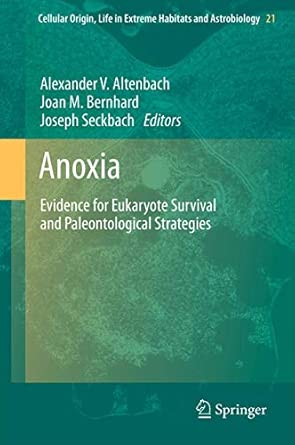
Anoxia: Evidence for Eukaryote Survival and Paleontological Strategies: 21 2012th Edition
Author(s): Alexander Altenbach (Editor), Joan M. Bernhard (Editor), Joseph Seckbach (Editor)
- Publisher: Springer
- Publication Date: 20 Oct. 2011
- Edition: 2012th
- Language: English
- Print length: 684 pages
- ISBN-10: 9789400718951
- ISBN-13: 9789400718951
Book Description
Editorial Reviews
From the Back Cover
ANOXIA defines the lack of free molecular oxygen in an environment. In the presence of organic matter, the metabolism of anaerobic prokaryotes soon produces compounds such as free radicals, hydrogen sulfide, or methane that are typically toxic to aerobes. The concomitance of suppressed respiration and the presence of toxic substances suggests that these habitats are inhospitable to eukaryotes. Ecological definitions thus sometimes term these environments ‘Death Zones’. In this book, however, we present a collection of remarkable adaptations to anoxia, observed in protists, fungi, plants and animals. Presented are case studies that provide evidence for controlled beneficial use of anoxia by, for example, organic modification of free radicals, use of alternative electron donors for anaerobic metabolic pathways, and employment of anaerobic symbionts. Marine, freshwater, and terrestrial organisms and habitats are considered. Ecological, cell biological, and physiological studies are included. In addition to these biologically oriented chapters, the book also presents a paleontological perspective by discussing indirect and direct evidence of eukaryote survival in ancient times. For example, the complex and often interwoven existence of oxic and anoxic milieus in space and time is also highlighted. Finally, we revisit the idea that eukaryotic inhabitation of anoxic habitats was established early in Earth history. This book will certainly increase your concepts regarding abilities of EUKARYOTA.