 Wow! eBook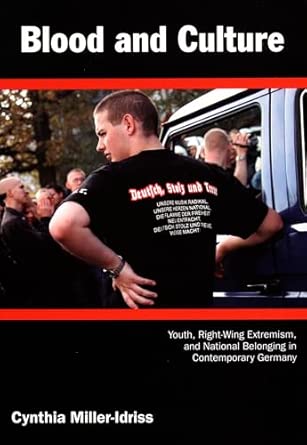
Blood and Culture: Youth, Right-Wing Extremism, and National Belonging in Contemporary Germany
Author(s): Cynthia Miller-Idriss (Author)
- Publisher: Duke University Press
- Publication Date: 28 Aug. 2009
- Language: English
- Print length: 256 pages
- ISBN-10: 0822345277
- ISBN-13: 9780822345275
Book Description
Miller-Idriss describes a new understanding of national belonging emerging among young Germans-one in which cultural assimilation takes precedence over blood or ethnic heritage. Moreover, she argues that teachers’ well-intentioned, state-sanctioned efforts to counter nationalist pride often create a backlash, making radical right-wing groups more appealing to their students. Miller-Idriss argues that the state’s efforts to shape national identity are always tempered and potentially transformed as each generation reacts to the official conception of what the nation “ought” to be.
Editorial Reviews
Review
“In this rare work on ‘everyday’ understandings of citizenship and nationhood, Cynthia Miller-Idriss helps to dispel stereotypes about allegedly ‘blood’-based and ‘racial’ ideas of German nationhood. She shows that ordinary people (even those particularly suspected to hold ‘racial’ ideas, such as working-class youth), espouse a cultural and behavioral, rather than biological, idea of nation. Moreover, in making generational experience key to national self-conceptions, she proposes a dynamic, change-centered notion of nationhood.”–
Christian Joppke, author of Selecting by Origin: Ethnic Migration in the Liberal StateFrom the Back Cover
About the Author
Cynthia Miller-Idriss is Assistant Professor of International Education and Educational Sociology at New York University.
Excerpt. © Reprinted by permission. All rights reserved.
Blood and Culture
Youth, Right-Wing Extremism, and National Belonging in Contemporary GermanyBy Cynthia Miller-Idriss
Duke University Press
Copyright © 2009 Duke University Press
All right reserved.
ISBN: 978-0-8223-4527-5
Contents
preface……………………………………………………………………………………..ixacknowledgments………………………………………………………………………………xiiiabbreviations………………………………………………………………………………..xviiintroduction Citizenship and National Belonging as Cultural Practices……………………………..1chapter 1 Who Belongs to the Nation?…………………………………………………………..23chapter 2 Being and Becoming in Germany………………………………………………………..46chapter 3 Germany’s Forbidden Fruit: National Pride and National Taboos……………………………63chapter 4 Raising the Right Wing: Educators’ Struggle to Confront the Radical Right…………………93chapter 5 Teaching and Unteaching National Identity……………………………………………..122chapter 6 Blood, Culture, Birthplace…………………………………………………………..149chapter 7 Generational Change and the Re-imagining of Nations…………………………………….169appendix a Overview of the Case Studies………………………………………………………..183appendix b Methodological Overview…………………………………………………………….189notes……………………………………………………………………………………….201bibliography…………………………………………………………………………………207index……………………………………………………………………………………….229
Chapter One
Who Belongs to the Nation?
At least since Benedict Anderson (1991) introduced the notion that nations are communities of individuals who imagine themselves to be connected to one another, much of the theoretical and empirical work on nations, nationalism, and national identity has begun from the premise that nations are constructed entities with emergent and contested boundaries (Gek 2002; also see Fulbrook 1997; Grant 1997; Levy 1999; Spillman 1996, 1997). The view of nations as imagined and constructed entities posits nations and national identity as based on a sense of individuals’ attachments to other people who share their customs, language, traditions, culture, or residence within a set of borders-even though they may be dispersed across space and time and will likely never meet each other. This understanding represents a shift from previous views of nationhood, which perceived nations to be determined by primordial attachments which were “given” through birth into a particular community (Geertz 1973).
Imagining and Re-imagining Nations
This theoretical shift in the study of nations has had consequences for empirical studies on nations and nationhood, as the idea that the nation is “constructed” has inspired a growing sociology of the everyday experiences and practices of nationhood among ordinary individuals. Work in this emergent tradition examines the everyday experiences of individuals in the construction and interpretation of their national and ethnic identities (Brubaker et al. 2006; Condor 2000; Fox 2003; Fox and Miller-Idriss 2008; Glaeser 2000; Rothenberg 2002). Such scholarship broadens a prior emphasis on the ways in which the nation is constructed and mediated through official narratives, state policies, formal curriculum, or legal policies (see, e.g., Fulbrook 1999; Olick 1998) to focus on the experiences of ordinary citizens in shaping and reshaping the imagined community. In part as a result of this focus on the experiences of ordinary individuals, scholars have come to recognize that even when there is a single hegemonic version of national identity in a given nation, there are also, typically, various alternative or marginalized expressions of national identity that exist parallel to the dominant version (Cooke 2002; Gek 2002). Particularly prominent among field researchers working in Europe and eastern Europe since 1989, many scholars in this new vein of research have focused on the responses and resistance of ordinary citizens to the mediation of national narratives and myths in various spheres of their lives, such as schools, workplaces, and the media. Empirical examples include investigations of how nationality is reproduced through symbolic boundaries of national difference that are maintained and reproduced in everyday practices in Estonia; how nationhood and ethnicity are produced and reproduced in everyday life in Transylvania (Brubaker et al. 2006); the reception of modernist architecture in Hungary as architects were confronted in their everyday work with issues of national identity under late socialism (Molnr 2004); and the impact of political apathy among sectors of national populations on the efficacy of nationalist politics in Romania (Fox 2003).
Of course, ordinary people do not create national identities in isolation. Nations are imagined and constructed (Anderson 1991; Gek 2002; Kastoryano 2002) through processes ranging from the everyday kinds of practices evidenced in activities such as flag-waving (Billig 1995) or reciting the Pledge of Allegiance in public schools (Rippberger and Staudt 2003) to the selection by intellectuals of historical narratives and national heroes (Suny and Kennedy 1999a, 2) and the mediation of knowledge about citizenship through public institutions, the media, and popular culture (Bourdieu 1999, 62; Giroux 1987; Steinmetz 1999, 11). Various individuals, whether elites and intellectuals (Suny and Kennedy 1999a) or ordinary citizens (Fox 2003), are involved in these processes of the construction, reification, and negotiation of nations and national identities.
Yet while the literature has clearly emphasized the constructed, transient, and emergent nature of nations-whether through the efforts of elites or of ordinary people-the overall focus has been on the how and when of nation-formation. Nations are thus something that have already happened, whether in the very distant or the more recent past (see, e.g., Hroch 1996). Nation-formation is depicted as a linear, one-directional process or as a one-time event that has been or can be completed, such as is implied when Brubaker (1992) argues that either the nation creates the state or the state creates the nation (Behnke 1997, 245; also see Calhoun 1997; Gellner 1983; Hobsbawm 1990, 10). For too long, the nation has been thought of as something that is static (although constructed), unified (even when diverse), and formed at some point in the distant past. Scholars have paid less attention to the ways in which the meanings attached to nationhood shift and are part of a process of continual re-imagining, even within relatively short periods of time (for exceptions, see Suny and Kennedy 1999b; Kennedy 1999; Levy 1999). As Suny and Kennedy (1999b, 397) explain, the “language of invention and imagination” used in many analyses of the nation can be challenged “because it leaves little room for the variable degrees to which nations are transformable.”
This inattention to the potential for collective national identities to be transformed is a departure from the literature on other forms of collective identities, which has increasingly acknowledged the complexity of collective identities and the inadequacy of essentialized categories of identity according to bounded notions of gender, ethnicity, race, or sexuality (Calhoun 1995). Instead, scholars in these fields recognize that singular categories of collective identities do little to capture the layers of subtlety involved in complex negotiations of identity. In the case of nations, one such layer consists of the variations in national identity across generations within the same nation, which is the primary focus of this book.
Even when scholars acknowledge that changes in the conception of nations and nationhood can take place (see, e.g., Hobsbawm 1990, 11; Lepsius 2004), such accounts typically lack an explanation of how these processes take place. There is scholarship which details the ways in which citizenship (Soysal 1994, 1996) and political communities (Archibugi, Held and Khler 1998) can be transformed. This work, however, focuses on changes in structures, systems, and institutions-such as related to globalization, civil society, or legal policies-and their effect on political communities, either without attending to questions of transformations in collective identity or by assuming that transformations in identity are derived from institutional changes.
This isn’t to say that there are no clues as to how the meaning of the nation might change over time. Zimmer (1998, 648), for example, points out that changes in national identity are causally linked to international factors such as wars or ideological clashes, but does not explain how these changes in national identity actually take place, or whether similar kinds of changes can occur in the absence of significant international events. Cultural accounts of the relationship between ideology and individual action (Swidler 1986) provide a partial theoretical explanation for how dominant national narratives can influence individuals’ actions or beliefs, but with limited application to periods that are not characterized by significant international or national upheaval or trauma. Historical accounts that trace the formation and reformation of nations are an appealing source to consider in the search for mechanisms contributing to transformations in national meanings. But historical examinations-such as those relying on narrative or path dependency models (see, e.g., Haydu 1998)-are often forced to rely on written accounts and documentation that primarily depict elite and intellectual perspectives. This leaves us with little understanding as to the mechanisms through which ordinary individuals engage in or experience transformations in the meaning of nationhood.
Other scholars have examined the role that the state plays in shaping or resocializing citizens’ conceptions of national identity, such as through public schooling (Apple 1990; Aronowitz and Giroux 1993; Bourdieu and Passeron 1990; Gumbert 1986; Hahn 1998; Popkewitz and Brennan 1998). But focusing on the reproduction of national meanings during socialization processes across generations (Bourdieu and Passeron 1990) runs the risk of overemphasizing the constancy of national identities, even as we acknowledge that national identities cannot be understood as essentialized, stable, or static (Calhoun 1993, 1997). Such work has also tended to emphasize structural and institutional attempts to transform identities and collective practices among citizens of a given nation, without examining how such efforts are received by the individuals who are the objects of the state’s attention. Literature that traces the reception of national or international narratives and the reaction of ordinary individuals to the nationalist politics, official narratives or state-sponsored identities in which their lives are embedded on the other hand (e.g., Fox 2003; Molnr 2004), leaves open the question of how the reception of such narratives differs across generations or whether differences can be construed as mechanisms of transformations in national meanings.
In sum, empirical accounts of the shifting meaning of nationhood for ordinary individuals are rare, both because the literature has emphasized elite perspectives and because it has focused its attention on the constructed and contingent nature of identities in an already-imagined nation.
So how do processes of change in the conception and imagination of the nation take place? If national identities can be transformed, what are the processes through which the meaning attached to, and the identification with, a nation shift? How are national identities renegotiated and redefined? The remainder of this book explores these questions by investigating transformations in the meaning of the nation across generations. We already know that new generations react differently to national wars or military actions, create new perceptions of historical events and traumas-such as slavery, genocide, apartheid, or the Holocaust-and develop awarenesses that previous generations did not have of injustices toward various groups according to race, gender, ethnicity, sexuality, or physical or mental handicap (Griffin 2004; Schuman and Scott 1989; Schuman and Rieger 1992). In the remainder of this book, I extend our understanding of generational transformation to encompass the collective identities associated with nationhood. As social and historical circumstances change, I argue, new generations re-imagine the nation. This process further reveals how multiple meanings of nationhood can emerge and exist simultaneously.
It is important to bear in mind, of course, that power plays a role in which versions of national narratives prevail. Some meanings come to acquire more resonance than others, at least in part due to unequal power relationships in terms of who is in a position to promote (through the media, through the educational system, or elsewhere) a particular version of the past or of current events (see, e.g., Carnoy 1992, 148; Dirks, Eley, and Ortner 1994; Hall 1988; Gramsci 1971; Laclau and Mouffe 1985; Morrow and Torres 1995, 251). While we know that such meanings are subject to continual reinterpretation and redefinition, the processes through which they are reinterpreted and redefined differently by various groups in any given society are not well understood. It is this task that I take up in this book.
To ground the claims that I will make later in this book, and in order to fully understand the debates around national belonging in Germany and what the transformations discussed in this book can teach us about how nations are continually re-imagined, it is also important to interrogate the literature on citizenship. This is particularly true in the German case, where questions of citizenship and national belonging have been so deeply intertwined historically.
Citizenship as Identity
While the state typically refers to the ruling apparatus-the institutions and structures, policies and policymakers that regulate the lives of individuals within a given territory (Althusser 1971; Bourdieu 1999; Steinmetz 1999)-the nation, as discussed above, is most often used to refer to an “imagined community” of individuals who are viewed as belonging together for reasons of shared ethnicity, heritage, language, culture, race, or territory (Anderson 1991; Guibernau 1999; Salecl 1994). Citizenship status reflects membership in the former, while national identity reflects an attachment to the latter. Although there are significant overlaps between the state and the nation, and although they are often equated in popular understandings, the literature has tended to treat the two concepts as analytically distinct and has, moreover, generally assigned analyses of identity to the realm of studies of the nation, while studies of citizenship have remained focused on structures, institutions, and policies.
The meaningfulness of citizenship has been called into question in recent years, moreover, as scholars have proposed that globalization and regional integration processes are unsettling the nation-state, causing national citizenship to be replaced with postnational, cross-border membership not tied to particular nation-states (see, e.g., Eley 1999, 10; Held 1996; Soysal 1994; Urry 1999). As Stuart Hall (1996, 343) explains, “So at one and the same time people feel part of the world and part of their village. They have neighborhood identities and they are citizens of the world.” National citizenship has been further complicated by increasing migration and immigration across borders. Particularly challenging for nation-states whose national populations have been historically homogenous, the increasing national, cultural, racial, or ethnic diversity within nations has forced a reframing of national membership and notions of “who belongs” to national communities in many places.
In analyzing the impact of local, regional, or global and migratory transformation on conceptions of citizenship, the scholarship on citizenship and national belonging has focused heavily on the study of institutions, policies, and structural reforms. In this approach, scholars examine policies, laws, and regulations that limit access to, and regulate the practice of, citizenship, often using these structural and institutional elements as a measure of conceptions of citizenship among national populations. One consequence of this emphasis is that we have come to think of citizenship, at least within the theoretical literature, as a unified, bounded, and static entity that is shared by all members of the same national or ethnic group and whose meaning, for individual citizens, can be extrapolated from national policies. Whether inherited through birthplace or ethnic heritage or achieved through naturalization, citizenship has not been conceived of as a notion whose meaning can necessarily shift for individuals or vary across national populations. I argue in this book, however, that a nation-state’s legal policies for citizenship and naturalization cannot be automatically extrapolated to the understandings of citizenship and national belonging among ordinary citizens, and furthermore, that it is problematic to assume a uniform conception of citizenship and national belonging for all of the members of a single nation.
(Continues…)
Excerpted from Blood and Cultureby Cynthia Miller-Idriss Copyright © 2009 by Duke University Press. Excerpted by permission.
All rights reserved. No part of this excerpt may be reproduced or reprinted without permission in writing from the publisher.
Excerpts are provided by Dial-A-Book Inc. solely for the personal use of visitors to this web site.


