Wow! eBook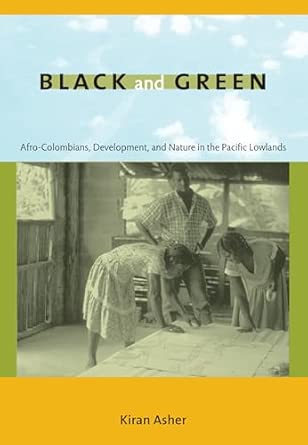
Black and Green: Afro-Colombians, Development, and Nature in the Pacific Lowlands Illustrated Edition
Author(s): Kiran Asher (Author)
- Publisher: Duke University Press
- Publication Date: 10 Aug. 2009
- Edition: Illustrated
- Language: English
- Print length: 272 pages
- ISBN-10: 9780822344872
- ISBN-13: 0822344874
Book Description
The Pacific region had yet to be overrun by drug traffickers, guerrillas, and paramilitary forces in the early 1990s. It was better known as the largest area of black culture in the country (90 percent of the region’s population is Afro-Colombian) and as a supplier of natural resources, including timber, gold, platinum, and silver. Colombia’s Law 70, passed in 1993, promised ethnic and cultural rights, collective land ownership, and socioeconomic development to Afro-Colombian communities. At the same time that various constituencies sought to interpret and implement Law 70, the state was moving ahead with large-scale development initiatives intended to modernize the economically backward coastal lowlands. Meanwhile national and international conservation organizations were attempting to protect the region’s rich biodiversity. Asher explores this juxtaposition of black rights, economic development, and conservation-and the tensions it catalyzed. She analyzes the meanings attached to “culture,” “nature,” and “development” by the Colombian state and Afro-Colombian social movements, including women’s groups. In so doing, she shows that the appropriation of development and conservation discourses by the social movements had a paradoxical effect. It legitimized the presence of state, development, and conservation agencies in the Pacific region even as it influenced those agencies’ visions and plans.
Editorial Reviews
Review
“The author manages to enthral the reader into her line of argument. . . . The combination of an ethnographic sensitivity and fluid and contextualising writing has a seductive effect on the reader whether or not they are an expert on the topic or region. This aspect, without a doubt, gives the book the potential to be an excellent tool for undergraduate programmes in a wide array of disciplines ranging from anthropology to development studies, and from political science to Latin-American studies.”–Eduardo Restrepo “Bulletin of Latin American Research”
“The strength of the work is Asher’s sophisticated conceptualization of how the various forces in play are mutually reactive. She consistently and lucidly explains the connections and ambivalent interplay between development projects, international environmentalism, the state, and global liberalization on the one hand, and local knowledge, community activism, gender roles, and Afro-Colombian traditional practices, whether in reference to land tenure or cultivation practices, on the other. . . . Highly recommended. Upper -division undergraduates and above.”–J. M. Rosehthal “Choice”
“This book is a welcome addition to the growing literature on indigenous and black resistance in Latin America. . . . Asher gives an ethnographically rich account of how the black movement emerged in the context of what appeared to be a changing rationale for sustainable development in the region.”–Ulrich Oslender “The Americas”
“This book is ideal for those conducting graduate-level research on Colombia and black movement issues in Latin America.”–Jan Hoffman French “Journal of Latin American Studies”
“Kiran Asher effectively captures the nuances of the multiple positions taken by Afrocolombians and their allies regarding the development of the Pacific lowlands–ethno-cultural activists, mainstream politicians, black women’s networks, nongovernmental organizations, and social scientists–producing an intricate and multifaceted vision of the heterogeneous interests at play in the creation of the black movement in Colombia. Asher’s keen ethnographic eye explores the contradictions that emerge when local demands are translated into transnational discourses of identity, rights, environmentalism, and community development. She lays bare the complex texture of the negotiations that gave rise to legislation and planning, on the one hand, and of the voicing of local hopes and aspirations–particularly of Afrocolombian women–on the other. She moves with ease between the halls of the Colombian Senate and the workshop of a women’s cooperative, revealing the numerous levels at which Afrocolombian environmental discourse emerges. In the process, Asher crafts a sensitive and sympathetic, yet also sharp-edged and daring portrait of a significant social movement that is coming to the fore across Latin America.”–
Joanne Rappaport, author of Intercultural Utopias: Public Intellectuals, Cultural Experimentation, and Ethnic Pluralism in Colombia“Kiran Asher provides the best exploration we have of Afro-Colombians’ experiences in the wake of an unprecedented 1991 constitutional clause recognizing collective land rights for black communities. Across the disciplines, students of racial politics and environmental organizing will benefit from her thoughtful analysis and the clarity of her approach.”–
Ann Farnsworth-Alvear, author of Dulcinea in the Factory: Myths, Morals, Men, and Women in Colombia’s Industrial Experiment, 1905-1960From the Back Cover
About the Author
Kiran Asher is Associate Professor of International Development & Social Change and Women’s Studies at Clark University.
Excerpt. © Reprinted by permission. All rights reserved.
BLACK AND GREEN
AFRO-COLOMBIANS, DEVELOPMENT, AND NATURE IN THE PACIFIC LOWLANDSBy Kiran Asher
Duke University Press
Copyright © 2009 Duke University Press
All right reserved.
ISBN: 978-0-8223-4487-2
Contents
ABBREVIATIONS AND ACRONYMS…………………………………………………………………..xiiiINTRODUCTION: Black Social Movements and Development in the Making……………………………….11 Afro-Colombian Ethnicity: From Invisibility to the Limelight…………………………………..322 “The El Dorado of Modern Times”: Economy, Ecology, and Territory……………………………….573 “El Ruido Interno de Comunidades Negras”: The Ethno-Cultural Politics of the PCN…………………1004 “Seeing with the Eyes of Black Women”: Gender, Ethnicity, and Development……………………….1305 Displacement, Development, and Afro-Colombian Movements……………………………………….154APPENDIX A. TRANSITORY ARTICLE 55…………………………………………………………….191APPENDIX B. LAW 70 OF 1993: Outline and Salient Features………………………………………..192NOTES……………………………………………………………………………………..197REFERENCES…………………………………………………………………………………211INDEX……………………………………………………………………………………..233
Chapter One
AFRO-COLOMBIAN ETHNICITY
From Invisibility to the Limelight
After Brazil, Colombia has the largest black population in Latin America. But it was only recently that both countries conferred specific rights to their black populations-or, indeed, recognized blacks as a distinct group within the nation. Why this is so is linked to a number of factors-histories of nationalism, the perception of blacks and blackness within prevailing ideologies of “race” and culture, and the structures and dynamics of political economy-and how they function in each context. There is an extensive and growing scholarship on the often “hidden” histories and complex interactions of “race,” culture, and nationalism. An in-depth engagement with this literature is beyond the scope of this study, but a brief overview follows to contextualize current black social movements in Colombia.
According to Norman Whitten and Arlene Torres (1998), three nationalist ideologies-racial mixture, Indianism, and blackness-functioned in the Spanish-, Portuguese-, and French-speaking American republics in the 1990s. In much of Latin America, the ideology of race mixture (mestizaje) between Europeans, indians, and blacks has prevailed since the post-independence period. Indianism (indigenismo) functions as a two-pronged component of mestizaje. It is seen as providing an authentic basis for a distinct Latin American nationalism but also as responsible for the “backward” elements in an underdeveloped nation. The third nationalist ideology-blackness, or ngritude-takes as positive the power attributed to people identified as “black” and was only adopted by Haiti. Whitten and Torres note that nationalist ideologies not only develop and depend on symbols of unity (often understood in terms of “race,” blood, or biology) but also of difference (understood in “cultural” terms).
Colombia, like many countries of Latin America, portrays itself as a nation of mestizos. Peter Wade (1993a) notes that historical mestizaje was a complex process and a contradictory ideology. While it celebrated the diverse elements of racial mixture, European or white components were nonetheless coded as more civilized and modern and, hence, more valuable. The process of miscegenation was intended to produce a homogeneous people speaking one language and believing in a single god (de Friedemann and Arocha 1995; Whitten and Torres 1998) and implied the whitening (blanqueamiento) of its darker populace and its eventual integration and assimilation into mainstream Colombian society. Indeed, mestizaje and blanqueamiento, common throughout Latin America, were supposed to help neutralize forms of diversity considered subversive, challenges to the official nation.
Anthropologists claim that these nationalist ideologies and the underlying structures of the colonial and postcolonial political economy are largely responsible for the “invisibility” of racial, cultural, and ethnic differences in Colombia and for the socioeconomic marginalization of minority groups (de Friedemann and Arocha 1995; Wade 1993a, 1995; Whitten and Torres 1992). But the dynamics of color, culture, and class played out differently for indians and blacks. These differences have had major implications for land rights.
Colombia has a long history of viewing indigenous communities as culturally distinct and recognizing-or, at least, legally articulating-their special rights (Gros 1991). For example, Law 89 of 1890 granted Colombian indians collective title to their lands and recognized the traditional authority of indigenous councils (cabildos) to govern and manage affairs within such territories. This law and other recognitions of difference were an extension of indigenist colonial policies to keep indians separate from whites or creolos. Concentrating indians in reserves (resguardos) also ensured the availability of native peoples as sources of labor and tribute. Resguardos and cabildos are classic examples of indigenism. They were seen as protecting the purity of indian culture (and providing labor reserves) but also ensured that indigenous “cosmovisions” did not contaminate the liberal individualist political philosophy of the nation-state.
Indians found opportunities to deploy this ideology for ends of their own. When agrarian reforms in the 1950s and 1960s threatened to dissolve resguardos, indigenous groups (and their anthropologist and lawyer advocates) used indigenist arguments to resist forced assimilation and appropriation of their land. They drew on the notion of tradition and custom and under Agrarian Reform Law 135 of 1961 were granted autonomous collective control over the lands that they had traditionally occupied. Since the 1960s, indigenous organizations in Colombia have invoked various international and national accords on the rights of cultural minorities to demand legal and administrative rights to self-government.
The case was different for blacks. While the exact numbers are subject to debate, it is estimated that 10 percent to 30 percent of the country is of African descent. The vast majority of Afro-Colombians live in the Pacific littoral, where they constitute 90 percent of the population. A significant percentage of this population is concentrated in urban centers (Urrea Giraldo et al. 2001) and increasingly being displaced to the Andean part of the country. The postcolonial constitution of 1886 defines blacks as mestizos, subject citizens with ostensibly the same political and economic rights as all other Colombians (except indians).
After manumission in 1851, blacks scattered along the length and breadth of the Pacific region, often joining existing palenques-settlements established by escaped or freed slaves (cimarrones). As black communities expanded and spread in the Pacific (and some other areas), Afro-Colombians developed a distinct set of cultural-symbolic beliefs and material practices, combining elements from their African past with new features developed in their present circumstances. The anthropologists Nina de Friedemann and Jaime Arocha (1984, 1986, 1995) stress that Afro-Colombians chose to isolate themselves from mainstream society as much as an act of resistance and independence as to escape racial discrimination and persecution.
Peter Wade (1991, 1993a) interprets the situation of black Colombians differently. He argues that the nationalist processes of mestizaje and blanqeamiento had a twofold effect. Some populations, especially along the Atlantic coast and in urban areas of Antioquia, assimilated culturally within dominant society, albeit subject to racism and discrimination. Others, such as those in the Pacific region, remained isolated from mainstream society more by imposition (as a structural effect of the political economy) than by choice. According to Wade, the fundamental contradictions within Colombia’s national ideologies-foreseeing an ultimate homogeneity but insisting on hierarchical distinctions based on “race”-led to a complex coexistence of integration and discrimination for blacks.
Roque Roldn (1993) asserts that in jurisdictional terms, blacks living in rural areas were treated as any other Colombian campesinos (peasants): all faced the same problems of land tenure and socioeconomic development. In his study of black peasants of the Cauca Valley in the late nineteenth century, Michael Taussig (1980: 58) describes his subjects as “outlaws-free peasants and foresters who lived by their wits and their weapons rather than by legal guarantees to land and citizenship.” In the twentieth century, the hacienda economy broke down, and agricultural production in the region became increasingly organized according to capitalist logic. As Taussig’s ethnography shows, even as these black outlaw peasants became incorporated into the wage economy as laborers, they drew on “black cosmology” to interpret and denounce the capitalist logic of agribusiness. They also continued to engage in non-market subsistence practices and retained social relations among black kin in the Pacific coastal region. Black communities also coexisted peacefully with their indigenous neighbors and often established kinship ties with them.
Whatever the understanding of the black situation, black communities had no special land rights. Nor were they legally considered a culturally distinct group until the inclusion of at 55 in the 1991 Constitution.
During my fieldwork, I heard diverging and fragmented versions of how this legal victory was attained. For many ordinary Colombians and state officials, the recognition of black ethnic rights was an extension of the change in Colombia’s nationalist ideology. Some referred to Article 7 of the 1991 Constitution, which declares Colombia to be a multiethnic and pluricultural nation. But many who espoused this view conceded that the state was reluctant to grant special ethnic or cultural status to black communities. During our conversation in April 1995, Angela Andrade, subdirector of the Agustn Codazzi Geographic Institute (Instituto Geogrfico Agustn Codazzi; IGAC), told me another story about the origin of the collective-title clause in at 55. In 1991, she flew over the Pacific region in a helicopter with the sociologist Orlando Fals Borda. During the flight, Fals Borda was struck by something he had noticed on an earlier flight: almost the entire area was unfenced. After discussing this issue with local communities in the region, he concluded that they managed resources in a collective fashion and that people did not hold individual titles to their lands. Fals Borda, one of the framers of at 55, consequently saw fit to enshrine collective land rights for black communities in the draft legislation. Andrade notes that Fals Borda later acknowledged that the land situation in the Pacific was more complicated than he thought and that by stipulating collective land rights as the basis of at 55, he had inadvertently opened a can of political and administrative worms.
Fals Borda’s mea culpa overstates his influence: the can was pried open by many. Legal recognition of black rights was a controversial affair riddled with conflicts and opposed by powerful actors in Colombian society and the state. Black activists, not surprisingly, emphasize the role of their own organizing and mobilization efforts in bringing black demands to national attention. Before assessing such a claim, an overview of pre-1993 black organizing-and the cultural, political economic, and ecological context in which it happened-is in order.
Land Struggles in the Northern Choc: The Seeds of AT 55?
In addition to substantial representation in the Colombian metropolises (Bogot, Medelln, and Cali), there are six regions of important black presence in Colombia: the Atlantic/Caribbean coast; the Magdalena river valley; the Cauca river valley; the Pata river valley; the San Andrs and Providencia archipelagos (where English predominates); and the rural riparian zones of the Pacific littoral.
As noted previously, the Pacific littoral is the largest contiguous area of black presence in Colombia. As such, it has played a crucial role in shaping notions of Afro-Colombian identity. In the colonial era, Spanish invaders decimated or dislodged the vast majority of the region’s indigenous inhabitants, replacing them with African slaves brought to work in the gold placer mines. Through the collapse of Spanish rule in 1810 and the arrival of manumission in 1851, blacks and the surviving indigenous peoples formed the backbone of the region’s political economy.
Escaped and freed blacks continued to arrive and settle in the Pacific lowlands throughout the nineteenth century. Alongside Ember and Waunana indians, these newcomers farmed, fished, hunted, mined, logged, and engaged in other subsistence activities. Over decades, culturally vibrant black settlements developed along the extensive river valleys and the littoral. Yet the Pacific remained subject to capitalist economic forces. Particularly transformative were the various boom-and-bust cycles of resource extraction. Both forest products (timber, rubber, tagua, etc.) and minerals (gold, platinum, silver) provided lucrative trade for outsiders (de Friedemann and Arocha 1986; West 1957; Whitten 1986).
Under Law 2 of 1959, vast areas of the country, including extensive swathes of the Choc, were declared state forest reserves and tierras baldas (empty or uninhabited lands). While the Chocoan indians had a semblance of control over their communally owned resguardos, black inhabitants of these rural zones became de facto squatters, or colonos. The Pacific economic “frontier,” at the geographic and economic periphery of the Andean centers of commerce, also became the focus of major development interventions in the 1950s. As I discuss in the next chapter, these interventions intensified as a result of Colombia’s apertura in the 1980s. While the “invisible,” “ignored,” or “exploited” Afro-Colombian communities were not key targets of these interventions, their mere presence required treatment beyond the longstanding habit of neglect. Moreover, given their own ambitions, these communities became central actors in the unfolding drama in the region.
While there are significant black communities in all four Pacific departments, only Choc has a black majority (in the other three, non-blacks in the interior outnumber coastal blacks). Since the middle of the twentieth century, a black elite based in Choc’s capital, Quibd, has dominated the department’s political administration, including the Choc Regional Development Corporation (Corporacin Autonma Regional para el Desarrollo del Choc; CODECHOCO). Rural communities and other poor groups remained on the margins of this patron-client system of politics and were exploited within the parameters of an extractive economy. In the 1980s, the precarious livelihood of black peasants came under increased pressure as CODECHOCO handed large concessions to private logging and mining firms. With the help of the Catholic church, black peasants in the Atrato region organized to contest these giveaways (Arocha 1994; Pardo 1998; Wade 1995).
It was during this period that the United Peasant Association of the Atrato River (Asociacin Campesina Integral del Ro Atrato; ACIA) emerged as one the largest associations of black peasants in the Choc. In a March 1995 conversation with me, ACIA members recounted the history of their group’s formation:
The March to June harvest time was very wet, and our harvest was destroyed. In difficult times we used to get loans from the Caja Agraria [a state-run agrarian financial institution]. But they asked for 30 million pesos as a guarantee deposit for the loan we requested. We organized together with the missionaries and grassroots groups to fight the logging concessions given to Maderas de Darin, later Balsa II and IV [all logging interests]. But we got discouraged with praying on an empty stomach and severed our church connections. We got our Personera Jurdica [legal status] and became an ngo with the aim of protecting our natural resources. Esperanza Pacheco, the very nice lawyer who is the asesora [adviser or consultant] for OREWA [Organizacin Regional Ember-Waunana del Choc, the regional organization of the Ember indians] advised us, and we realized that indigenous people and black communities have similar problems. We felt that this problem of land was not just a problem for us as peasants but also a problem of black communities.
(Continues…)
Excerpted from BLACK AND GREENby Kiran Asher Copyright © 2009 by Duke University Press. Excerpted by permission.
All rights reserved. No part of this excerpt may be reproduced or reprinted without permission in writing from the publisher.
Excerpts are provided by Dial-A-Book Inc. solely for the personal use of visitors to this web site.