Wow! eBook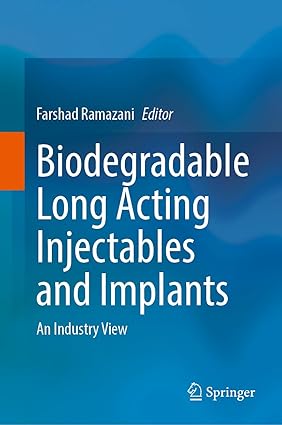
Biodegradable Long Acting Injectables and Implants: An Industry View 2025th Edition
Author(s): Farshad Ramazani (Editor)
- Publisher: Springer
- Publication Date: March 30, 2025
- Edition: 2025th
- Language: English
- Print length: 265 pages
- ISBN-10: 3031723015
- ISBN-13: 9783031723018
Book Description
Long acting injectables and implants (LAI) are known to improve patient adherence and treatment outcomes. They reduce costs for the healthcare system and ensure sustainable sales for pharmaceutical companies. LAI are usually administered intramuscularly (IM) or subcutaneously (SC). In this way, the drug is released from its depot in a controlled manner over a longer period of time (e.g., a few days to a year). There is a trend toward increasing interest in the development of long-acting drugs for local administration versus systemic administration of depot products (i.e., IM or SC injection). This is leading to finding new ways of administration of the depot formulation, intra-ocular, intra-articular, pri-tendon etc. Therefore, it is expected that more drugs based on LAI formulations will enter the clinical phase in the future. Due to many benefits in adherence, efficacy, and safety of the treatment up until now around 50 brand name medicines using different biodegradable long-acting technology have received FDA approval. Manufacturing of LAI involves many steps with their unique challenges, which is why pharmaceutical companies consider them to be complex formulations to develop. Most of the published papers and books in this field are written by scientists who never worked in industry and whose knowledge on the topic is limited to small scale formulation screening. Therefore, this book aims to address the challenges of the development of biodegradable LAI from an industrial perspective.
Editorial Reviews
Editorial Reviews
From the Back Cover
Long acting injectables and implants (LAI) are known to improve patient adherence and treatment outcomes. They reduce costs for the healthcare system and ensure sustainable sales for pharmaceutical companies. LAI are usually administered intramuscularly (IM) or subcutaneously (SC). In this way, the drug is released from its depot in a controlled manner over a longer period of time (e.g., a few days to a year). There is a trend toward increasing interest in the development of long-acting drugs for local administration versus systemic administration of depot products (i.e., IM or SC injection). This is leading to finding new ways of administration of the depot formulation, intra-ocular, intra-articular, pri-tendon etc. Therefore, it is expected that more drugs based on LAI formulations will enter the clinical phase in the future. Due to many benefits in adherence, efficacy, and safety of the treatment up until now around 50 brand name medicines using different biodegradable long-acting technology have received FDA approval. Manufacturing of LAI involves many steps with their unique challenges, which is why pharmaceutical companies consider them to be complex formulations to develop. Most of the published papers and books in this field are written by scientists who never worked in industry and whose knowledge on the topic is limited to small scale formulation screening. Therefore, this book aims to address the challenges of the development of biodegradable LAI from an industrial perspective.
About the Author
Dr. Farshad Ramazani is a Senior Expert Science and Technology at Novartis Pharma AG in Basel, Switzerland, specializing in parenteral drug development. He has been instrumental in developing several patient-centric long-acting injectable formulations, now in various clinical trial phases. Dr. Ramazani regularly publishes research and review articles in leading pharmaceutical journals and is a co-inventor on three patents on long acting injectables. He received the TRD Culture Award in 2021 and 2023, and the Innovation Award of the Year in 2016 at Novartis. In 2010, he was among the top four candidates nationally to receive a PhD scholarship from the Iranian Health Ministry. He completed his PhD in 2015 at Utrecht University in the Netherlands, focusing on polymeric micro and nanoparticles for local and targeted drug delivery.